Open day and night, all year Free entry, always Motomiya-sai · 19 to 20 Jul Founded 711 · Hata clan 233 m sacred mountain trail
Step off the train and the first great torii already stands across the road. Past the courtyards the path narrows into twin tunnels of close-set gates, and the daylight turns orange around you. Gravel crunches, cicadas ring in the cedars, and the pillars slide by inked with the names of givers. Stone foxes watch from every landing, a key or a jewel held in their teeth. This is not a shrine with a mountain behind it. The mountain itself is the shrine.
This is the head shrine, the sohonguu, of some 30,000 Inari shrines across Japan. Inari Okami, the kami of rice, harvests and the prosperity of every trade, has been worshipped on this mountain since 711.
About 10,000 vermilion torii stand along the mountain paths, each one donated by a family or a business because a wish went through, or in prayer that it will. The custom has run unbroken since the Edo period.
The whole of 233 metre Mount Inari is the sanctuary. The o-yama meguri circuit past its mossy otsuka altars takes two to three hours, and the shrine receives pilgrims day and night, every day of the year.
The mochi that became a white bird
The Yamashiro fudoki, one of Japan's oldest provincial records, tells how it began. Hata no Irogu, a lord of the immigrant Hata clan whose storehouses overflowed with rice, grew careless with his wealth and set up a round of mochi as an archery target. When his arrow struck, the rice cake turned into a white bird and flew away to the peak of the mountain, and where it alighted, rice sprouted from the ground. Awed, Irogu raised a shrine on that spot. The shrine's own telling traces the name Inari to that sign: ine nari, rice grew here.
Tradition holds that Inari Okami was first enshrined on the mountain on a day of the horse in the second month of Wado 4, the year 711, and the Hatsuuma festival still fills the shrine each February on that day. From this one hill the Inari faith spread along every road in Japan, to roughly 30,000 shrines, and all of them look back to Fushimi as their head shrine.
The buildings carry their own stories. The present main sanctuary was raised in 1499, five seats of the kami under one cypress-bark roof. In 1589 Toyotomi Hideyoshi, then the most powerful man in Japan, built the great two-storey gate below it; his written vow survives, promising 10,000 koku of rice if his ailing mother Omandokoro recovered. When the gate was dismantled for repair in 1973, carpenters found the year Tensho 17 brushed in ink on its timbers, and the old story proved true.
What you'll actually see
1
The Romon of Hideyoshi's vow
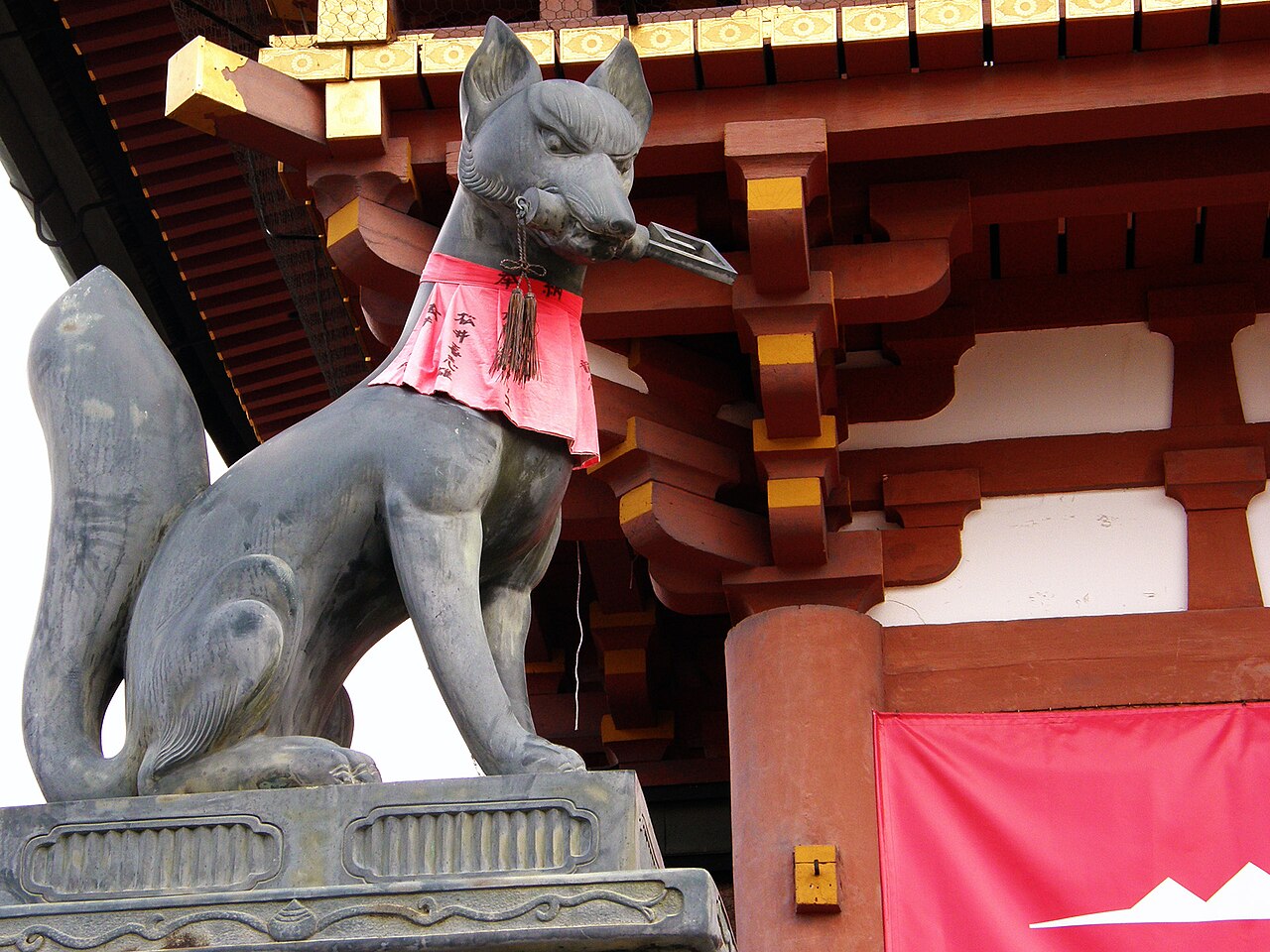
The vermilion two-storey gate of 1589, one of the largest shrine gates of its kind in Japan and an Important Cultural Property, its cypress-bark roof sweeping over white plaster and red lacquer. Two stone foxes in red bibs flank it in place of the usual guardian lions, one holding a key in its jaws.
2
The Senbon Torii
Behind the main sanctuary the path divides into two parallel corridors of gates set so close they become glowing tunnels. Every pillar carries the donor's name and date in black ink on vermilion. They end at the Okusha worship place, where the mountain's three peaks are venerated from below and fox-faced ema hang in their hundreds.
3
The foxes with the granary key
Everywhere on the mountain sit byakko-san, the white messenger foxes of Inari Okami, invisible beings honoured in stone. Many hold in their teeth the key to the rice granary, others a jewel or a sheaf of rice, and pilgrims tie red votive bibs at their necks and leave offerings of aburaage, the fried tofu the foxes are said to love.
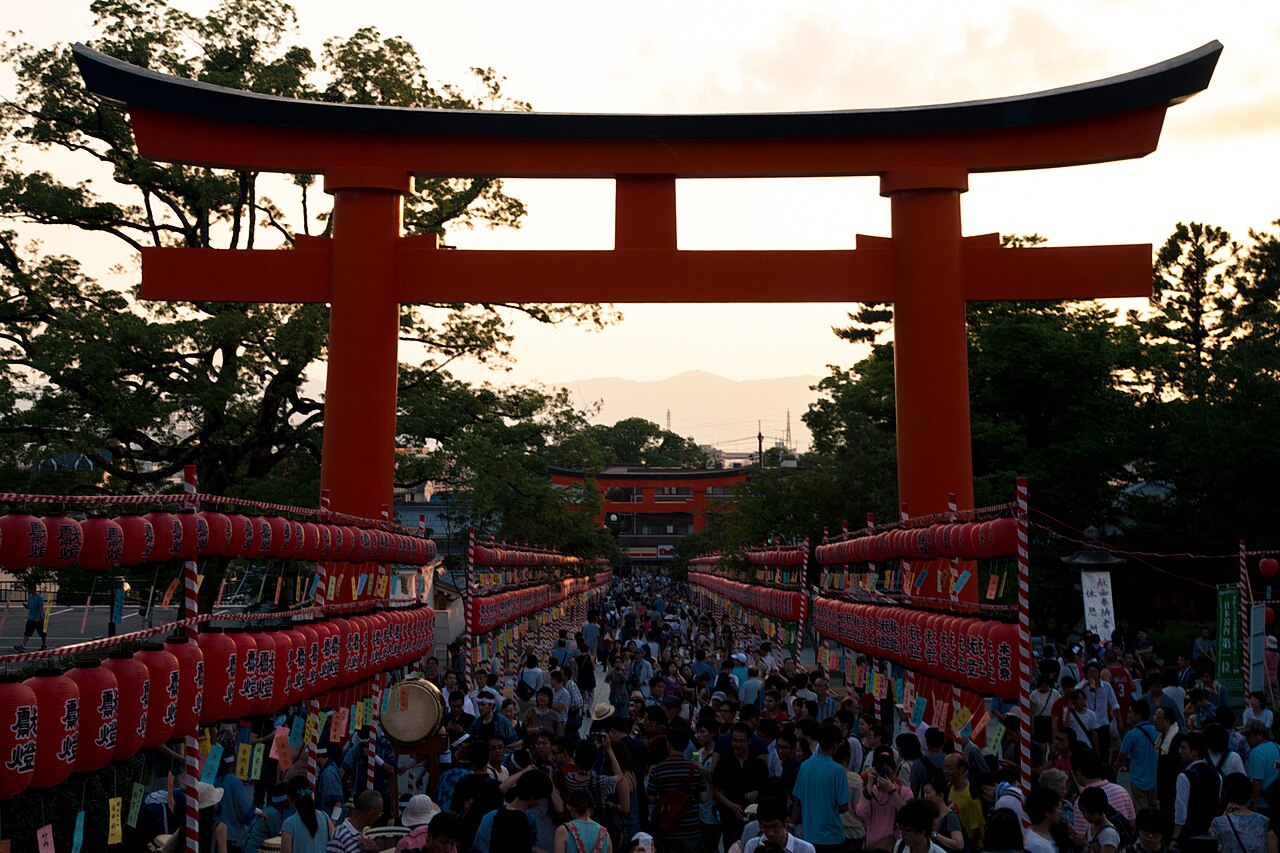
Stone fox messenger with a granary key in its teeth and a red votive bib, at the gate of Fushimi Inari TaishaCrowds and rows of red lanterns beneath the first torii at dusk during the Motomiya-sai festival
A byakko-san messenger with the granary key, and Motomiya-sai lanterns at dusk · photos CC BY-SA 3.0 Tomi Mäkitalo and CC BY 2.0 nobu3withfoxy, Wikimedia Commons
THE NIGHT THE MOUNTAIN LIGHTS UP
Motomiya-sai · 19 to 20 July 2026
Once a year the devotees of Inari shrines all over Japan come home to the head shrine to give thanks. On the evening of Sunday 19 July 2026, at the yoimiya rite from 6 pm, the mando shinji is performed: the stone lanterns and thousands of donated paper lanterns across the precincts and Mount Inari are all lit, and the vermilion gates glow red into the night. Around 400 painted lantern panels offered by artists hang at the outer worship hall through both evenings. The main Motomiya-sai rite follows on Monday 20 July at 9 am.
Come at dusk on the yoimiya evening for the lighting, and expect dense, festive crowds on the lower slopes both nights.
Plan your visit
By air
Kansai International and Osaka Itami airports connect by rail to Kyoto Station; from there the shrine is two stops on the JR Nara Line.
By rail
JR Nara Line to Inari Station, about 5 minutes from Kyoto Station; the first torii faces the station. Or Keihan Main Line to Fushimi-Inari Station, a 5 minute walk from the approach.
By bus or car
Minami 5 city bus to Inari Taisha-mae, then a 7 minute walk. Drivers allow about 20 minutes from the Kyoto Minami interchange, but parking is scarce and the shrine itself urges the train.
Timings
The grounds and the mountain never close. Prayer ceremonies at the main sanctuary are received 8:30 am to 4:30 pm, no booking needed.
The mountain
The o-yama meguri circuit above the Senbon Torii takes 2 to 3 hours round trip; the Yotsutsuji crossing, roughly halfway up, looks out over the whole city. Turn back whenever you wish.
Best time
First light, when the tunnels of gates stand empty and cool. The shrine receives pilgrims day and night, so late evening is the other quiet hour.
Entry
Free, at any hour. There is no gate fee and no ticket.
The name Inari is traced by the shrine itself to the old record's phrase ine nari, rice grew here, though other tellings exist.
Rinse hands and mouth at the temizu basin, then greet the kami the Shinto way: two deep bows, two claps, one final bow.
The foxes are not the kami. They are byakko-san, white messengers invisible to the eye; trailside shops serve kitsune udon and inari sushi in their honour, both topped with the fried tofu foxes are said to love.
Carry cash for ema, omikuji and the mountain teahouses, and wear proper shoes: the upper circuit is a real hillside climb with long flights of stone steps.
Questions pilgrims ask
Is Fushimi Inari a Temple?
No. It is a jinja, a Shinto shrine, and taisha marks its rank as a great head shrine. There is no Buddha image here; the mountain, its gates and its altars belong to Inari Okami, and pilgrims come to make omairi, the shrine visit, not to attend a Temple.
Are there really one thousand torii?
More. About 10,000 torii stand along the mountain's paths, donated for wishes that went through. The famous Senbon Torii, the thousand gates, names the twin close-set corridors just behind the main sanctuary, the most photographed stretch of the climb.
Do I have to climb the whole mountain?
Not at all. Most pilgrims walk the Senbon Torii to the Okusha worship place and turn back. The full circuit of the 233 metre summit takes 2 to 3 hours; the Yotsutsuji crossing, roughly halfway, gives the great view over Kyoto if you want a natural turning point.
Can I visit at night?
Yes. The grounds never close and entry is free at any hour; the shrine says worshippers come day and night. Ceremonies, amulets and the shrine office keep daytime hours, with prayers received 8:30 am to 4:30 pm.
Dharamshalas and guest houses near this Sthan, shared by devotees. Adisthan takes no bookings and no money; contact each stay directly.
No stays are listed here yet. Know one that serves pilgrims well?
Are you a priest or officer of Fushimi Inari Taisha or its shrine office? Claim this page to add true seasonal notices, rite schedules, and guidance for pilgrims coming from afar.