Gates open 5:00 am Free entry, always Kannamesai · 15 to 17 Oct Rebuilt whole every 20 years 125 shrines in one forest
Cross the Uji Bridge at dawn and the town falls away behind you. A hundred metres of bare wooden planks over the Isuzu River, a great hinoki torii at either end, then white gravel crunching underfoot through a forest of ancient cryptomeria. Pilgrims pause at the riverbank to rinse their hands in the Isuzu itself, the oldest temizu there is. At the stone steps of the main palace a white silk curtain lifts in the wind. This is as far as anyone goes. What dwells beyond is never seen, and never photographed.
This is the most venerable sanctuary of Shinto. The Naiku enshrines Amaterasu-Omikami, the Sun Goddess and ancestral kami of the imperial house, and holds the Yata-no-Kagami, the sacred mirror of the imperial regalia, which no visitor has ever been shown.
The Shikinen Sengu: for more than 1,300 years the entire sanctuary has been rebuilt from new hinoki timber every twenty years on the adjoining plot, and the kami transferred to the new palace. It has been done 62 times; the 63rd is underway for 2033.
Jingu is not one shrine but 125, scattered through the forests of Ise around the Naiku and the Geku, where Toyouke-Omikami has received food offerings every morning and every evening for some 1,500 years.
The kami who chose this river
In the oldest chronicles, Amaterasu-Omikami was worshipped within the imperial palace itself. Then, tradition holds, the princess Yamatohime-no-mikoto, daughter of Emperor Suinin, was charged with finding the kami a dwelling of her own. For years she wandered the provinces, carrying the sacred mirror, until she came to the upper reaches of the Isuzu River. There, the Nihon Shoki records, the great kami spoke: Ise, the land of the divine wind, a beautiful land where she wished to dwell. The shrine rose on this riverbank, by tradition some two thousand years ago.
About 1,500 years ago a second kami was called to Ise: Toyouke-Omikami, brought from the province of Tanba to prepare the sacred meals of Amaterasu-Omikami. Her sanctuary is the Geku, in the heart of the town, and morning and evening without a single day's break since, priests have kindled fire and offered rice, water and salt in her Mikeden. The rite is called the Higoto-Asayu-Omikesai, and it is the oldest unbroken daily liturgy in Japan.
In the seventh century Emperor Tenmu decreed that the whole sanctuary be rebuilt every twenty years, and the first Shikinen Sengu was carried out in 690 under Empress Jito. The shrine you see today is at once brand new and thirteen centuries old, an idea the priests call tokowaka, everlasting youth.
What you'll actually see
1
The Uji Bridge and its torii
The pilgrim's crossing into the Naiku: about 100 metres of unpainted wood over the clear Isuzu River, framed by a towering plain torii at each end. Like the palaces, the bridge itself is torn down and rebuilt every twenty years, so the planks under your feet are never old.
2
The riverbank purification
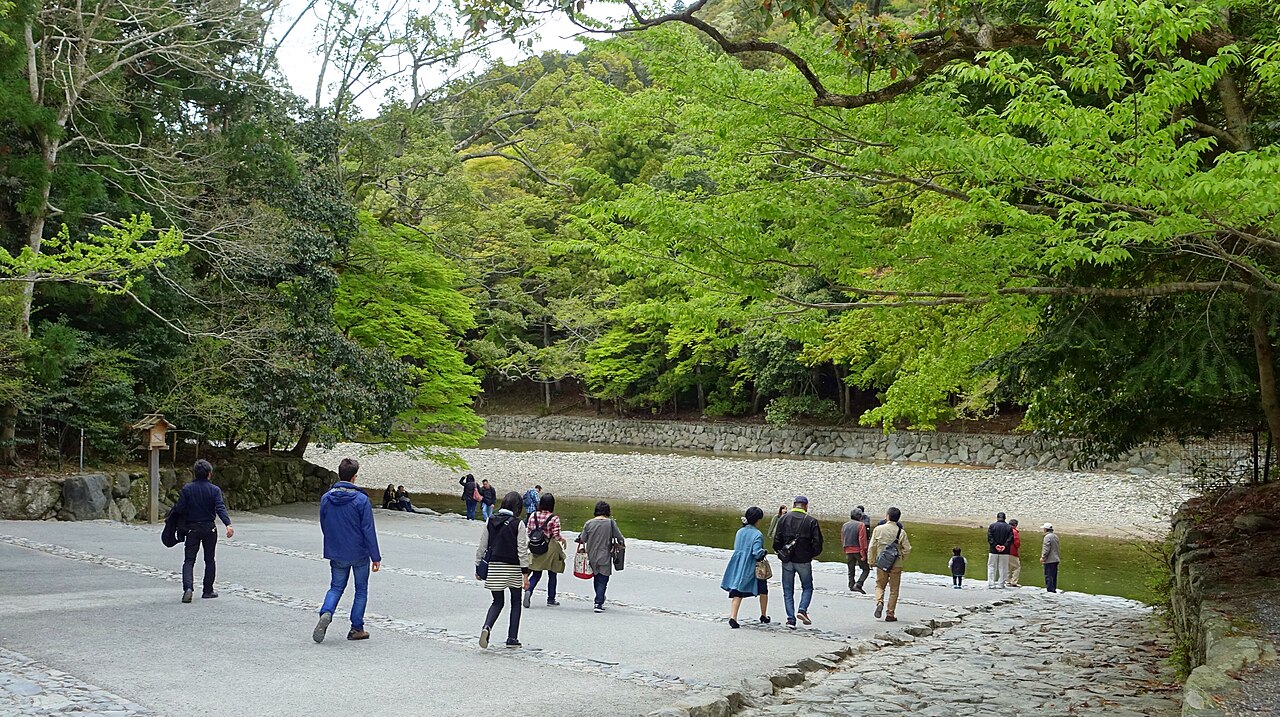
Past the bridge the path bends to the Isuzu itself, where stone paving runs down into the water. Pilgrims crouch here to rinse their hands in the living river before approaching the kami, the older form of the temizu basin. Koi drift in the shallows and the forest closes overhead.
3
The main palace behind its fences
At the top of worn stone steps stands the Shogu, screened by four concentric fences. You see unpainted hinoki pillars, a deep roof of miscanthus thatch, golden-tipped crossbeams against the sky, and a white curtain across the gate. Beside it lies a bare gravel plot exactly the same size: the site where the next shrine will rise.
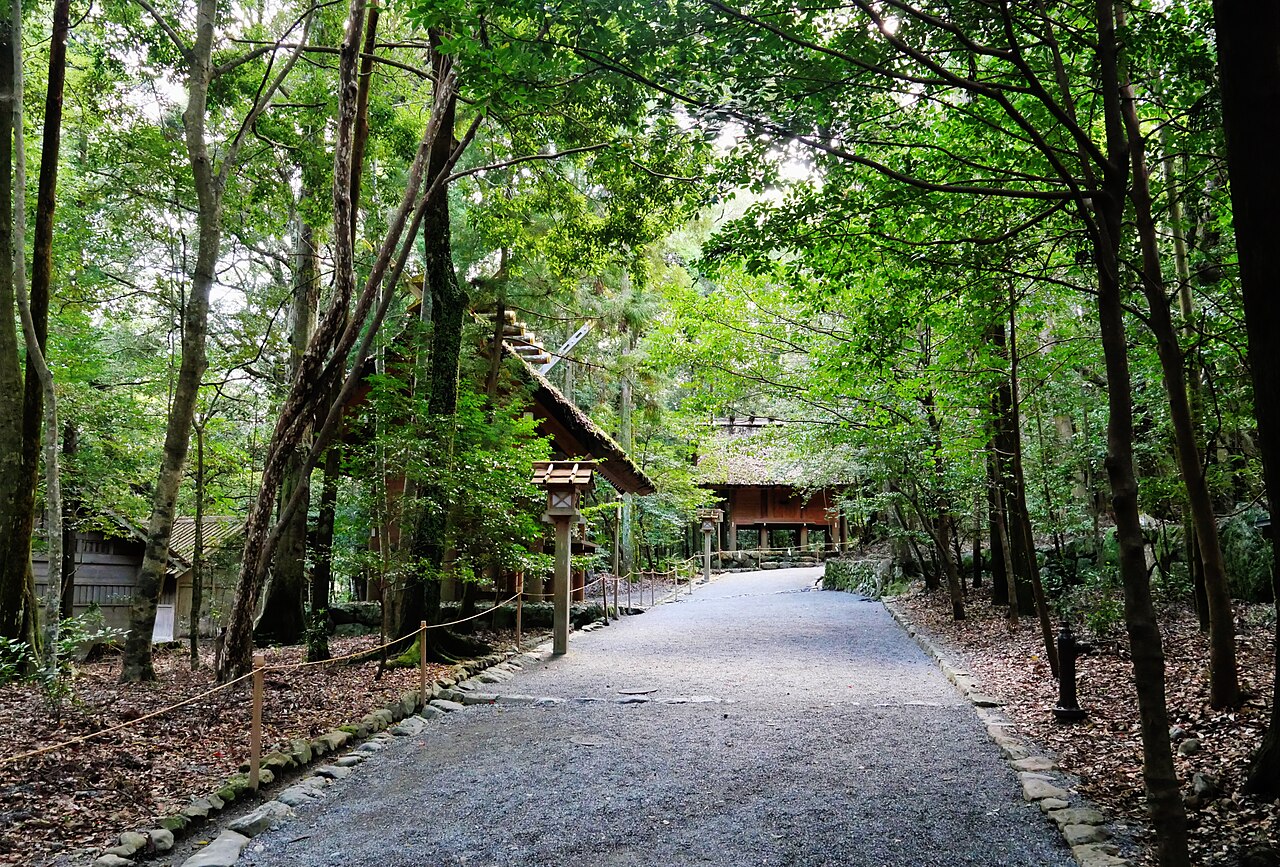
A gravel path through the shrine forest of Ise Jingu, lined with lanterns and thatched hallsPilgrims descending to the Isuzu River at the Naiku to purify their hands
The forest path and the Isuzu riverbank where pilgrims purify · photos CC BY 4.0 Zairon and CC0 Daderot, Wikimedia Commons
THE RENEWAL FOUND NOWHERE ELSE
Shikinen Sengu: the shrine reborn every twenty years
Every twenty years Jingu is built again from the ground up: new hinoki pillars, new thatch, new treasures and vestments, raised on the empty plot beside the standing shrine, after which the kami is transferred to the new palace in a night ceremony and the old buildings are taken down. The 62nd Sengu was completed in 2013; the 63rd will culminate in 2033, and its eight years of preparatory rites are already underway. The first rites were held in 2025, and in 2026 the Okihiki festivals bring the sacred logs to the shrines: floated up the Isuzu River for the Naiku from 9 May to 13 June, and hauled through the streets of Ise on great carts for the Geku from 25 July to 2 August, by thousands of townspeople in traditional dress.
The Okihiki log-hauling is public and joyful to watch, and both sanctuaries remain fully open throughout the years of rebuilding.
Plan your visit
By air
Fly to the Nagoya or Osaka area airports, then continue by rail; from Kintetsu Nagoya the limited express reaches Ise in about 90 minutes.
By rail
Ise-shi Station (JR and Kintetsu) is the stop for the Geku; Isuzugawa Station (Kintetsu) is nearest the Naiku. From Osaka allow about 2 hours by Kintetsu limited express.
Between the shrines
The Geku is a 5 minute walk from Ise-shi Station; buses on routes 51 and 55 link the Geku with the Naiku in roughly 25 minutes.
Timings
Gates open 5:00 am daily; closing is 6 pm January to April and September, 7 pm May to August, 5 pm October to December.
Order of visit
Old custom is Geku first, then Naiku, following the order of the shrine's own rites: Toyouke-Omikami, who serves the meals, is greeted before Amaterasu-Omikami.
Entry
Free. There is no ticket at either sanctuary.
Best time
Early morning is quietest: the gates open at 5:00 am while mist still hangs over the Isuzu River and the gravel paths are almost empty.
Photography is not permitted at the worship areas of the main palaces, and the inner sanctuaries can never be photographed at all; every honest picture of Ise shows the bridge, the torii, the forest and the outer halls.
Properly the shrine is called simply Jingu, "the Shrine", the only one in Japan needing no other name; people across the country speak of it warmly as O-Ise-san.
To pray in the Shinto way, purify hands and mouth at the temizusha (at the Naiku many pilgrims use the Isuzu riverbank itself), then bow twice, clap twice, and bow once more deeply.
Eating, drinking and smoking are not allowed within the precincts outside designated areas, and the gravel paths are long, so walk in comfortable shoes.
Questions pilgrims ask
Can I see the shrine buildings or the sacred mirror?
Not directly, and no one can. The Yata-no-Kagami is never displayed, and the main palaces stand behind four fences; pilgrims worship at a white curtain hung across the outermost gate, seeing only the thatched roofs and golden crossbeams above the fence line. The concealment is not a restriction on foreigners; it applies to everyone, and it is the point.
Why is the shrine rebuilt every twenty years?
The Shikinen Sengu keeps the sanctuary eternally new while passing the carpentry, thatching and treasure-making crafts intact from one generation of artisans to the next. Practised since 690, it expresses the idea of tokowaka, everlasting youth: the buildings are replaced so that the shrine itself never ages.
Should I visit the Geku or the Naiku first?
Custom says Geku first. The shrine's own ceremonies begin with Toyouke-Omikami, provider of sacred food, before Amaterasu-Omikami, and pilgrims have long followed the same order. The Geku sits in town near Ise-shi Station; the Naiku is a short bus ride away at the foot of the sacred hills.
Is Ise Jingu open to visitors of other faiths?
Yes. Anyone may walk the precincts and make omairi with respect; there is no fee and no registration. Quiet conduct matters more than creed: purify your hands, keep voices low, and do not photograph at the prayer areas.
What is happening with the rebuilding right now?
The 63rd Shikinen Sengu is in progress. Its opening rites were held in 2025, and in 2026 the Okihiki festivals carry the new hinoki logs to the shrines, on the Isuzu River for the Naiku from 9 May to 13 June and through the streets of Ise for the Geku from 25 July to 2 August. The transfer of the kami to the new palaces comes in 2033.
Dharamshalas and guest houses near this Sthan, shared by devotees. Adisthan takes no bookings and no money; contact each stay directly.
No stays are listed here yet. Know one that serves pilgrims well?
Are you an official of Jingu or its shrine office? Claim this page to add true seasonal notices, rites open to pilgrims, and guidance for those coming from afar.