Roughly 3,800 stone steps from the base First plateau · 2,370 ft above Junagadh Neminath Temple rebuilt 1129 CE Māru-Gurjara carving in dark granite Neminath Nirvana Kalyanak · 20 Jul 2026 Free · no fee to enter
The stairway leaves the plains at Bhavnath Taleti and climbs for hours through forest and bare granite, past pilgrims resting on numbered steps, until the trees fall away and a walled town of white spires appears on a ledge cut into the cliff. Bells and quiet chanting carry across the courtyard. Inside, the stone is not the pale marble of Rajasthan but dark granite, carved close and left almost bare of colour. This mountain does not hold a shrine built in memory of a liberation. It holds the ground where the liberation happened.
Girnar concentrates three of Bhagwan Neminath's five kalyanakas on one mountain: tradition holds that His diksha, renunciation, and kevalgyan, omniscience, took place at Sahasavan on Girnar's slope, and His moksha, final liberation, at the fifth peak above the Temples. Few tirthas anywhere carry three kalyanakas of one Tirthankara together.
Alongside Ashtapad, Shikharji, the Dilwara Temples of Mount Abu, and Shatrunjaya at Palitana, Girnar is counted among the Śvētāmbara Pañca Tirtha, the tradition's five foremost pilgrimage shrines.
The mountain is held sacred beyond the Jain world alone. Above these sixteen Śvētāmbara shrines the same ridge carries Hindu Temples to Amba Mata, Gorakhnath and Guru Dattatreya, each reached by its own stretch of the numbered stone steps.
The wedding that turned into a renunciation
The legend says Bhagwan Neminath, the twenty-second Tirthankara, rode toward His own wedding at the head of a great procession when He heard the cries of animals penned to be slaughtered for the marriage feast. He asked why they were bound, and on learning the answer, turned the procession around before it reached the bride's house. He gave away His ornaments, renounced the world, and climbed Mount Girnar to take diksha. His betrothed, Rajulmati, renounced in turn and followed Him to the mountain as a nun. Tradition holds that Neminath attained kevalgyan, omniscience, at Sahasavan on Girnar's slope, and moksha at the mountain's fifth peak, the highest point above the Temples.
The Temples that gather below that peak carry their own long history of devotion. The Neminath Temple at the heart of the complex was entirely rebuilt in 1129 CE by Sajjana, governor of Saurashtra under the Solaṅkī king Jayasimha Siddharaja, and was later gilded with gold plates in 1364 CE by Mandalika I of the Chudasama dynasty. In 1232 CE, the ministers Vastupala and Tejpala, brothers who a few years earlier had raised the Luna Vasahi at Dilwara in memory of their late brother, completed a triple shrine of their own on Girnar, the Vastupala-vihara, dedicated in part to Mallinatha.
Later centuries added further shrines and repairs rather than a single new wave of building: the Melak Vasahi and Kumarapala's Temple both rose in the 1430s, the Ambika Temple was restored under a colophon dated 1468 CE, and in the Mughal era the Bikaner minister Karmachandra Bachchhavat funded repairs at Girnar during Akbar's reign. That same unbroken thread of patronage continues today under Sheth Anandji Kalyanji Pedhi, the Ahmedabad-based trust that maintains the tirth.
What you'll actually see
1
The Neminath Temple's granite court
A quadrangular court, ringed by sixty-seven shrine cells each holding a marble image, surrounds the black-grey granite mulaprasada at the centre. Inside, a large black image of Neminath sits within a circumambulatory passage; the hall in front is raised on twenty-two square granite columns beneath a carved stone ceiling some fifteen feet across, the floor laid in tessellated marble. A second hall, added in the seventeenth century, holds paired stone padukas representing the feet of the 420 Ganadharas, the first disciples of the Tirthankaras.
2
The Vastupala-Tejpal triple shrine
Completed in 1232 CE by the same ministers who built Dilwara's Luna Vasahi, the Vastupala-vihara carries two domes over a central shrine flanked by twin halls. Each hall once held a samovasarana, a tiered tower symbolising the cosmic hall where a Tirthankara first preaches, rising through four narrowing storeys almost to the roof.
3
The colossal Adabadji and the older Ambika Temple
Near the Neminath Temple's north porch stands the Adabadji shrine, its colossal standing image of Adinatha held in kayotsarga, the upright meditation posture, echoing the still larger figure at Palitana. A short walk beyond, the Ambika Temple, dated before 784 CE and repeatedly restored across the centuries, honours the Goddess Ambika, the yakshini long associated with Neminath's worship on this hill.
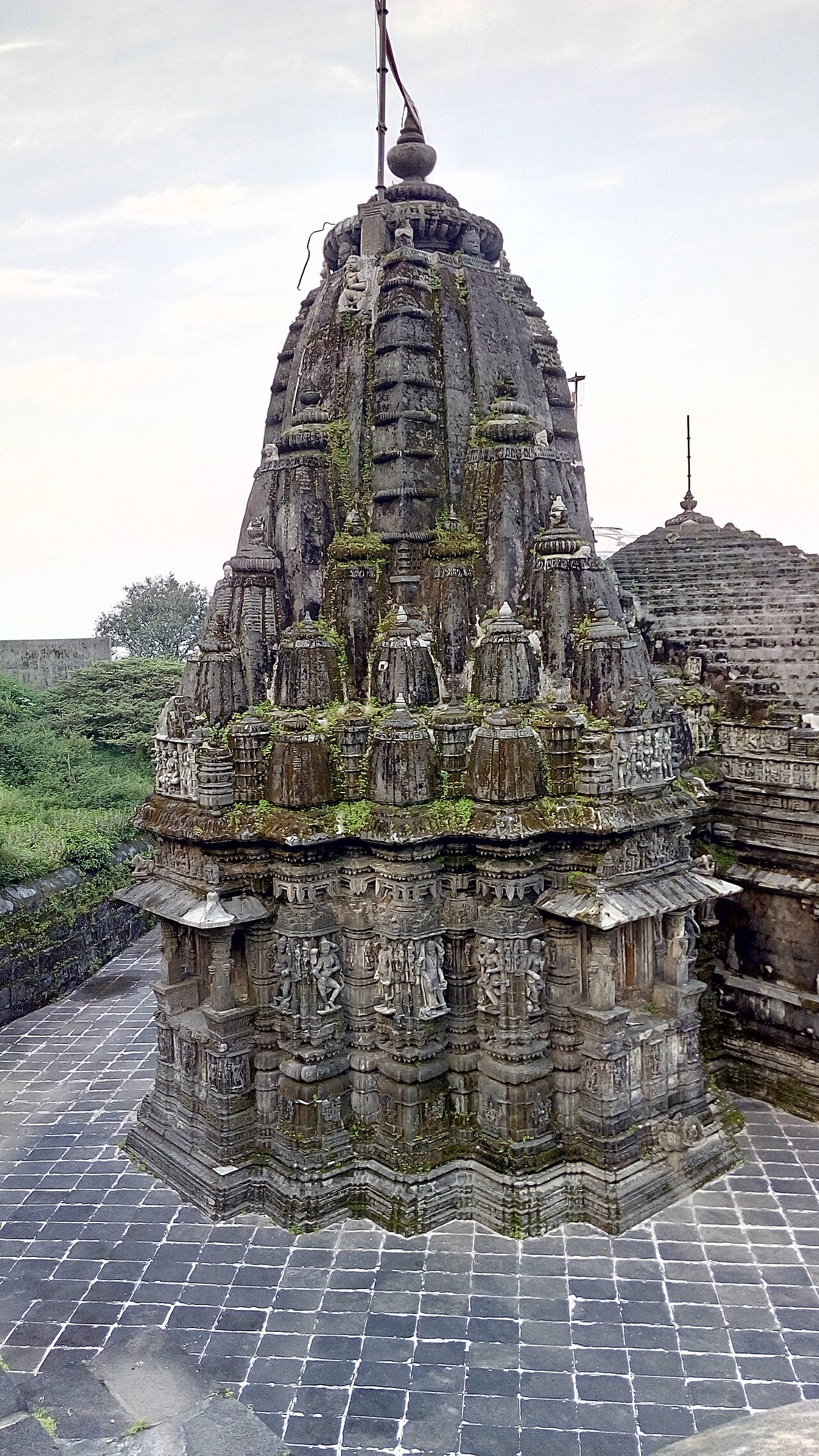
Close view of a carved dark granite shikhara at the Girnar Jain Temples, its tiers layered with small figures and mossA Girnar Jain shrine with a pale carved spire and dome set against the mountain's rocky peaks at dusk
Carved granite shikhara photographed by Murtazasmyths, and the Dharamchand Hemchand shrine against Girnar's peaks by Jayjadz18, both CC BY-SA 4.0 · Wikimedia Commons
THE KALYANAK KEPT ON THE FIFTH PEAK
Neminath Nirvana Kalyanak · 20 July 2026
On Ashadha Shukla Saptami, Jain pilgrims converge on Girnar to mark the day Bhagwan Neminath is held to have shed the last of His karma at the mountain's fifth peak. In 2026 the observance falls on 20 July, and community groups from across India organise a shared ascent for the occasion. Girnar keeps this kalyanak with an intensity found at few other tirthas, because it is remembered here as the actual ground of the liberation, not a Temple built afterward in its memory.
The climb to the fifth peak continues well beyond the Jain Temple plateau; start before sunrise and confirm the day's arrangements with a local Jain sangh, since the tithi shifts against the Gregorian calendar each year.
Plan your visit
By rail
Junagadh railway station, about 8 km from Girnar, sits on the Western Railway network with regular trains from Ahmedabad and Rajkot.
By air
Keshod Airport is closest, about 80 km away with limited flights; Rajkot Airport, around 150 km, has fuller connections to Delhi, Mumbai and Hyderabad.
By road
Bhavnath Taleti, the base of the climb, is a short taxi or auto-rickshaw ride from Junagadh city and the railway station.
The climb
Roughly 3,800 stone steps rise from Bhavnath Taleti to the Jain Temple plateau, a climb most pilgrims complete in 2 to 3 hours; the stairway continues further to the Hindu shrines and the fifth peak.
The ropeway
The Girnar ropeway, opened in 2020, runs only from Bhavnath Taleti to the Hindu Amba Mata Temple higher up the ridge. It does not stop at the Jain Temples, which still require climbing several thousand steps, whether directly from the base or down from the ropeway's upper station.
Best time
Begin before dawn, ideally between October and March when the hill climate is coolest and the climb is easier on the body.
Dress
Modest clothing is expected inside the shrines, in keeping with Jain Temple custom.
Hours & entry
Free for all visitors, open roughly 6 am to 6 pm; several smaller shrines close between 11 am and 3 pm, though the main Neminath Temple stays open through the day.
Girnar was known in antiquity as Raivata or Ujjayanta, and was already a place of Jain pilgrimage before 250 BCE.
Most of the roughly sixteen enclosed shrines on the ledge follow Śvētāmbara worship, with only one or two held by the Digambara tradition; both communities honour the hill equally as Neminath's tirtha.
Above the Jain Temples the same mountain rises to Hindu shrines at Amba Mata, Gorakhnath and Guru Dattatreya's peak, a reminder that Girnar has drawn more than one tradition's devotion for centuries.
Dolis, chair-palanquins carried by bearers, can be hired at Bhavnath Taleti for pilgrims unable to climb; agree the fare before setting out.
Questions pilgrims ask
Does the Girnar ropeway take me to the Jain Temples?
No. The ropeway, opened in 2020, carries pilgrims only to the Hindu Amba Mata Temple higher on the ridge. Reaching the Jain Temples still means climbing roughly 3,800 stone steps from the base, or descending on foot from the ropeway's upper station.
Whose liberation does Girnar mark?
Bhagwan Neminath, the twenty-second Tirthankara. Tradition holds that His renunciation and omniscience took place at Sahasavan on Girnar's slope, and His final liberation, moksha, at the mountain's fifth peak.
Can visitors who are not Jain climb to the Temples?
Yes. Respectful visitors of any tradition are welcome during daylight hours, though the customary modesty in dress and quiet inside the shrines is expected of everyone.
Are these Śvētāmbara or Digambara Temples?
Mostly Śvētāmbara. Of the roughly sixteen enclosed shrines on the ledge, only one or two follow Digambara worship, though both traditions honour the hill equally as Neminath's tirtha.
How long does the climb take?
Most pilgrims take 2 to 3 hours to reach the Jain Temple plateau from Bhavnath Taleti, climbing before the day's heat sets in. Dolis can be hired at the base for those unable to walk.
Dharamshalas and guest houses near this Sthan, shared by devotees. Adisthan takes no bookings and no money; contact each stay directly.
No stays are listed here yet. Know one that serves pilgrims well?
Are you a trustee or representative of Sheth Anandji Kalyanji Pedhi's Girnar tirth office? Claim this page to confirm current darshan timings, kalyanak-day arrangements, and a way for pilgrims to reach the tirth directly.