The Great Church of 537 · Grand Mosque of Istanbul
Hagia Sophia Grand Mosque · Ayasofya
Sultanahmet · Istanbul
Under one dome, fifteen centuries of prayer: the Holy Wisdom praised in Greek, and answered now by the call of the adhan.
Be the first to check in
Coming up: Ramadan at Ayasofya · 8 FebEntry tended 25 May 2026
Sultanahmet · tram T1 Prayer hall free for worshippers Upper gallery visit €25 Dome of 537 · 55.6 m above the floor Ramadan · from about 8 Feb 2027 Mosque again since 24 July 2020
You cross the wide square at Sultanahmet, past fountains and plane trees, and the building rises like a hillside of rose-coloured stone: half-domes climbing toward one vast crown, four minarets holding the corners of the sky. Inside, beneath calligraphy roundels the size of houses, the dome does what it was built to do: it floats, a ring of windows dissolving its rim into light. Listen. The adhan sounds where Greek liturgies once rose. No other building on earth has been the greatest church of one faith and then a great mosque of another.
The largest cathedral in the world for nearly a thousand years. Raised in five years, 532 to 537, by the geometers Anthemius of Tralles and Isidore of Miletus for the emperor Justinian, its dome spans about 31 metres and hangs 55.6 metres above the floor, carried on pendentives that taught the world how to set a circle upon a square.
The great mosque of the conquest. Sultan Mehmed II entered on 29 May 1453, endowed the church as a mosque, and attended the first Friday prayer here on 1 June 1453. For nearly five centuries it was the sultans' own mosque, the model the imperial architect Mimar Sinan and his successors answered across Istanbul.
A building that holds two traditions at once. Cathedral from 537 to 1453, mosque from 1453 to 1934, museum from 1935 to 2020, and a working mosque again since 24 July 2020: the Byzantine mosaics still look down from the galleries while the prayer hall below fills for the five daily prayers.
The Great Church, four times given
Three churches have carried the name Holy Wisdom on this hill. The first, raised under Constantius II in 360, burned; so did its successor in the Nika riots of 532. Justinian answered with a church unlike any before it, built in five years by the geometers Anthemius of Tralles and Isidore of Miletus and dedicated on 27 December 537; a mediaeval legend has the emperor cry, Solomon, I have surpassed you. When earthquakes brought the first dome down, Isidore the Younger raised it back higher, and that is the dome that stands. For nearly a thousand years this was the largest cathedral in the world and the seat of the Ecumenical Patriarch; on its altar in 1054 a papal bull opened the schism of East and West, and from 1204 to 1261 crusaders held it as a Latin cathedral.
On 29 May 1453 Constantinople fell to Sultan Mehmed II. He converted the church into a mosque, endowed it with a great waqf, and attended the first Friday prayer beneath the dome on 1 June 1453. Minarets rose at its corners, the two identical western towers built by Mimar Sinan in the reigns of Selim II and Murad III, and Sinan braced the ancient walls with the buttresses that helped them outlast the earthquakes.
In 1934 the cabinet of the young Turkish republic decreed it a museum; from 1935 mosaic and calligraphy were shown side by side, and UNESCO inscribed it within the Historic Areas of Istanbul in 1985. On 10 July 2020 Turkey's Council of State annulled the 1934 decree, care of the building passed to the Presidency of Religious Affairs, and on 24 July 2020 Friday prayers returned. Today it is a working mosque whose galleries stay open to every visitor.
What you'll actually see
1
The dome that floats on light
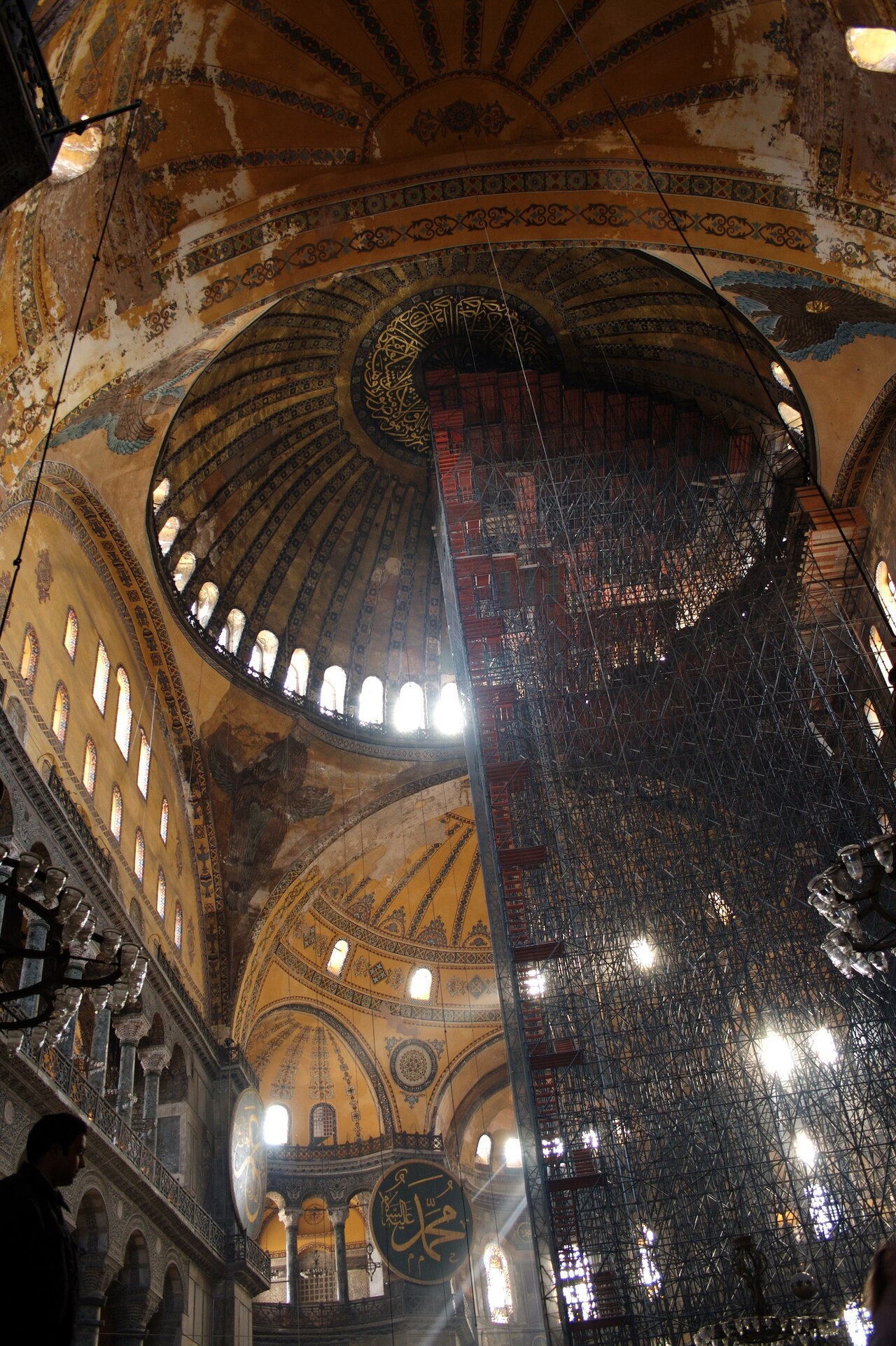
From the gallery balustrade the whole conception opens at once: four great pendentives gathering the square of the nave into a circle, and above them the dome, about 31 metres across and 55.6 metres above the marble floor, its rim pierced by a ring of windows so the crown seems to hover free of the walls. Around the nave hang eight vast roundels of Arabic calligraphy bearing the names of Allah, the Prophet Muhammad, peace be upon him, and the first caliphs.
2
The Deesis mosaic in the south gallery
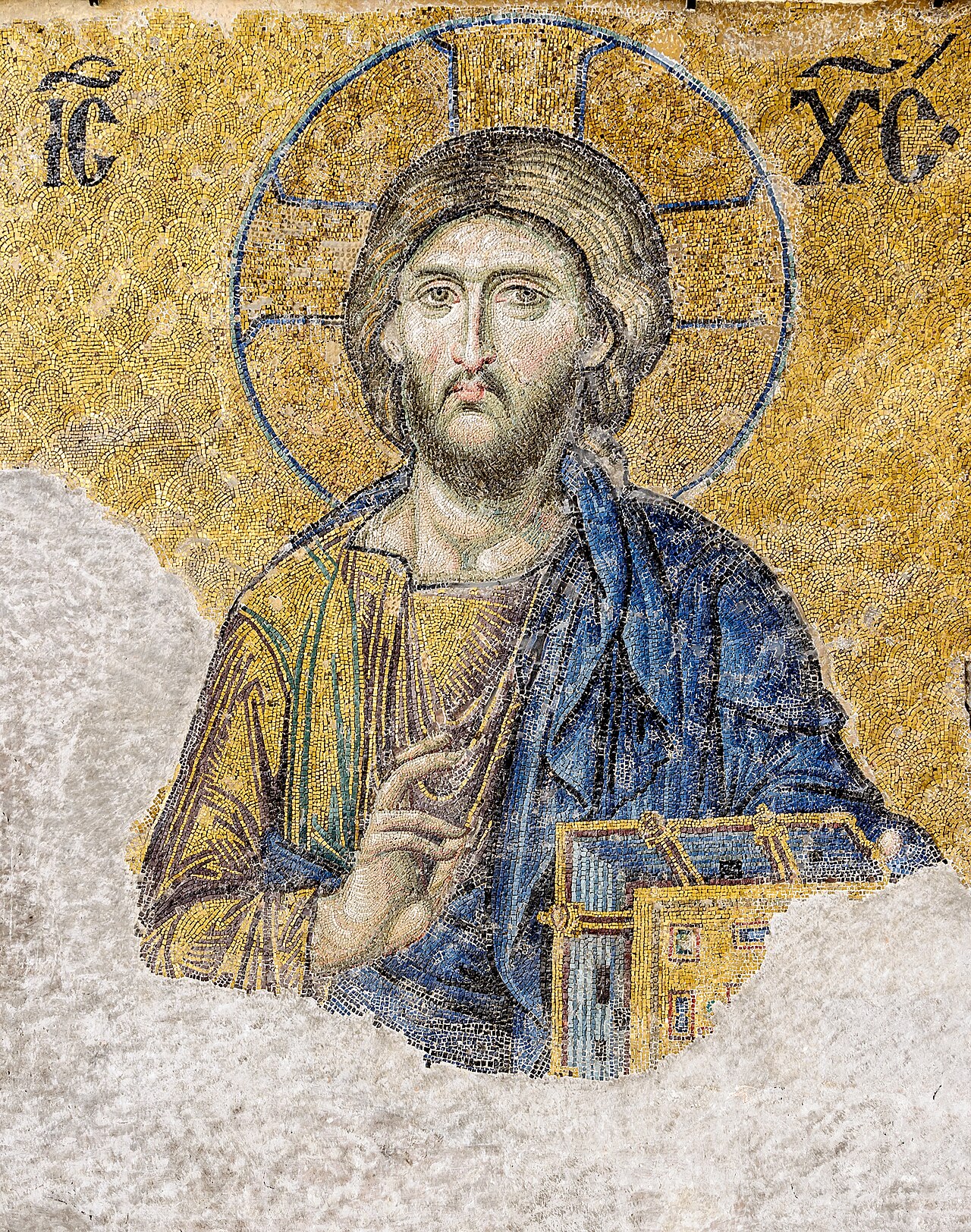
The paid visiting route climbs a stone ramp to the upper gallery, where the finest of the Byzantine mosaics survive in open view. Greatest of them is the Deesis, set up after the Byzantine recovery of the city in 1261: Christ Pantocrator between the Virgin Mary and John the Baptist, their faces worked in tesserae so fine the mosaic reads like painting. Nearby are the imperial panels of the empress Zoe and of John II Komnenos, and the route passes the carved Marble Door.
3
The prayer hall and the floor of emperors
Below, the nave is now a carpeted prayer hall, free and open to worshippers. The mihrab stands in the old apse, angled toward Makkah, with the minbar beside it; during prayer times the figural mosaics of the hall are veiled by curtains and unveiled again after. In the pavement near the southeast bay lies the Omphalion, the wheel of coloured marble discs where Byzantine emperors were crowned, still set in the floor the centuries have polished.
The dome of Hagia Sophia from below, its ring of windows and calligraphy roundels catching the lightChrist Pantocrator from the thirteenth-century Deesis mosaic in the south gallery of Hagia Sophia
The dome and the Deesis mosaic · photos CC BY-SA 3.0 (Matthew Badger) and public domain photograph (Myrabella), Wikimedia Commons
THE MONTH THE DOME FILLS AGAIN
Ramadan at Ayasofya · expected from about 8 February 2027
Since Friday prayers returned in July 2020, the mosque lives Ramadan with the whole of the old city around it: the fast breaks across Sultanahmet square at maghrib, and worshippers fill the carpeted nave for the night prayers beneath Justinian's dome. Laylat al-Qadr is sought in the last ten nights of the month, and the Eid al-Fitr prayer gathers the largest congregations of the year. Ramadan 1448 is expected to begin around 8 February 2027, with Eid al-Fitr expected around 9 March 2027, both subject to the sighting of the moon.
The tourist visiting area closes on Fridays from 12:30 to 14:30 for jumu'ah, and prayer times take precedence throughout Ramadan, so plan visits between prayers.
Plan your visit
By air
Istanbul Airport (IST) is about 49 km away on the European side; Sabiha Gökçen serves the Asian side. Metro and Marmaray connections or a taxi bring you to Sultanahmet.
By rail and tram
Tram T1 stops at Sultanahmet, a few minutes' walk across the square. The Marmaray rail line stops at Sirkeci, about 10 to 15 minutes on foot.
Getting in
Worshippers enter the ground-floor prayer hall free of charge. Visitors enter by a separate entrance and take a ramp to the upper gallery visiting route.
Timings
The mosque lives around the five daily prayers, with jumu'ah on Friday. The visiting area opens daily from 9:00 to 19:30 and closes on Fridays from 12:30 to 14:30 for the Friday prayer. Check locally, as arrangements shift with prayer times and season.
Entry fee
Worship is free. The upper gallery visiting route costs €25 for foreign visitors; children under 8 enter free with an adult, and museum passes are not accepted.
Dress
Modest dress for all: shoulders and knees covered, and women cover the hair. Head coverings are available at the entrance, and shoes come off before the prayer carpet.
Best time
The first hour after opening is quietest on the visiting route. Worshippers find the nave stillest at fajr, before the city wakes.
Hagia Sophia means Holy Wisdom: the church was dedicated to Christ as the Wisdom of God, not to a saint named Sophia. In Turkish it is Ayasofya, and its full official name today is Ayasofya-i Kebir Cami-i Şerifi, the Hagia Sophia Grand Mosque.
The figural mosaics of the prayer hall, including the Virgin and Child of the apse, are veiled by curtains during prayer times and uncovered between them; the mosaics of the upper gallery, including the Deesis, remain on open view throughout visiting hours.
A major restoration is under way to strengthen the building against earthquakes: scaffolding wraps parts of the facades and one minaret, and the dome's lead sheathing is being renewed, but the mosque remains open for both worship and visiting throughout the works.
The building holds two living memories at once: for Eastern Orthodox Christians it remains the mother church of their tradition, and for Muslims it is a working congregational mosque. This page presents each in its own voice and takes no side.
Questions pilgrims ask
Is Hagia Sophia a church, a mosque, or a museum?
It has been all three, and today it is a mosque. It served as the cathedral of Constantinople from 537 to 1453, as a mosque of the Ottoman Empire and early republic from 1453 to 1934, as a museum from 1935 to 2020, and since 24 July 2020 it has been a working mosque again, administered by Turkey's Presidency of Religious Affairs. The upper gallery operates as a ticketed visiting and museum route.
Can non-Muslims visit?
Yes. Visitors of every faith are welcome on the upper gallery route, which costs €25 for foreign visitors and stays open daily from 9:00 to 19:30, closing Fridays from 12:30 to 14:30 for jumu'ah. The ground-floor prayer hall is reserved for worshippers. Modest dress is required, and women cover the hair.
Can I still see the Byzantine mosaics?
The finest surviving mosaics are in the upper gallery, on the visiting route, and are not covered: the thirteenth-century Deesis, the empress Zoe panel, and the John II Komnenos panel among them. The figural mosaics down in the prayer hall, including the Virgin and Child in the apse, are veiled by curtains during prayer times and revealed between prayers.
Why was it turned back into a mosque in 2020?
On 10 July 2020 Turkey's Council of State, the country's highest administrative court, annulled the 1934 cabinet decree that had made the building a museum, ruling on the status of Mehmed II's original endowment. A presidential decree then transferred the building to the Presidency of Religious Affairs, and the first Friday prayers were held on 24 July 2020. This page states the sequence as it happened and takes no position in the debate around it.
Is it open during the restoration?
Yes. The earthquake-strengthening restoration, which includes renewing the dome's lead covering and repairing the minarets, is being carried out in stages so that the mosque stays open for prayer and the gallery for visiting, though scaffolding covers parts of the building inside and out.
Dharamshalas and guest houses near this Sthan, shared by devotees. Adisthan takes no bookings and no money; contact each stay directly.
No stays are listed here yet. Know one that serves pilgrims well?
Do you serve with the Hagia Sophia Grand Mosque administration or the Presidency of Religious Affairs? Claim this page to keep its guidance exact for every worshipper and visitor who comes to the Holy Wisdom.