He asked the sea to keep him; the sea has kept him ever since.
Be the first to check in
Entry tended 10 Jul 2026
Open 5:30 am to 10 pm 700 yard causeway over the sea Chadar and flowers at the mazar Urs · around 27 Sep 2026 Free entry · all welcome 85 foot minaret · Indo-Islamic
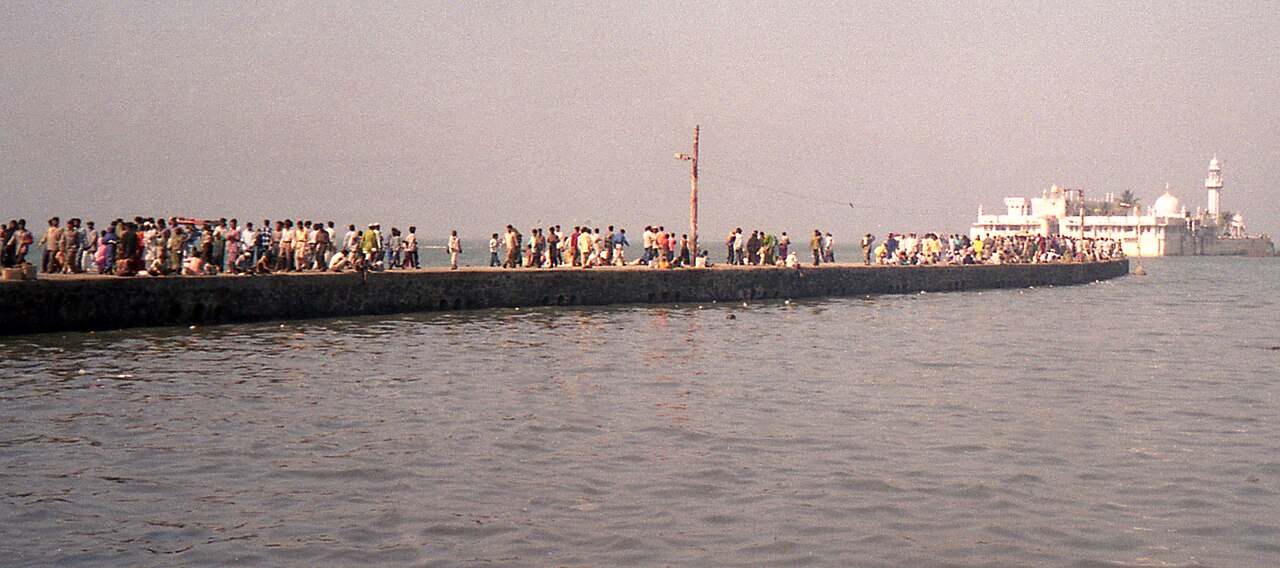
The city falls away behind you. On either side there is only the Arabian Sea, slapping at the rubble stones of a narrow path that runs seven hundred yards out into the water. Gulls wheel overhead, fakirs hold out their bowls along the right edge, and ahead the white dome and minaret ride the horizon like an anchored ship. At the end of this walk lies a saint who asked the sea to be his grave. The sea agreed, and has held him for nearly six hundred years.
The dargah stands on a rocky islet about 500 metres off the Worli shore, on the very rocks where, tradition holds, the saint's shroud came to rest in the sea. It is reached only on foot, over a causeway that the tides still command.
This is the mazar of Pir Haji Ali Shah Bukhari, a wealthy merchant of Bukhara who renounced all he owned before setting out for the pilgrimage to Mecca. The shrine raised in his memory is dated by tradition to 1431.
Its doors are open to every religion and nationality. Ten to fifteen thousand people cross the sea path on an ordinary day, and on Thursdays, Fridays and Sundays the number rises to twenty or thirty thousand.
The merchant who gave himself to the sea
The Trust that keeps his shrine tells it this way. Haji Ali was a rich merchant who left Bukhara, in the old Persian lands of Central Asia, and gave up the world for the way of Allah. One day he came upon a poor woman weeping on the road over her spilled oil. He took her vessel, pressed the earth with his thumb, and oil sprang up like a fountain. The woman went home rejoicing, but the saint was shaken: he had wounded the earth. Remorse ate at his health, and with his mother's permission he sailed for India with his brother, until they reached the shore near Worli. The brother went home. Haji Ali stayed, teaching, until his last day.
Before he passed, he told his followers not to bury him in any graveyard. Cast my kafan, my shroud, into the ocean, he said, and bury me wherever it comes to rest. His wish was obeyed. The shroud settled on a small mound of rocks rising above the sea, and there, on those same rocks, the dargah was raised, in 1431 by the tradition the shrine keeps.
Devotion has been building on that rock ever since. The complex took its present form in the early nineteenth century, and the Haji Ali Dargah Trust was constituted in 1916. In 1944 the Trust laid the stone causeway that pilgrims still walk, and since 2008 the shrine has been slowly rebuilt in white marble from Makrana in Rajasthan, the same quarries that gave the Taj Mahal its stone.
What you'll actually see
1
The walk over the sea
The causeway runs seven hundred yards from Lala Lajpat Rai Marg to the main gate, rubble stone masonry laid in 1944 and raised higher in the 1980s. It has no railing: sea on both sides, sky above, and along the right edge the needy and the fakirs with their bowls. At the highest tides, and for hours at a time in the monsoon, the sea closes over it and the gates shut until the waves subside.
2
The marble courts and mirror halls
Three open halls, the sehan, wrap the main hall on the west, south and east. You enter through an arched doorway of pure white marble with a delicately carved crown above the arch. Look up: the south hall ceiling carries the ninety nine names of the Prophet Muhammad, peace be upon him, worked in pieces of mirror, and the main hall's ceiling and upper walls carry the ninety nine names of Allah in the same glittering glass mosaic.
3
The mazar beneath the dome
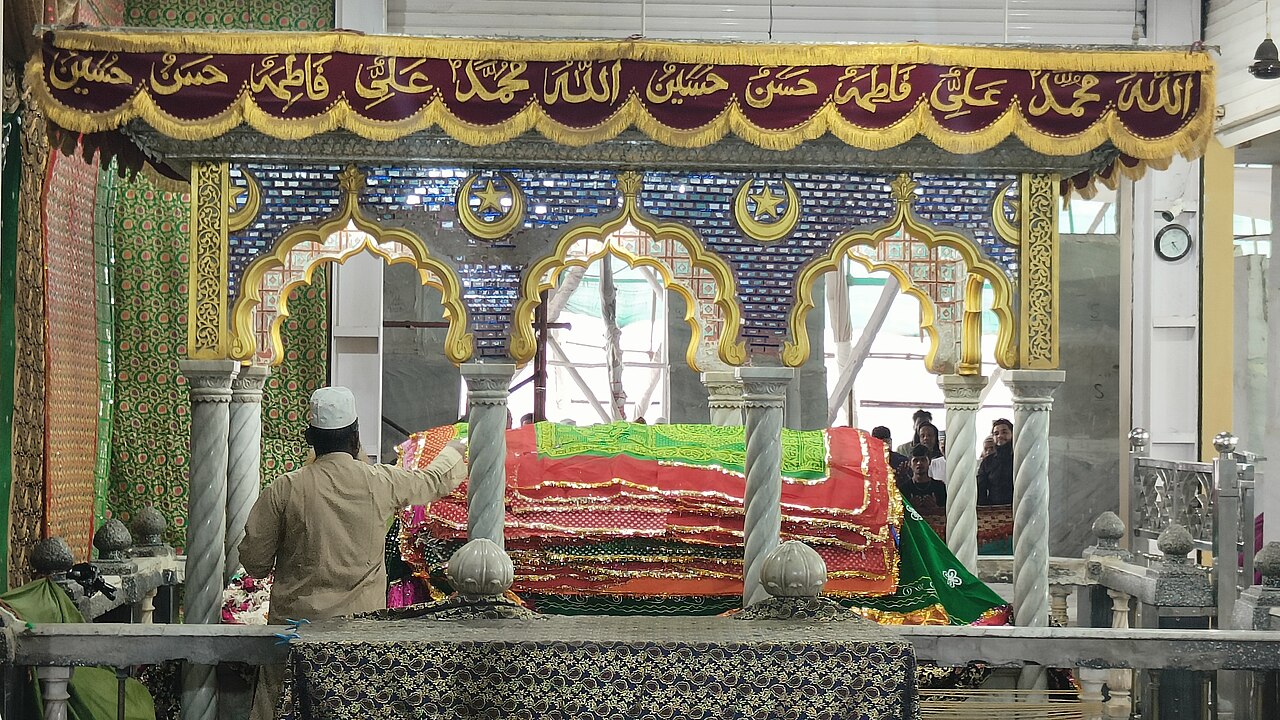
At the centre stands the tomb in a pure white marble enclosure, an arched marble frame set with mirror work on eight marble pillars. The grave is layered in red and green brocade and zari cloth worked with verses of the Quran Sharief. Pilgrims bow their heads, kiss the cloth, and lay flowers and chadars; the hall on the west is reserved for women to offer their prayers.
Pilgrims streaming both ways along the causeway to Haji Ali Dargah, the white shrine and minaret rising from the sea beyondThe mazar of Pir Haji Ali Shah Bukhari layered with red and green chadars beneath its canopied marble enclosure
The sea path and the mazar · photos CC BY 2.0 and CC BY-SA 4.0, Wikimedia Commons
The days the dargah keeps
Urs, Milad, and the sixteenth of every month
The Urs of Pir Haji Ali Shah Bukhari, the anniversary of his passing, is observed on the sixteenth of Rabi ul Aakhir with rituals at the mazar and the distribution of niyaz, blessed food. In 2026 it is expected around 27 September, with the exact day following the sighting of the moon. The shrine also holds a Milad program on the sixteenth of every Islamic month after the Isha prayers, and on Eid e Milad un Nabi, the twelfth of Rabi al Awwal, expected on 26 August 2026 in India, the birth of the Prophet Muhammad, peace be upon him, is celebrated with prayers and the viewing of the holy relic.
Thursdays and Fridays already double the crowds; on festival days come early in the morning and check the tide before you set out.
Plan your visit
By rail
Mahalaxmi or Mumbai Central on the Western line, Byculla on the Central line; taxis and BEST buses run along Lala Lajpat Rai Marg to the shore gate.
By air
From Mumbai's Chhatrapati Shivaji Maharaj International Airport, taxis reach the causeway gate via the Sea Link and Worli.
On foot
The last stretch is always walked: seven hundred yards over the open sea from Lala Lajpat Rai Marg. No vehicle goes beyond the shore.
Timings
5:30 am to 10 pm daily. The Trust office keeps Monday to Saturday, 9:30 am to 5:30 pm.
Best time
Weekday mornings are gentlest. Thursdays, Fridays and Sundays draw 20,000 to 30,000 pilgrims; check tide timings before setting out.
Dress
Dress modestly and remove your shoes before entering the shrine. The west hall is reserved for women's prayers.
Entry
Free, for people of every religion and nationality. Offerings of chadar and flowers are by choice, never a condition.
Monsoon
In July and August the gates on the causeway close for a few hours when the waves run high, and at the highest tides the path can go under. Plan around low tide.
Haji is the title of one who has made the pilgrimage to Mecca; the saint carried it from his own hajj, and the whole neighbourhood of Mumbai now bears his name.
In August 2016 the Bombay High Court ruled that women could enter the sanctum of the mazar, setting aside a bar imposed in 2012; the Trust complied, and women have offered ziyarat at the inner tomb again since 29 November 2016.
The structure you see took shape in the early nineteenth century and is being renewed in white Makrana marble with inlaid precious and semi precious stones, replicating the Mughal patterns of the original.
The Trust, registered in 1916, also runs a sanatorium on the islet, and the muezzin still climbs the 85 foot minaret to give the call to prayer five times a day.
Questions pilgrims ask
Do I have to be Muslim to visit?
No. The Trust keeps the dargah open to people of all religions and nationalities, and on any day the crowd crossing the causeway is all of Mumbai in miniature. Everyone removes their shoes before entering the shrine and dresses modestly.
Can women enter the mazar?
Yes. Following the Bombay High Court ruling of 26 August 2016, women again enter the sanctum, as they had before 2012; the change took effect on 29 November 2016. A hall on the west side of the shrine is reserved for women's prayers.
Can I always walk across, or does the sea close the path?
The causeway was raised in the 1980s and stands above most tides, but the sea still rules it. At the highest tides the path can be submerged, and in the monsoon months of July and August the gates close for a few hours until the waves subside. Check the day's tide timings before you go.
What happens during ziyarat?
You cross the causeway, leave your shoes at the shrine entrance, and come through the marble halls to the tomb. Pilgrims bow at the mazar, kiss the cloth that covers it, lay flowers or a chadar, and offer fatiha, the opening chapter of the Quran, for the saint. Give what your heart and means allow; nothing is demanded.
When can I hear qawwali?
Qawwals sing in the Qawwal Khana, the open hall at the south west corner of the shrine, most of all on Fridays. Great qawwals, among them the Sabri brothers, have performed their worship here, with the sea breeze carrying the harmonium out over the water.
Dharamshalas and guest houses near this Sthan, shared by devotees. Adisthan takes no bookings and no money; contact each stay directly.
No stays are listed here yet. Know one that serves pilgrims well?
Do you serve the Haji Ali Dargah Trust or its khidmat? Claim this page to keep timings, tide guidance, and the days of the Urs true for the pilgrims setting out across the water.