One of the very few mosques in Morocco open to non-Muslims
Hassan II Mosque
Casablanca · Morocco
The Quran says His throne was upon the water, so the king built his mosque there too.
Be the first to check in
Coming up: Ramadan · 8 FebEntry tended 24 May 2026
Guided tours run six times daily Built out over the Atlantic 210 m minaret, world's second-tallest Ramadan · expected from 8 Feb 2027 140 DH tour · salah is free
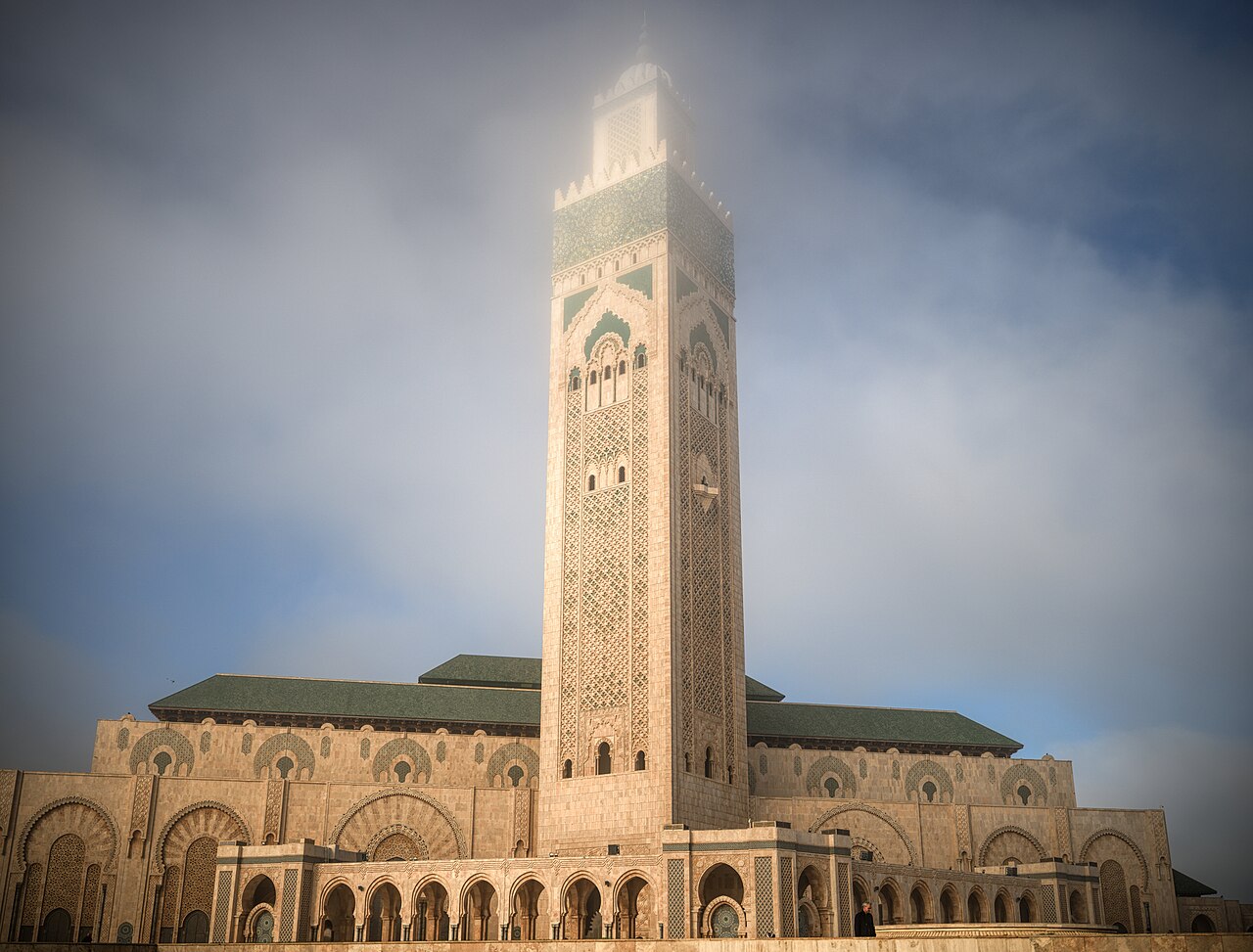
You reach it along a stone causeway with the Atlantic on three sides, gulls crossing the courtyard, spray sometimes reaching the marble. The minaret climbs 210 metres overhead, and at night a green beam leaves its summit and runs out across the water toward Makkah. Inside, the roof itself can slide open to the sky. This mosque was built to be entered, and it is one of the very few in Morocco that welcomes visitors of every faith through its doors.
King Hassan II commissioned the mosque after the Quranic verse describing God's throne as resting upon the water, and had it raised out over the Atlantic itself; it remains one of the very few mosques in Morocco open to visitors of every faith.
Its minaret rises 210 metres over sixty storeys, the tallest minaret in the world when it was completed in 1993 and still the second-tallest on Earth; a laser at its summit reaches roughly 30 kilometres toward Makkah to mark the qibla after dark.
Tens of thousands of Moroccan craftsmen and labourers, working in day and night shifts across seven years, cut the zellij, carved the cedar, and hung titanium doors, chosen because ordinary wood could not survive the salt air off the sea.
A king's gift, raised by a nation
Late King Hassan II wished to give Casablanca a great spiritual monument on the edge of the sea, near the old quarter of Sour Jdid, so that the faithful gathered there might contemplate sky and ocean together, echoing the Quranic verse that His throne rests upon the water. Ground was broken on 12 July 1986. The French architect Michel Pinseau drew the plans in close collaboration with Morocco's own artisanal bodies, and thousands of maalems, master craftsmen, set to work.
The mosque was financed largely by the Moroccan people themselves: some twelve million citizens contributed according to their means, the smallest gift five dirhams, each donor issued a receipt and a certificate. At the height of the work, roughly 2,500 people laboured day and night in shifts, and across the seven years some 35,000 workers and craftsmen passed through the site, cutting stone from Agadir, carving cedar brought down from the Middle Atlas, and setting titanium and brass at every door the sea wind could reach.
It was not finished in time for the king's sixtieth birthday as first planned. Instead the doors opened on 30 August 1993, the eleventh of Rabi al-Awwal 1414 AH, the eve of Mawlid al-Nabi, the Prophet's birthday. Since then the mosque has stood at the edge of Sour Jdid, its minaret visible from every approach to Casablanca, gathering the city for the five daily salah, for jumu'ah, and for the great congregations of Ramadan and the two Eids.
What you'll actually see
1
The minaret and its beam toward Makkah
At 210 metres and sixty storeys, the square minaret was the tallest religious structure on Earth when it opened in 1993 and is still the world's second-tallest minaret, after Algiers' Djamaa el Djazair. A laser at its summit reaches roughly 30 kilometres out over the Atlantic, aimed toward the Kaaba to mark the qibla after dark.
2
The prayer hall beneath a roof that opens to the sky
Inside, up to 25,000 worshippers kneel beneath a gilded cedar ceiling, among columns faced in Agadir marble, on a floor built out toward the ocean. The retractable roof itself, roughly 1,100 tonnes of wood and steel, slides open in about five minutes so the hall can breathe sun and sea air.
3
The courtyard, the fountains, and the hammam below
Above ground, a marble courtyard holds up to 80,000 more for Friday and festival prayers, its 41 fountains catching the coastal light. Below ground, a hammam built in the old style, a madrasa, and one of Morocco's fullest Islamic libraries extend the mosque's life well beyond the hours of salah.
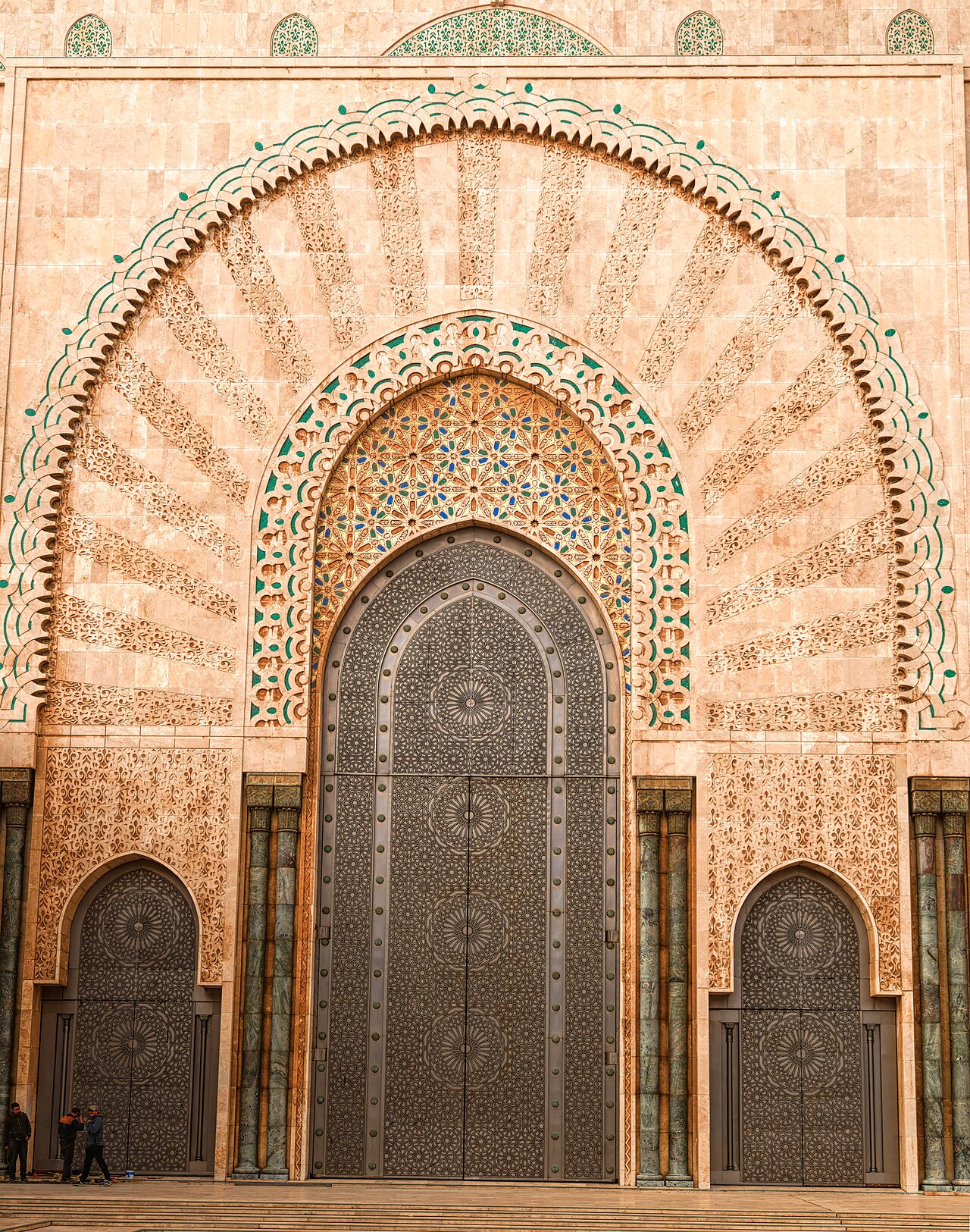
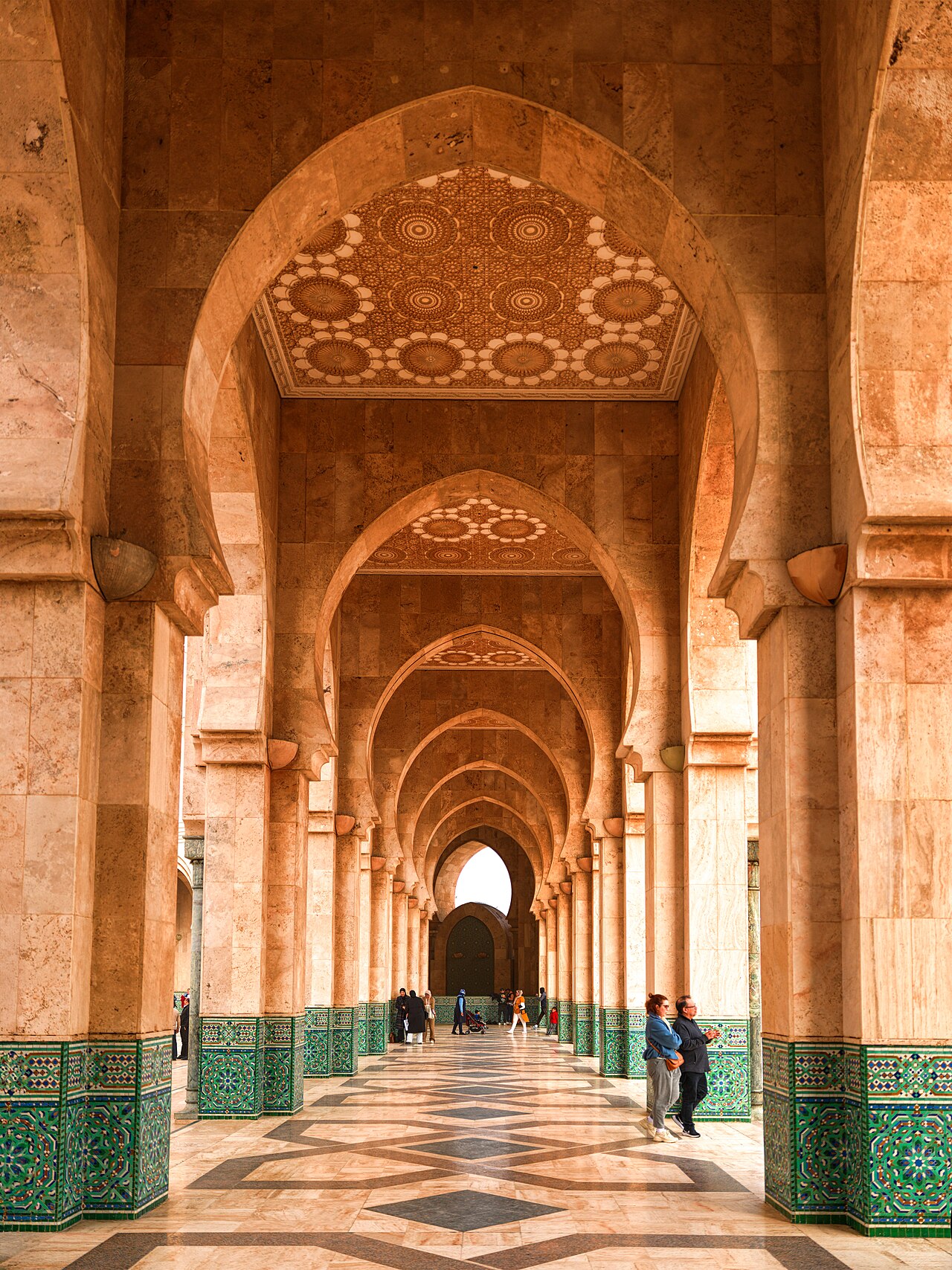
A titanium and brass entrance door at the Hassan II Mosque, set against the sea air the metal was chosen to resistA marble corridor within the Hassan II Mosque complex, carved and tiled by Moroccan maalems
A titanium door and a marble corridor of the mosque · photos CC BY 4.0, Wikimedia (Tinuzzo)
THE MONTH THE CITY GATHERS
Ramadan and the two Eids · Ramadan expected from about 8 February 2027
Each Ramadan the courtyard and the great hall fill after Maghrib, as families break the fast nearby and return for tarawih beneath the retracted roof; the mosque itself was inaugurated on the eve of Mawlid al-Nabi, so the coincidence of gathering and remembrance runs deep here. Guided tours for sightseers shorten during the month and pause in the afternoon, since the mosque's own rhythm of fasting and prayer takes priority over visiting. The month closes with the Eid al-Fitr congregation, expected around 9 to 10 March 2027, and the Eid al-Adha congregation follows about ten weeks later, expected around 16 to 17 May 2027; both dates depend on the sighting of the new moon.
If you are Muslim, come for tarawih to pray inside; if you are visiting only to see the mosque, check the shortened Ramadan tour hours before you go, and expect the year's largest crowds at the two Eids.
Plan your visit
By air
Mohammed V International Airport (CMN) is about 30 km away, roughly 30 to 45 minutes by taxi depending on traffic.
By rail
Casa-Port station is the nearest, about a 20-minute walk or a few minutes by taxi from the mosque.
Where it stands
On Boulevard Sidi Mohammed Ben Abdallah in the Sour Jdid quarter, on a promontory between Casablanca's harbour and the El Hank lighthouse.
Tour hours
Saturday to Thursday 9, 10, 11 am, 12 and 3 pm (plus 4 pm from mid-March to mid-September); Friday 9, 10 am and 3 pm (plus 4 pm in summer), the late-morning gap belonging to jumu'ah.
Entry
Salah is free for worshippers. The guided tour costs 140 DH for foreign adults, 70 DH for residents and foreign students, 30 DH for Moroccan students and children over 6, free under 6.
Dress
Clothing that covers the shoulders, torso, and knees; shorts and sleeveless tops are not permitted, and shoes come off before the prayer halls.
Best time
Late afternoon, when the marble takes the coastal light; avoid the late-morning hours on Friday, reserved for jumu'ah.
The famous claim of a glass floor over the sea is a myth: architects kept the prayer floor solid so as not to distract worshippers, though glass panels do look down into the ablution hall beneath the main floor.
The titanium and brass entrance doors replaced what would have been wood, chosen because the sea air would have worn ordinary timber down within a few years.
The mosque was paid for largely by its own people: about twelve million Moroccans contributed, the smallest gift five dirhams, each one given a receipt.
Ten years after it opened, sea-air corrosion required a major restoration beginning in 2005, reinforcing the structure with specialised stainless steel.
Questions pilgrims ask
Can non-Muslims visit the mosque?
Yes. Unlike most mosques in Morocco, the Hassan II Mosque is one of the very few open to visitors of every faith, through a paid guided tour outside prayer times. Muslims are welcome for all five daily salah and jumu'ah at no charge.
Is there really a glass floor looking out over the sea?
No, this is a common myth. The architects chose not to build a glass floor over the ocean so as not to distract worshippers at prayer; what does exist are glass panels in the floor that look down into the ablution hall below.
Do I need a ticket to pray there?
No. Salah is free for all Muslims, every day. The ticket and tour schedule apply only to non-worshipping visitors touring the mosque outside prayer times.
What should I wear to visit?
Clothing that covers the shoulders, torso, and knees, for both women and men; shorts and sleeveless clothing are not allowed, and shoes are removed before entering the prayer halls.
How was such an enormous mosque paid for?
Largely by public subscription. About twelve million Moroccans gave according to their means, the smallest recorded gift five dirhams, and every donor received a receipt and certificate.
Dharamshalas and guest houses near this Sthan, shared by devotees. Adisthan takes no bookings and no money; contact each stay directly.
No stays are listed here yet. Know one that serves pilgrims well?
Do you serve with the Fondation de la Mosquée Hassan II? Claim this page to keep its tour hours, ticket tiers, and prayer guidance exact for worshippers and guests from every land.