The disciple sings, the master listens, and seven centuries have not ended the mehfil.
Be the first to check in
Coming up: Urs of Hazrat Amir Khusrau · 24 MarEntry tended 10 Jul 2026
Open 5 am to 10:30 pm Qawwali nightly after Maghrib 723rd Urs · from 29 Sep 2026 Chadar and rose petals The baoli of 1321 Free · all faiths welcome
The lanes of the basti close in around you: rose petals in shallow baskets, prayer caps and velvet chadars on hooks, the smell of attar and frying bread, and somewhere ahead a harmonium clearing its throat. Then the lane opens and the small white dome floats up over a marble courtyard that has never really emptied in seven hundred years. Here lies the saint Delhi calls Mehboob-e-Ilahi, the Beloved of God. Steps away lies the disciple who taught the world to sing to him. You greet the disciple first. That is the custom of this house.
This is the tomb of Hazrat Nizamuddin Auliya (1238 to 1325), Sultan-ul-Mashaikh, the greatest Chishti saint of Delhi, who taught that love is the road to God, fed whoever came, and never once went to a king's court.
Qawwali as the world knows it was born in this courtyard. Hazrat Amir Khusrau, the saint's most beloved disciple, fused Persian and Indian song for his master, and the Qawwal Bachchon ka Gharana, descended from the twelve children Khusrau trained, sings here still, every single evening.
The baoli of 1321 beside the shrine is the only stepwell in Delhi still fed by a living underground spring. Tradition holds its water is blessed; the story of how it was dug at night, by lamps burning water instead of oil, is Delhi's most famous miracle tale.
The master and the disciple
Nizamuddin was born in Badayun in 1238 and came to Delhi a brilliant, penniless scholar. At twenty he travelled to Ajodhan to become the disciple of Baba Farid, Fariduddin Ganjshakar, in the Chishti line that carries its chain of transmission back to the Prophet Muhammad, peace be upon him. On his third visit Baba Farid made him his successor. He settled at Ghiyaspur, a village outside the city, and his hospice became a kitchen and refuge that turned no one away. He held that God is reached through love of God's creatures, refused the wealth of sultans, and Delhi named him Mehboob-e-Ilahi, the Beloved of God.
Kings still tried to bend him. When Sultan Ghiyasuddin Tughlaq, marching home from Bengal, sent word that the saint must leave Delhi before he arrived, Hazrat Nizamuddin answered with four words that became a proverb: Hunuz Dilli door ast, Delhi is still far away. The Sultan never reached the city; the pavilion raised for his welcome collapsed on him. The saint passed on 3 April 1325 and was buried where his dargah now stands; the dome above him was raised in 1562, and emperors, princesses and poets begged to be buried near him, more than seventy graves in this one compound.
His disciple Amir Khusrau, poet of seven sultans, was away in Bengal when the master died. He returned, saw the fresh grave, and spoke a Hindavi verse at it: the fair one sleeps on her bed, her face veiled by her hair; come home, Khusrau, dusk has fallen on the four quarters. He gave away what he had and was gone within six months, buried steps from his master. That is why every pilgrim greets Khusrau first: the way to the master's door, tradition holds, is through the one who loved him most.
What you'll actually see
1
The mazar beneath the dome
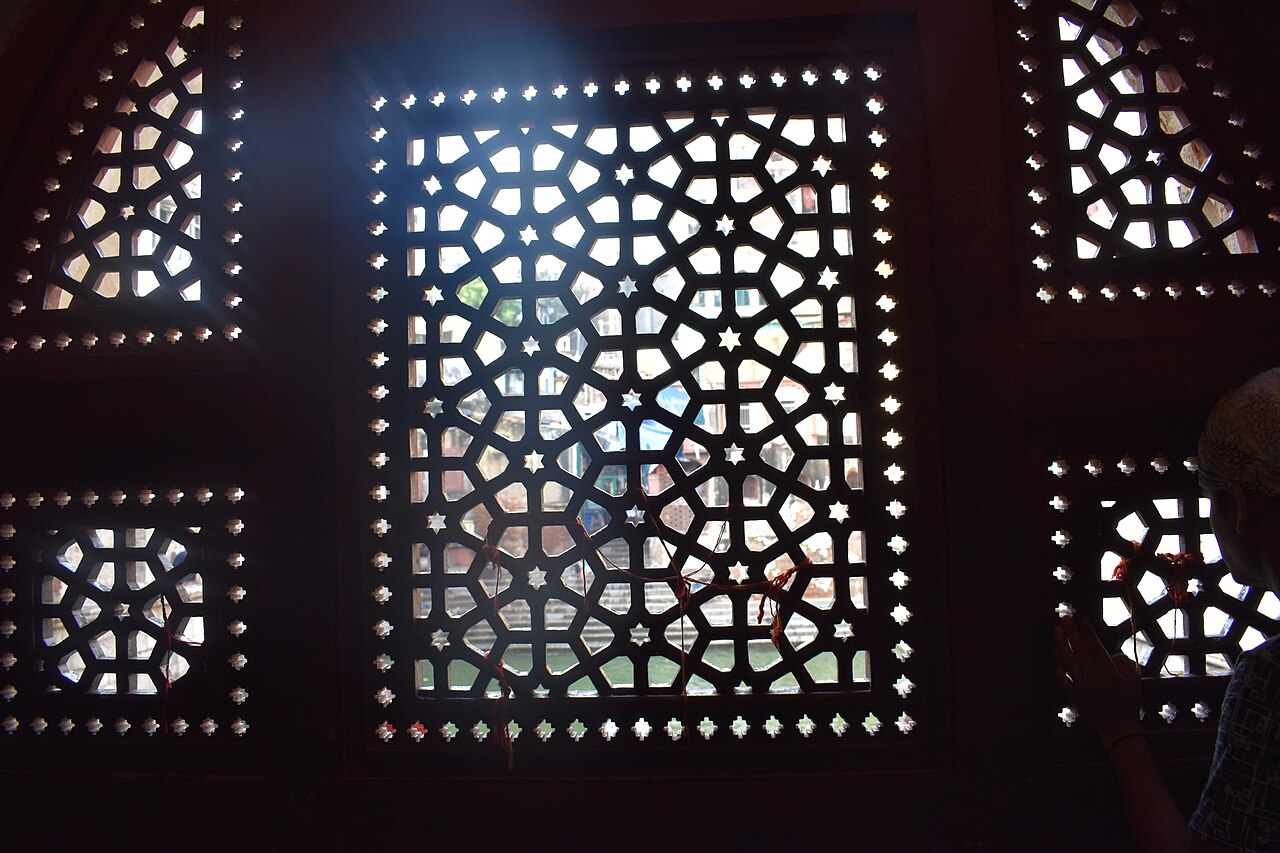
The tomb chamber is small, marble floored, and bright with love: a canopy over the grave, mounds of rose petals, folded chadars, the smell of attar. Around it runs a verandah of carved marble jali screens, and pilgrims tie red and yellow threads into the lattice, each knot a prayer. The white dome above, striped with slim black lines, was raised by Faridun Khan in 1562.
2
The red mosque of the sultans
The western side of the courtyard is filled by the Jamaat Khana Masjid, a red sandstone mosque of three domed bays ringed with Quranic script and lotus-bud carving, older than the marble around it. The five daily prayers sound here, a fortress-coloured elder standing over the white shrine.
3
Jahanara's grass-roofed grave
In a marble enclosure near the saint lies Jahanara Begum, Shah Jahan's eldest daughter, Padshah Begum of the empire and a Chishti disciple. Her sarcophagus is open to the sky and grows grass, exactly as she asked. Her epitaph reads: let naught cover my grave save the green grass, for grass well suffices as a covering for the lowly.
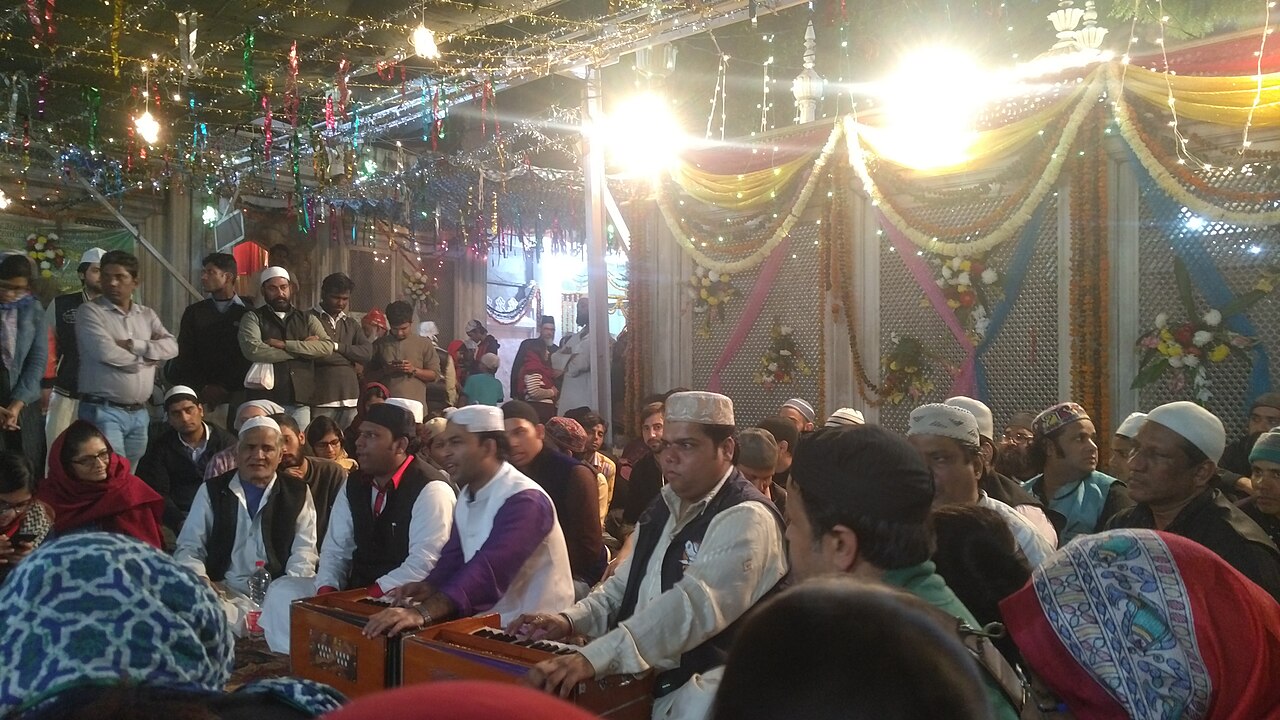
Qawwals at their harmoniums singing the evening mehfil-e-sama before the decorated mazar at Hazrat Nizamuddin DargahPrayer threads tied into a carved marble jali screen at the dargah, the baoli water visible through the lattice
The mehfil and the threads in the jali · photos CC BY-SA 4.0, Wikimedia Commons
The court that never fell silent
Qawwali sung where qawwali was born
Every evening, after the Maghrib prayer, the qawwals take their places on the marble between the two tombs and the mehfil-e-sama begins: harmonium, dholak, clapped hands, and the verses of Khusrau, Chhaap Tilak among them, sung to the master they were written for. Thursday evenings draw the largest gatherings, often with a second sitting near 9 pm. Twice a year the mehfil swells into an urs, a passing remembered as a wedding: the 723rd Urs of Hazrat Nizamuddin Auliya is expected from about 29 September 2026 (17 to 19 Rabi al-Thani), and the Urs of Hazrat Amir Khusrau from about 24 to 28 March 2027 (16 to 20 Shawwal); exact days follow the sighting of the moon.
Come on a Thursday well before sunset to find a place on the marble, and keep your belongings close in the press of the crowd.
Plan your visit
By air
Delhi's Indira Gandhi International Airport; take a taxi or the metro towards Nizamuddin West, then walk the basti lanes.
By rail
Hazrat Nizamuddin railway station, one of Delhi's main terminals, is about 2 km from the dargah; the New Delhi station is farther across town.
By metro
JLN Stadium on the Violet Line and Hazrat Nizamuddin on the Pink Line are both close; an autorickshaw covers the last stretch to the basti.
On foot
Vehicles stop short of the shrine. The last stretch is always walked through the bazaar lanes; shoes are left with a minder or a stall at the gate.
Timings
Open daily, about 5 am to 10:30 pm. Qawwali begins after the Maghrib prayer at dusk.
Dress
Cover your head, men and women both; caps and scarves are sold and lent in the lanes. Shoulders and knees covered.
Best time
Early morning for a quiet ziyarat; Thursday after sunset for the fullest mehfil; October to March for kind weather.
Humayun's Tomb, the great Mughal garden tomb, stands about 1 km away; emperors chose that ground because the saint lay near, and many pilgrims pair the two visits.
The complex holds more than seventy graves, for to lie near the saint was itself counted a blessing: the princess Jahanara, the emperor Muhammad Shah, and the historian Ziauddin Barani among them.
The dargah belongs to the Delhi Waqf Board, while hereditary pirzada and khadim families, organised as the Anjuman Peerzadan Nizamiyan Khusravi, conduct the rituals and receive pilgrims; langar is distributed daily.
The baoli was restored by the Aga Khan Trust for Culture after a partial collapse in 2008 and desilted to its full depth of 80 feet, part of the Trust's long renewal of the whole Nizamuddin Basti.
Questions pilgrims ask
Can people of other faiths visit the dargah?
Yes. This has never been a shrine for one community alone; Hindus, Sikhs, Christians and Muslims have sought the Beloved of God together for seven centuries, and all are received the same way. Cover your head, remove your shoes at the gate, and come with respect.
Why do pilgrims visit Amir Khusrau's tomb first?
It is the custom of the house. Khusrau was the master's most beloved disciple, and tradition holds that the way to Hazrat Nizamuddin passes through the one who loved him most, so ziyarat begins at the disciple's mazar and only then moves to the master's.
When can I hear qawwali?
Every evening, just after the Maghrib prayer at dusk, in the courtyard between the two tombs. Thursday evenings are the largest, often with a second sitting around 9 pm, and the urs nights are the greatest of all. There is no ticket; you sit on the marble with everyone else.
Can women enter the tomb chamber?
Women do not enter the inner chamber of the mazar. They pay their respects from the verandah, through the carved jali screens, where prayers are made and threads are tied; the courtyard, the qawwali and the rest of the complex are open to all.
What is the story of the baoli?
The stepwell was dug in 1321, while Ghiyasuddin Tughlaq was building Tughlaqabad and forbade workers and oil to any other site. The labourers came to the saint's well by night, and tradition holds the lamps burned that night on the baoli's water instead of oil. It is the only baoli in Delhi still fed by a living spring, and pilgrims hold its water blessed.
Dharamshalas and guest houses near this Sthan, shared by devotees. Adisthan takes no bookings and no money; contact each stay directly.
No stays are listed here yet. Know one that serves pilgrims well?
Do you belong to a pirzada or khadim family of the dargah, or serve on its committee? Claim this page to keep timings, urs dates and the ways of the house true for every pilgrim who sets out towards Mehboob-e-Ilahi.