Bada Danda, Puri, by the sea Nitis from about 5 am Rath Yatra · 16 to 24 Jul 2026 12th-c. Kalinga Rekha Deula Entry free · Hindus only
You come to Him along the Bada Danda, the Grand Road, wide enough for three chariots to roll abreast. Sea wind crosses the town, woodsmoke drifts from the Temple kitchen, and high above everything a triangular flag snaps from the pale curve of the tower. At the Lion Gate the crowd presses close, calling Jai Jagannath. The Lord inside is not stone, not metal. He is carved of neem wood, He falls ill each year after His bath, and in time He changes His body itself.
This is the eastern seat of the Char Dham, the four great abodes of Lord Vishnu. Here He is Lord Jagannath, Lord of the Universe, enthroned as a wooden Trinity with His elder brother Lord Balabhadra and His sister Devi Subhadra, and in the Nabakalebara rite the deities are ritually reborn in new bodies of sacred neem, last performed in 2015.
Its kitchen is counted among the largest on earth: 32 rooms, some 240 wood-fired hearths, and near a thousand cooks preparing the Mahaprasad in earthen pots stacked five to seven high, where tradition holds the topmost pot cooks first.
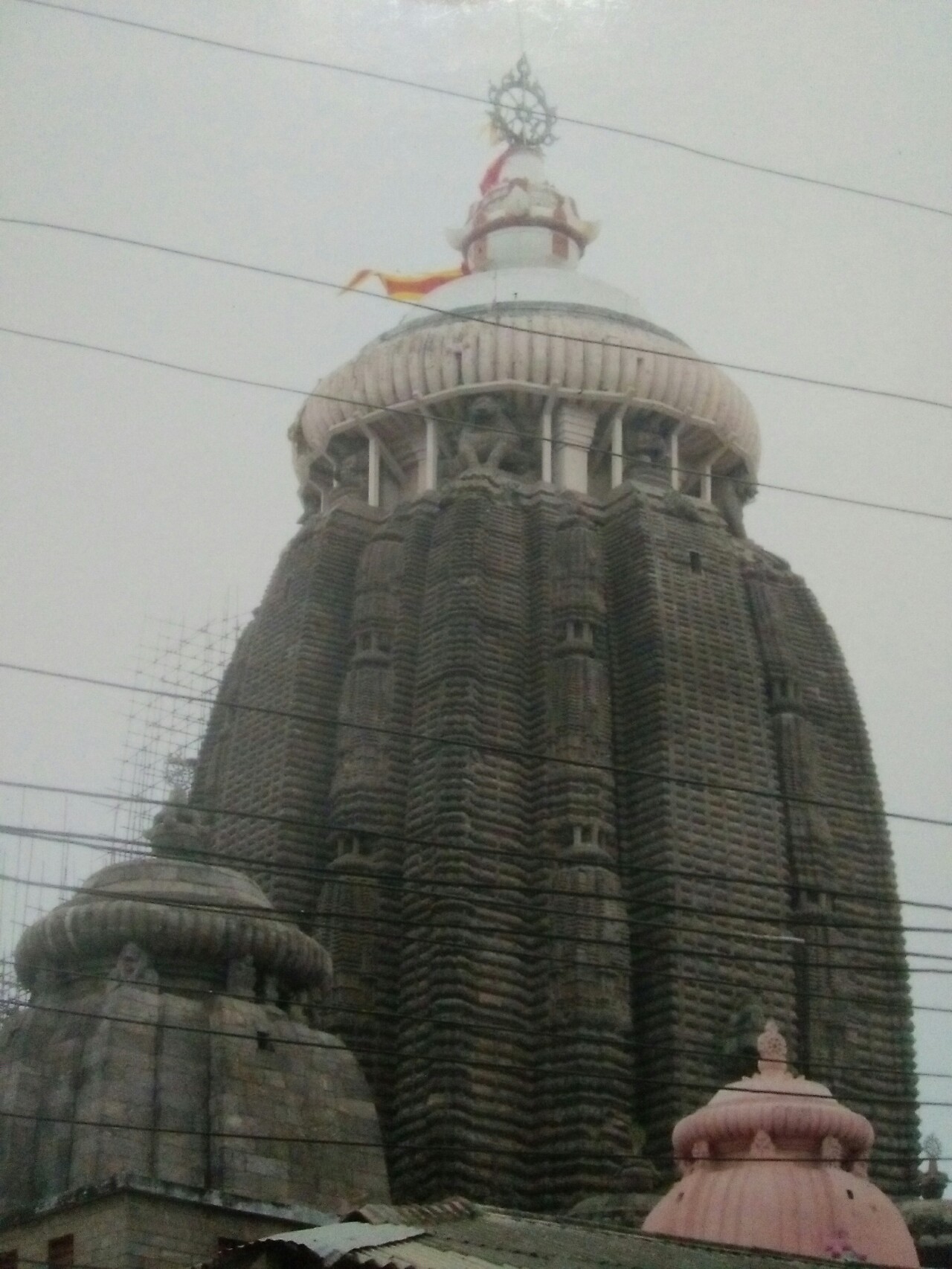
Every single day for centuries, a Chunara sevak has climbed the 65 metre tower without a harness to change the Patita Pavana flag above the Nilachakra. Tradition holds that if the flag ever fails to change, the Temple must close for eighteen years.
The unfinished form He chose
The legend says King Indradyumna longed to see Lord Vishnu as Nila Madhava, a form worshipped in secret in the forest. The form vanished from his reach, but a promise followed it: The Lord Would come to him as daru, sacred wood. In time a great log washed ashore at Puri, and no axe could touch it until an old carpenter appeared and agreed to carve the images alone, behind closed doors, on the condition that no one look upon him until the work was done. Days passed, the sounds of carving stopped, and the anxious queen had the doors opened. The craftsman, who was the divine architect himself, was gone. The images stood unfinished: great round eyes, no hands, no feet. As the king despaired, the voice of The Lord told him that this was the very form in which He wished to be worshipped. So He stands to this day.
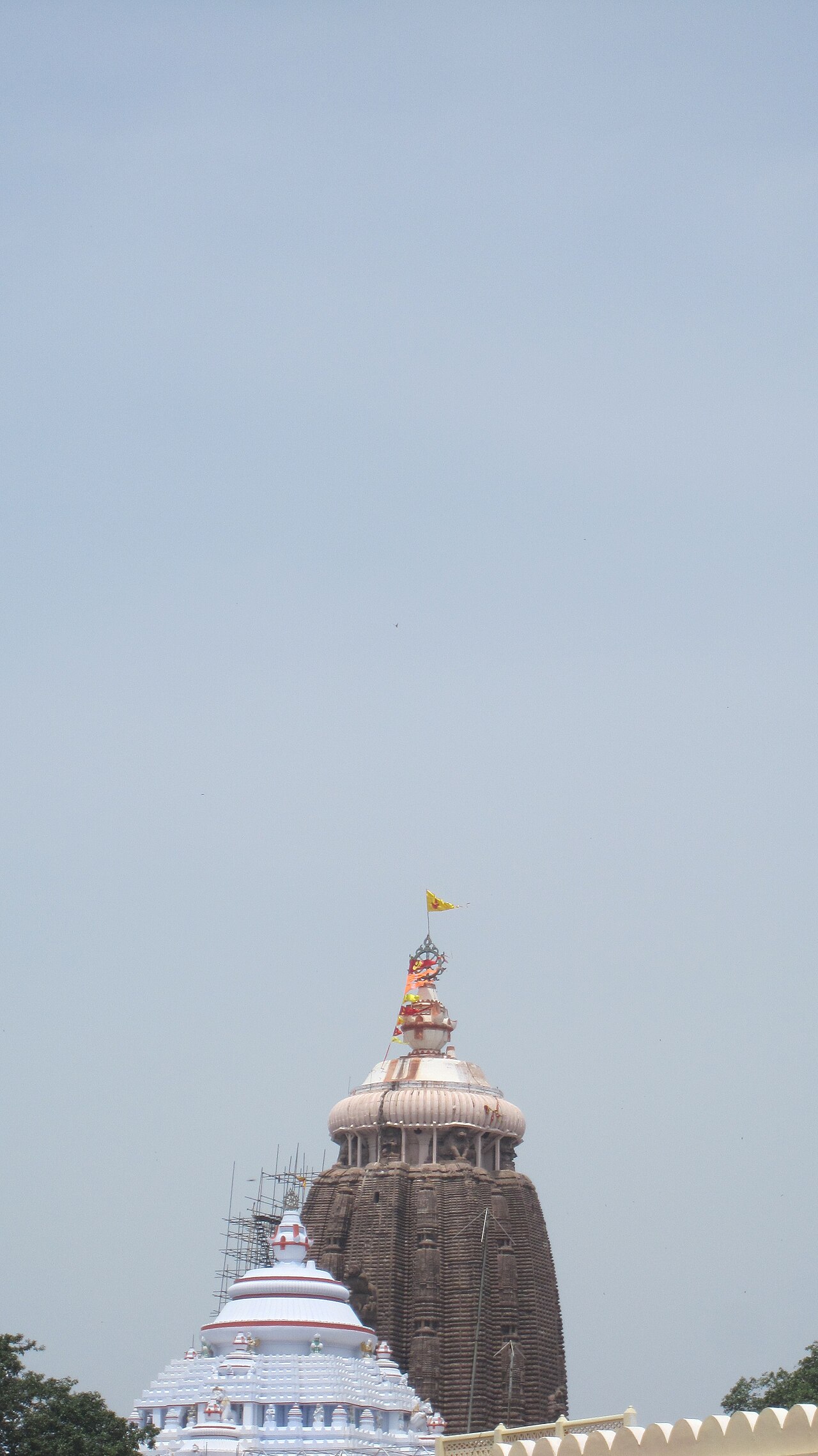
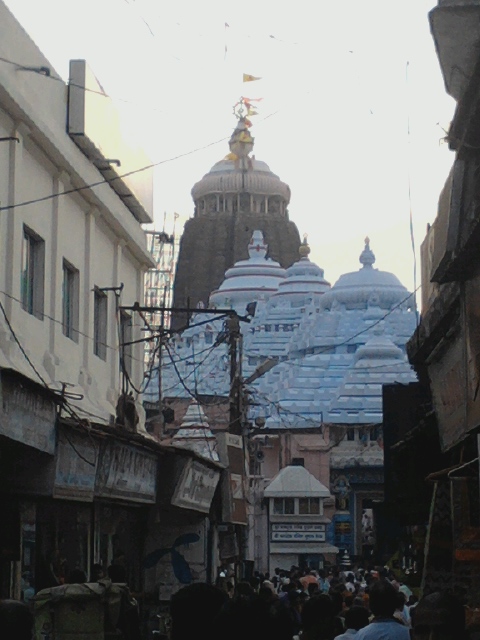
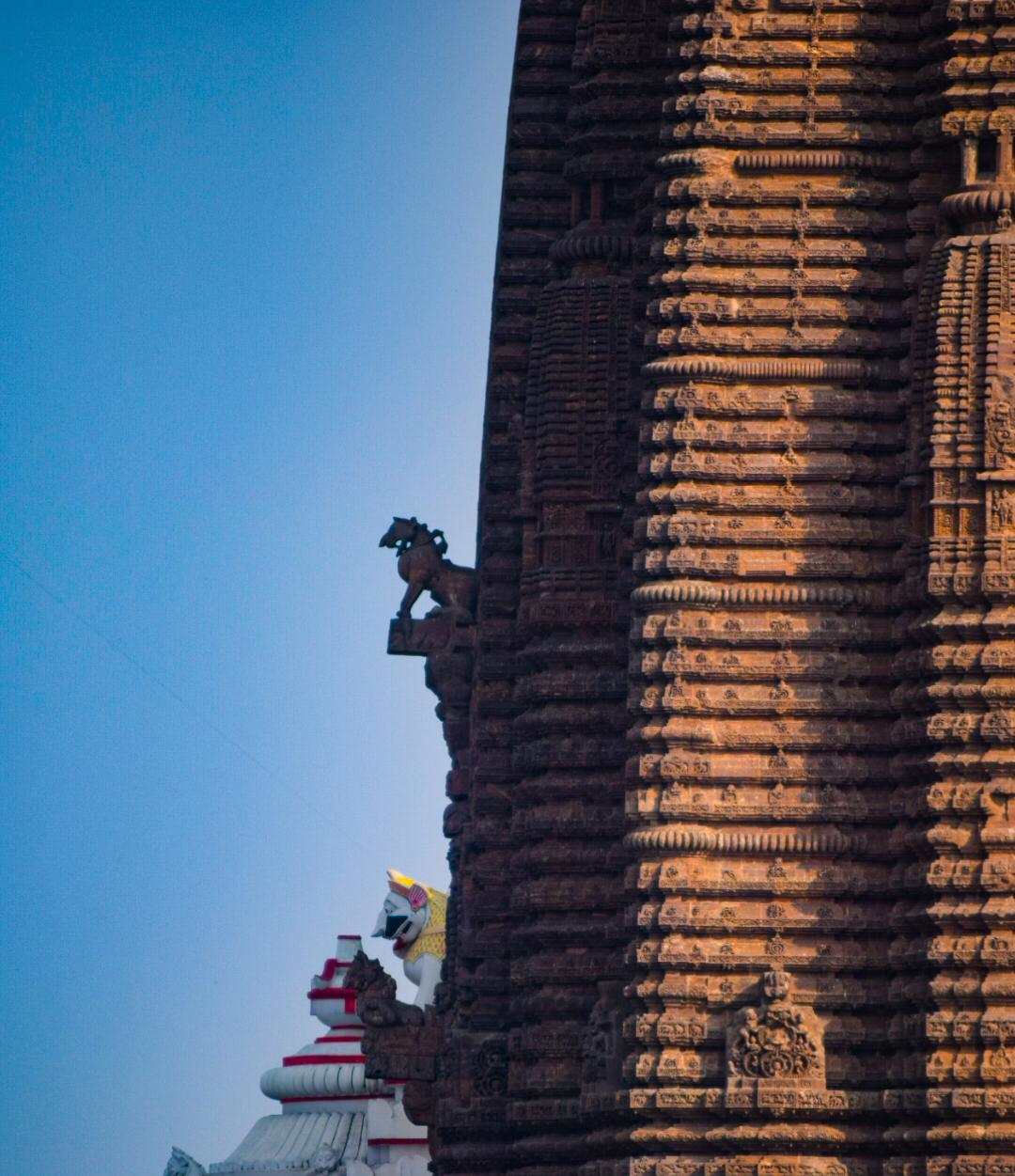
The Temple that houses Him, the Srimandir or Bada Deula, was raised in the early 12th century by Anantavarman Chodaganga of the Eastern Ganga dynasty and completed by his successors. It is Kalinga architecture at full height, a Rekha Deula whose curvilinear tower climbs 65 metres over the sanctum, crowned by the Nilachakra, a wheel of eight metals more than three metres high.
And because The Lord here is wooden and living, He does not keep one body forever. In Nabakalebara, held when the lunar calendar doubles the month of Ashadha, sacred neem trees are found by dream and omen, new images are carved in secrecy, and the life-substance is moved from the old bodies to the new in the dark of night, the bearers' eyes bound. The last Nabakalebara was in 2015.
What you'll actually see
1
Singhadwara and the Aruna Stambha
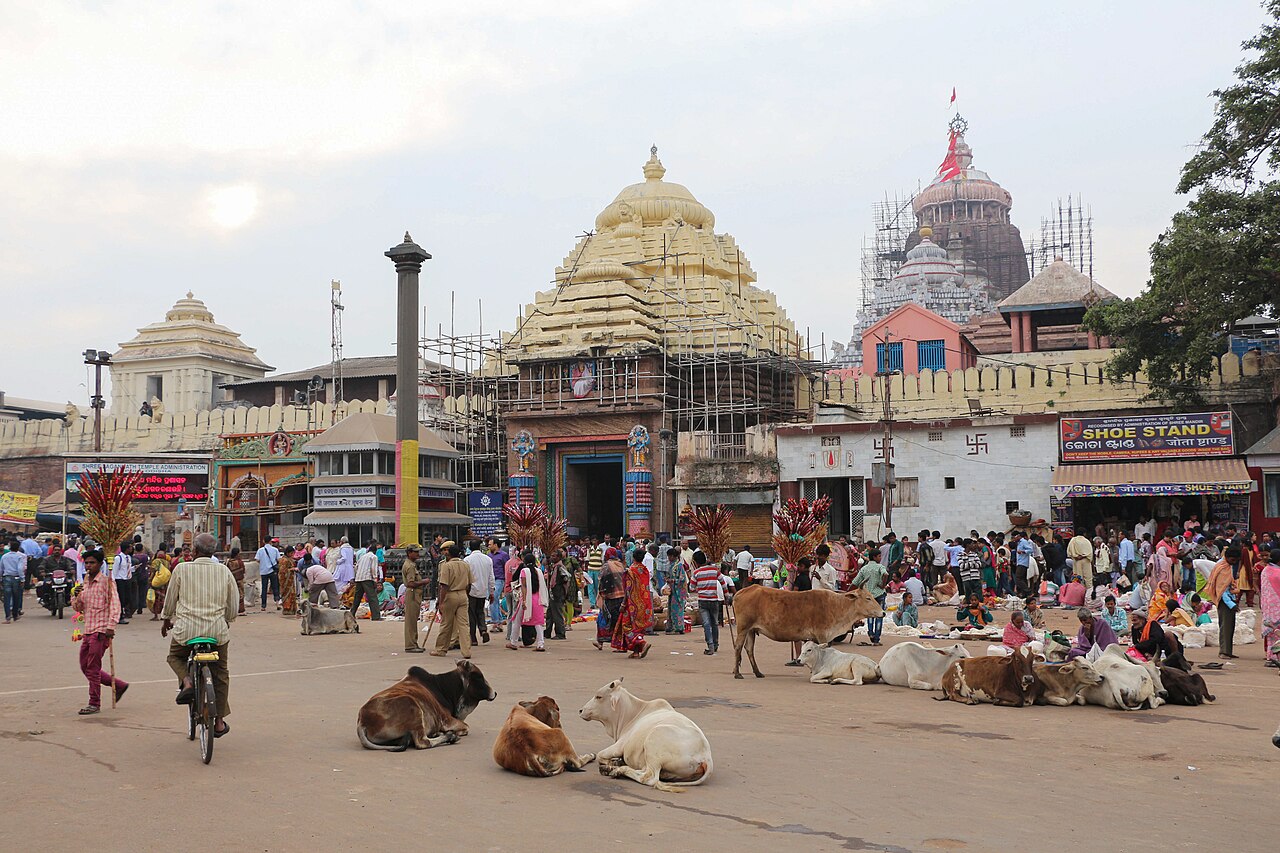
You enter from the east through the Lion Gate, past a monolithic chlorite pillar crowned by Aruna, charioteer of the sun, which records and tradition say was brought from the Sun Temple at Konark in the 18th century. On the gate itself is the image of Patitapabana, Saviour of the fallen, placed so that those who cannot enter the Temple may still have darshan of The Lord from the street.
2
The Nilachakra and the daily flag
Atop the tower sits the Nilachakra, a wheel of ashtadhatu, the eight-metal alloy, about 3.5 metres high and 11 metres around. Beneath it the Patita Pavana flag is replaced every day by Chunara sevaks who climb the full height of the tower barefoot and unroped, a seva their families have kept for centuries.
3
Ananda Bazar and the great kitchen
In the northeast of the complex lies Ananda Bazar, where the day's Mahaprasad is sold and eaten. Behind it works the Rosaghara, the Temple kitchen: fifty-six varieties of food cooked over wood fire in unglazed earthen pots that are used once and never again, stacked five to seven high on each hearth. Pilgrims of every caste eat this rice together, often from the same pot.
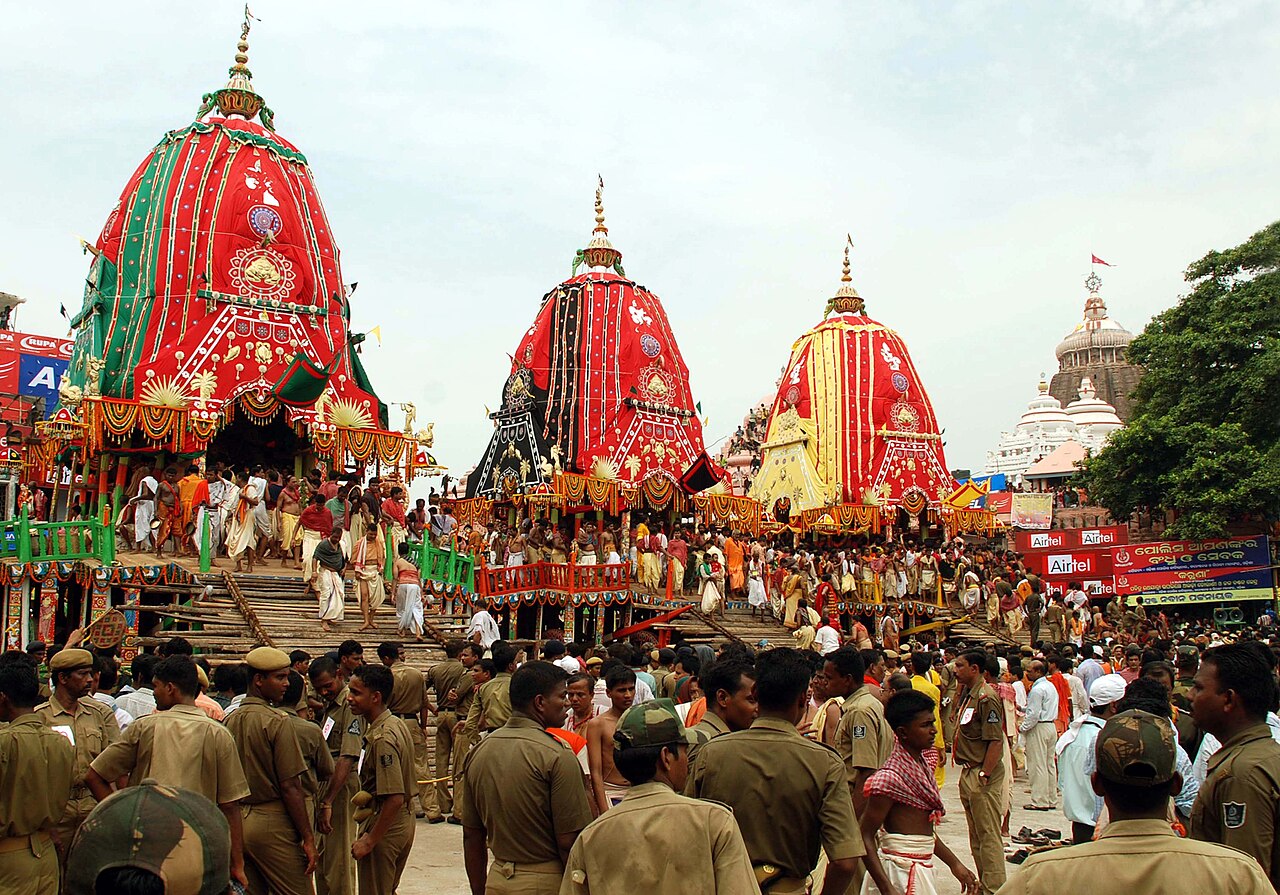
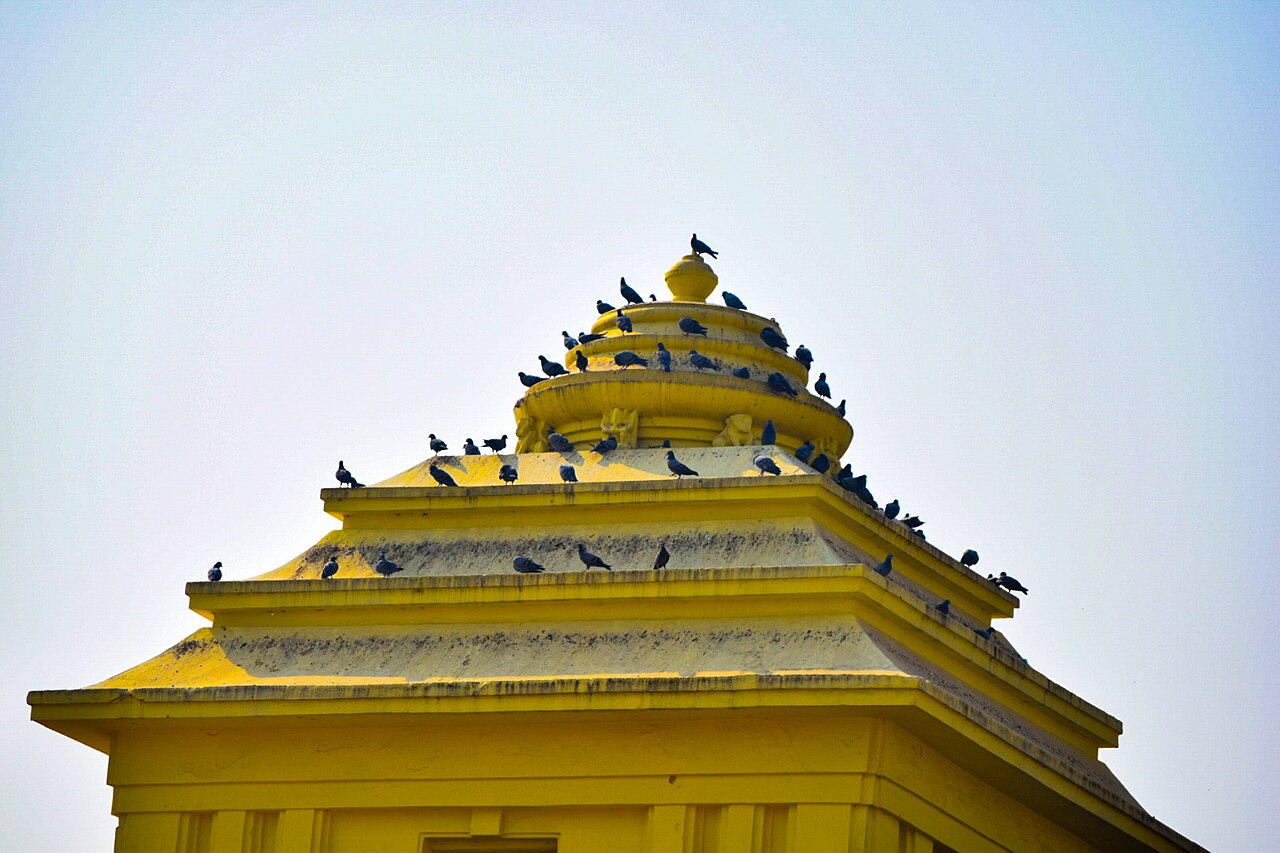
Singhadwara, the Lion Gate of Shri Jagannath Temple, the main eastern entrance in PuriThe chariots of Lord Jagannath, Lord Balabhadra and Devi Subhadra amid the sea of devotees on Bada Danda during Rath Yatra
The Lion Gate and the road of the chariots · photos Bernard Gagnon and Krupasindhu Muduli · CC BY-SA 3.0, Wikimedia Commons
The festival found nowhere else
Rath Yatra: when The Lord takes to the road
Once a year Lord Jagannath, Lord Balabhadra and Devi Subhadra leave the sanctum and ride three towering wooden chariots, Nandighosha, Taladhwaja and Darpadalana, built new every year by hereditary Maharana carpenters, some 220 artisans working for months. Devotees by the hundred thousand pull the ropes down the Bada Danda to the Gundicha Temple, where the deities stay for a week before the return journey, the Bahuda Yatra. On the road there is no restriction at all: people of every faith and nation see and touch the ropes of The Lord. In 2026 the chariots roll on Thursday 16 July, and the Bahuda Yatra returns them on 24 July.
The crowds run into the millions; reach Puri a day early, expect closed roads, and keep to the edges of Bada Danda unless you mean to pull.
Plan your visit
By air
Biju Patnaik International Airport, Bhubaneswar, about 60 km; roughly 1.5 hours by taxi on NH 316.
By rail
Puri railway station is about 2 km from the Temple; Bhubaneswar station is about 61 km with frequent connections.
Timings
Nitis begin about 5 am and continue till late night. Darshan pauses during rituals: morning darshan till about 8 am, then through Sakala Dhupa till about 11 am, till Bhoga Mandapa puja about 1 pm, again 2 to 5:30 pm, and finally 8 to 9 pm.
Entry
Free. Entry is restricted to Hindus; there are four gates, and pilgrims enter mainly by the eastern Singhadwara.
If you cannot enter
Non-Hindu visitors view the Temple, the Nilachakra and Patitapabana from the roof of the Raghunandan Library opposite Singhadwara on Grand Road; entry to the roof is free.
Dress
A dress code applies since 1 January 2024: no shorts, torn jeans, skirts or sleeveless wear. Dhoti, saree or salwar kameez are the safe choice.
Best time
Dawn for Mangala Alati and the quietest darshan; October to February for gentle weather; Rath Yatra week in June or July for the festival, with the year's largest crowds.
Mahaprasad
Buy and eat the day's Mahaprasad at Ananda Bazar inside the complex, generally after the midday offerings; carry cash.
Mobile phones and cameras are completely banned inside the Temple for everyone; lockers are provided near the entrance, so leave devices at your lodging or at the gate.
Puri is Sri Kshetra, the Purushottama Kshetra of the scriptures; the Temple is called Srimandir and Bada Deula, and the English word juggernaut entered the language from the unstoppable chariots of Lord Jagannath.
Gutkha, paan and plastic are banned on the Temple premises since January 2024.
The deities fall ritually ill for a fortnight after their grand bath on Snana Purnima and give no darshan until they recover just before Rath Yatra; check the ritual calendar if visiting in June or July.
Questions pilgrims ask
Can foreigners or non-Hindus enter the Temple?
No. Entry is restricted to Hindus, and the rule is enforced at all four gates without exception. Non-Hindu visitors have a long-accepted alternative: the roof of the Raghunandan Library opposite the Lion Gate, which looks over the walls to the tower and the Nilachakra, free of charge. And during Rath Yatra The Lord Himself comes out to the Grand Road, where everyone, of any faith, may see Him.
Why are the murtis made of wood, and why do they look unfinished?
The legend says the divine craftsman was interrupted before the images were complete, and The Lord declared the unfinished form, great round eyes, no hands or feet, to be the very form He chose. Because the bodies are neem wood, they are ritually renewed in the Nabakalebara ceremony, held when the month of Ashadha doubles in the lunar calendar; the last was in 2015.
What is Mahaprasad, and may I eat it?
Mahaprasad is the food offered to Lord Jagannath, cooked over wood fire in earthen pots in one of the world's largest kitchens: fifty-six varieties each day. It is sold at Ananda Bazar in the Temple's northeast corner, and pilgrims of all castes famously eat it together. Sharing it is considered a blessing, not a purchase.
When is Rath Yatra in 2026?
The chariots roll on Thursday 16 July 2026, and the deities return from the Gundicha Temple on the Bahuda Yatra of 24 July 2026. The preceding bathing festival, Snana Purnima, fell on 29 June 2026.
Can I take my phone inside?
No. Mobile phones and all camera devices are fully banned inside the Temple for devotees, servitors and police alike. Lockers are available near the entrance.
Dharamshalas and guest houses near this Sthan, shared by devotees. Adisthan takes no bookings and no money; contact each stay directly.
No stays are listed here yet. Know one that serves pilgrims well?
Are you a sevak, servitor or officer of the Shree Jagannatha Temple Administration? Claim this page to keep the nitis, festival calendar and pilgrim guidance exact for devotees worldwide.