Shah Jahan built it to hold a city at prayer, and it still does.
Be the first to check in
Coming up: Ramadan · 9 FebEntry tended 25 May 2026
Lives around the five daily prayers Courtyard holds some 25,000 in salah Shah Jahan · built 1650 to 1656 Ramadan · expected from 9 Feb 2027 Worship free · foreign visitors ₹400 Heart of Old Delhi, facing the Red Fort
You climb to it out of the lanes of Old Delhi, up broad flights of red sandstone steps loud with hawkers and pigeons, and pass through a towering gate into sudden stillness: a square of open sky, a pool of water at its centre, and a facade of striped marble domes and soaring minarets floating above the arcades. Kites wheel overhead. The adhan sounds over the rooftops of the old city, and the courtyard, big enough to hold a small town, begins to fill. This is not a monument that was once a mosque. It has never stopped being one.
One of the largest mosques in India. Its great courtyard, roughly 99 metres to a side, holds some 25,000 worshippers in salah, and on Eid mornings the congregation overflows the courtyard, down the steps and into the streets of Old Delhi.
The Shahi Imam tradition is as old as the mosque itself. Shah Jahan invited Syed Abdul Ghafoor Shah Bukhari from Bukhara to lead the first prayers at its inauguration on 23 July 1656, and the office of Shahi Imam has remained in the Bukhari family ever since; the mosque's committee serves under the present Shahi Imam, Syed Ahmed Bukhari.
A cabinet at the north gate keeps relics cherished by tradition: a Quran written on deerskin, a reddish hair of the beard of the Prophet Muhammad, peace be upon him, his sandals, and his footprint set in a marble block.
The last great work of Shah Jahan
When Shah Jahan moved his capital from Agra to the new walled city of Shahjahanabad, he set its congregational mosque on the highest ground he had, a rocky rise facing his Red Fort. Work began in 1650 and ran six years; the accounts speak of some 5,000 craftsmen, a cost of ten lakh rupees, and the emperor's wazir Sadullah Khan supervising the site, with the name of Ustad Khalil handed down as its architect. Shah Jahan called it Masjid-i-Jahan-Numa, the world-reflecting mosque. It was among the last great works of the emperor who had already raised the Taj Mahal.
For its opening on 23 July 1656 the emperor looked beyond his empire and invited a scholar of Bukhara, Syed Abdul Ghafoor Shah Bukhari, to lead the first prayers as Shahi Imam, the royal imam. The office has passed down through the Bukhari family from that day to this, and the later Mughal emperors, from Aurangzeb to Bahadur Shah II, were crowned in the presence of the Shahi Imam of this mosque.
After the uprising of 1857 the British seized the mosque and quartered soldiers in it, and for five years Delhi feared it would be pulled down. It was returned to the city's Muslims in 1862, and a managing committee has kept it since. The empire that built it is gone; the mosque simply continued. Five times a day, the adhan still crosses the rooftops it was built to command.
What you'll actually see
1
The steps and the three gates
The mosque stands on a plinth above the old city, reached by broad flights of red sandstone steps that are a bazaar, a meeting place and a dining room all at once. Three double-storeyed gates open north, south and east; the taller eastern gate was the royal entrance, reserved for the emperors who rode out from the Red Fort across the way.
2
The courtyard and the wudu tank
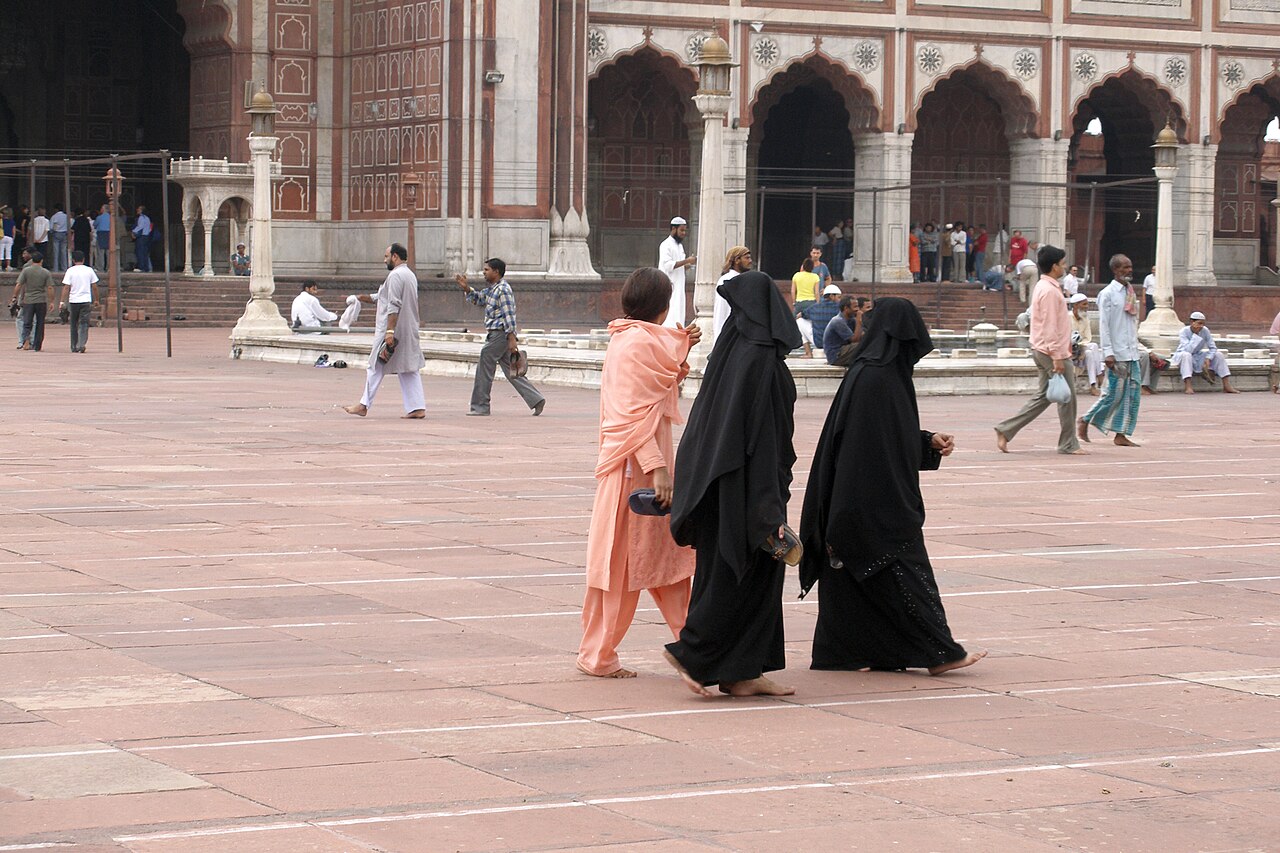
Through the gate the noise falls away into a paved square roughly 99 metres to a side, ringed by pillared arcades and open to the sky. At its centre a long marble tank serves for wudu, the ablution before prayer, and pigeons rise in clouds off the sandstone. On ordinary days families rest in the arcade shade; at jumu'ah the whole square becomes one congregation.
3
The prayer hall, domes and minarets
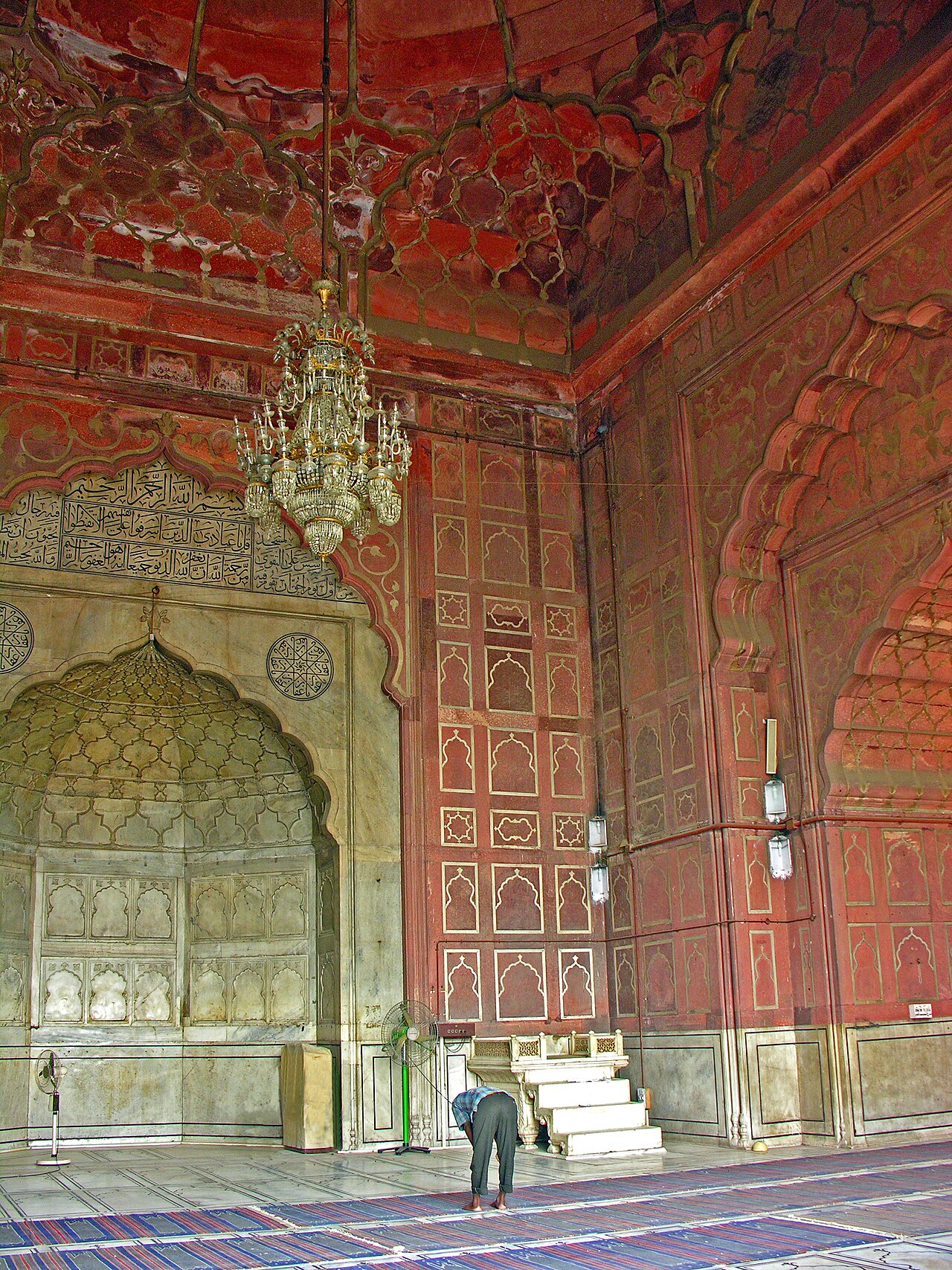
The western hall rises behind a great central arch flanked by arcades of engrailed arches, all red sandstone worked with white marble. Above float three bulbous domes of white marble striped with black, and at the corners two minarets climb about 40 metres in alternating stripes of sandstone and marble. Inside, the marble mihrab and minbar face Makkah, under a ceiling that has heard the Quran recited for nearly four centuries.
The marble mihrab and minbar of Jama Masjid's prayer hall, under painted vaults and a chandelierWorshippers crossing the sandstone courtyard of Jama Masjid, Delhi, the prayer hall arcades behind
The mihrab and the living courtyard · photos CC BY-SA 2.0 (Dennis G. Jarvis) and CC BY 4.0 (Vyacheslav Argenberg), Wikimedia Commons
THE MONTH THE STEPS BECOME A TABLE
Ramadan at Jama Masjid · expected from about 9 February 2027
Each Ramadan the mosque becomes the heart of Old Delhi's fasting days. As maghrib nears, the great steps and the courtyard fill with families spreading cloths for iftar, dates and fruit passed hand to hand until the adhan releases the fast, one of the most beloved scenes of the Delhi year. Tarawih prayers carry through the courtyard late into the night. Ramadan 1448 is expected to begin around 9 February 2027 in India, with the Eid al-Fitr prayer expected around 11 March 2027, both subject to the sighting of the moon; the Eid congregations here, at Fitr and again at Eid al-Adha in mid May, are among the largest in India.
Come toward sunset on any Ramadan evening to see the iftar on the steps; for the Eid prayer arrive very early, for the courtyard fills long before the takbir.
Plan your visit
By air
Indira Gandhi International Airport is about 20 km southwest; allow an hour by taxi in Delhi traffic, or take the Airport Express metro to New Delhi station and continue by metro or auto-rickshaw.
By rail and metro
Old Delhi railway station is about 1.5 km away and New Delhi station about 3 km. The Jama Masjid metro station on the Violet Line is a short walk from the mosque; Chawri Bazar and Chandni Chowk stations on the Yellow Line also serve the old city.
Timings
The mosque lives around the five daily prayers, Fajr through Isha. Guides commonly list visiting windows of about 7 am to noon and 1:30 to 6:30 pm; Delhi Tourism lists entry for visitors from 8 am until sunset. Sightseeing pauses during prayers, so confirm at the gate.
Entry
Worship is always free. Delhi Tourism lists free entry for Indian visitors and a ₹400 ticket for foreign visitors; some guides still describe this as a ₹300 camera charge, so carry cash and confirm at the gate. The minaret climb is a separate ₹100 ticket.
Dress
Modest dress for all: shoulders and legs covered, and women cover the hair. Robes are available at the gates, and shoes come off at the top of the steps; carry them or leave them with the keeper for a small tip.
Best time
Early morning, when the courtyard is quiet and the low sun warms the sandstone, or the last hour before sunset when the domes catch the light.
Jumu'ah
Friday midday prayer fills the courtyard. Worshippers should come early; sightseeing visitors should choose another time out of respect.
The formal name Shah Jahan gave it, Masjid-i-Jahan-Numa, means the world-reflecting mosque; Delhi simply calls it the Jama Masjid, the Friday mosque.
The southern minaret can be climbed for a view over Old Delhi to the Red Fort; the stair is narrow and steep, and posted notices do not permit unaccompanied women to climb.
Many Indian cities have a Jama Masjid; this is Delhi's, the imperial mosque of Shahjahanabad, not the namesakes of Agra, Ahmedabad or Jaunpur.
The lanes below the southern steps, Matia Mahal and the Urdu Bazar, are Old Delhi's famous food streets, at their liveliest after the evening prayer and through Ramadan nights.
Questions pilgrims ask
Can non-Muslim visitors enter Jama Masjid?
Yes. The mosque welcomes respectful visitors of every faith outside prayer times. Dress modestly, remove your shoes at the top of the steps, and note that the courtyard closes to sightseeing during the five daily prayers and for jumu'ah on Friday. Worship is free; Delhi Tourism lists a ₹400 ticket for foreign visitors.
Is this the largest mosque in India?
It is one of the largest, and its courtyard, holding some 25,000 worshippers, is among the great congregational spaces of the Muslim world. Larger mosques have been built since, but as the imperial Friday mosque of Mughal Delhi, Jama Masjid remains the country's most storied congregation, and its Eid prayers are among India's largest gatherings.
Can I climb the minaret?
Yes, the southern minaret is open with a ₹100 ticket, by a narrow spiral stair to a balcony with a view across Old Delhi to the Red Fort and New Delhi beyond. The climb is tight and unlit in stretches, and posted notices do not permit women to climb unaccompanied.
What relics are kept at the mosque?
A cabinet at the north gate keeps relics cherished by tradition: a Quran written on deerskin, a reddish hair of the beard of the Prophet Muhammad, peace be upon him, his sandals, and his footprint pressed into a marble block. They are shown to visitors per the custodians' discretion; ask respectfully at the north gate.
Who leads the mosque today?
The Shahi Imam, an office held by the Bukhari family since Shah Jahan invited Syed Abdul Ghafoor Shah Bukhari from Bukhara to inaugurate the mosque in 1656. The present Shahi Imam is Syed Ahmed Bukhari, whose son Syed Shaban Bukhari was anointed his deputy in February 2024, and a managing committee has administered the mosque since 1862.
Dharamshalas and guest houses near this Sthan, shared by devotees. Adisthan takes no bookings and no money; contact each stay directly.
No stays are listed here yet. Know one that serves pilgrims well?
Do you serve the Jama Masjid's managing committee or the office of the Shahi Imam? Claim this page to keep its guidance true for every worshipper and visitor who climbs these steps.