Buddhism's holiest site · The seat of enlightenment
Mahabodhi Temple
Bodh Gaya · Bihar, India
Here a man sat down beneath a tree, and rose as the Buddha.
Be the first to check in
Coming up: Buddha Purnima · 20 MayEntry tended 29 Jun 2026
Open 5 am to 9 pm daily Entry free · Camera ₹100 Buddha Purnima · 20 May 2027 5th-6th c. brick · UNESCO 2002 The living Bodhi tree
You leave your shoes and your phone at the gate, descend a flight of steps, and the noise of the town falls away above you. The courtyard lies below street level, and from it rises a mountain of carved brick, its pyramid tower drawing the eye straight up. Around its base the air hums in a dozen tongues at once, circles of robed monks each chanting their own scripture toward the same spot. Behind the Temple spreads a great peepal tree. This is the tree. Every Buddhist path on earth leads back to the ground beneath it.
This is where Prince Siddhartha attained enlightenment and became the Buddha, on the full moon of Vaishakha at the age of thirty-five. Of the four holy places of his life, Lumbini, Bodh Gaya, Sarnath and Kushinagar, tradition holds this one the most sacred of all.
The 50 metre brick tower, raised in the 5th to 6th century CE on the site of Emperor Ashoka's 3rd century BCE shrine, is one of the earliest Buddhist Temples still standing in India and among the oldest brick Temples of the late Gupta age. UNESCO inscribed the complex in 2002.
The Bodhi tree beside the Temple is held to be a direct descendant of the original: a sapling carried to Sri Lanka by Sanghamitta in the 3rd century BCE became the Jaya Sri Maha Bodhi of Anuradhapura, and from that unbroken line the present tree was planted here in 1881.
The tree, the throne, and the long return
Tradition tells that the ascetic Siddhartha came to the village of Uruvela worn thin by six years of austerity. A village woman named Sujata offered him kheer, rice cooked in milk, and with his strength returned he seated himself beneath a peepal tree facing east and vowed not to rise until he understood. Through the night of the Vaishakha full moon he touched the earth as his witness, and at the last watch of the night he attained supreme enlightenment. For seven weeks he remained in the grounds around the tree, walking, gazing, and meditating at the seven spots pilgrims still trace today.
Around 260 BCE the emperor Ashoka came here on pilgrimage and built the first shrine by the tree, placing a polished sandstone slab, the Vajrasana or Diamond Throne, to mark the exact seat. The great brick Temple that now rises above it was raised in the 5th to 6th century CE. When the Chinese pilgrim Xuanzang arrived in 637 CE he found a tower some 160 feet tall, bluish brick, its niches filled with gilded Buddhas, essentially the building that stands today.
After the 13th century the Temple fell silent and slowly into ruin. Burmese kings began repairs in the 19th century, and Alexander Cunningham and J. D. Beglar completed a full restoration in 1880 to 1884. The old tree had fallen in a storm in 1876; in 1881 Cunningham planted the present one, of the Anuradhapura line first carried from this very tree to Sri Lanka twenty-two centuries before. In 1949 the Bodhgaya Temple Act placed the shrine under the Bodhgaya Temple Management Committee, and in 2002 UNESCO inscribed it as a World Heritage Site.
What you'll actually see
1
The Vajrasana, the Diamond Throne
Between the Temple's west wall and the Bodhi tree lies a slab of polished sandstone installed by Emperor Ashoka in the 3rd century BCE to mark the precise spot of the enlightenment. Buried for centuries, it was unearthed in the excavations of 1863 and 1881. Pilgrims circle it in quiet circumambulation; no one sits on it. It is arguably the most revered single stone in the Buddhist world.
2
The gilded Buddha of the sanctum
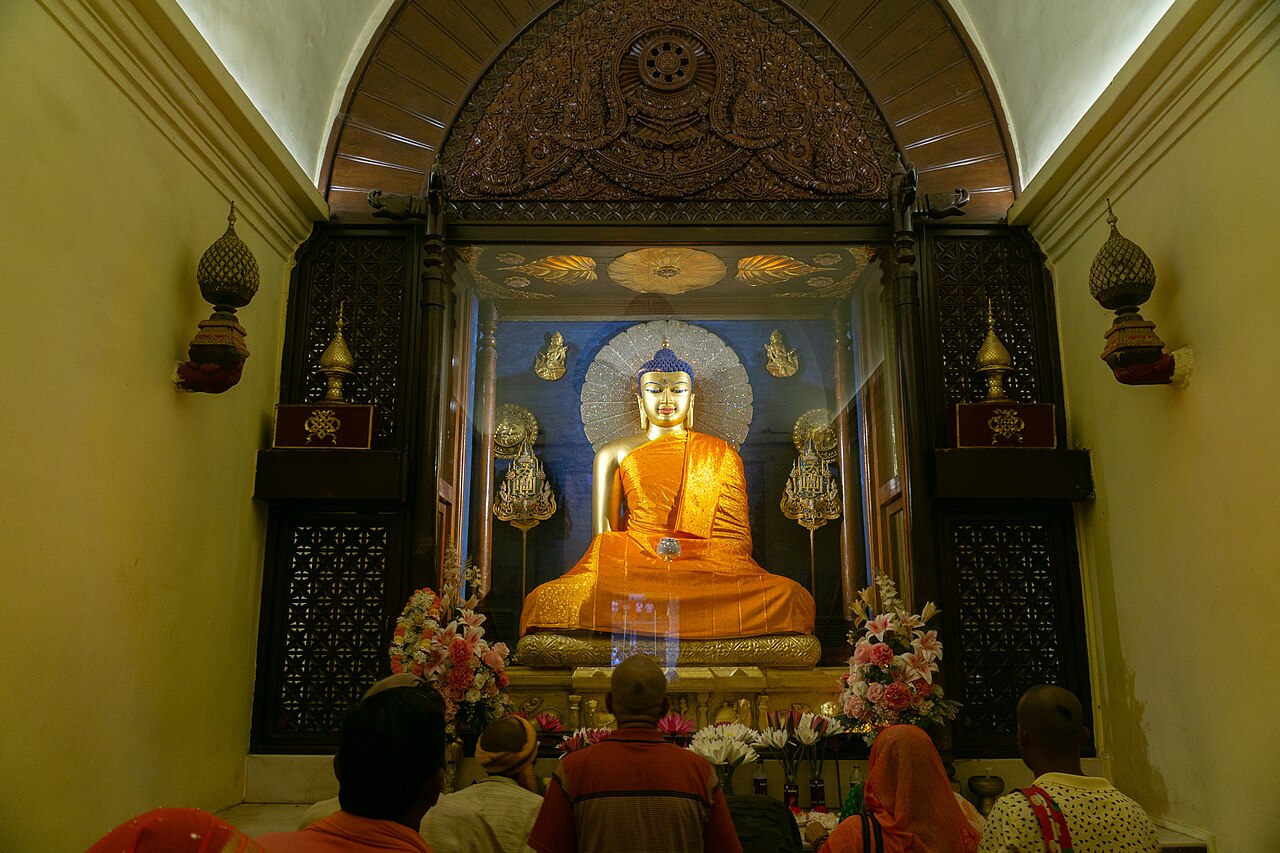
The Temple faces east, the direction the Buddha faced as he meditated. Through a small forecourt and hall you reach the sanctum, where a great gilded Buddha, more than five feet high and draped in bright robes, sits in bhumisparsha mudra, the earth-touching gesture of the enlightenment itself, right hand reaching down to call the earth as witness.
3
The seven sacred stations
The grounds map the seven weeks after the awakening: the Bodhi tree of the first week; the Animeshlochan Chaitya where he stood gazing unblinking at the tree; the Ratnachakrama or jewel walk, where carved stone lotuses mark his eighteen paces; the Ratnaghar Chaitya; the pillar of the Ajapala Nigrodh tree; the Lotus Pond of Muchalinda south of the enclosure; and the Rajyatana tree of the seventh week.
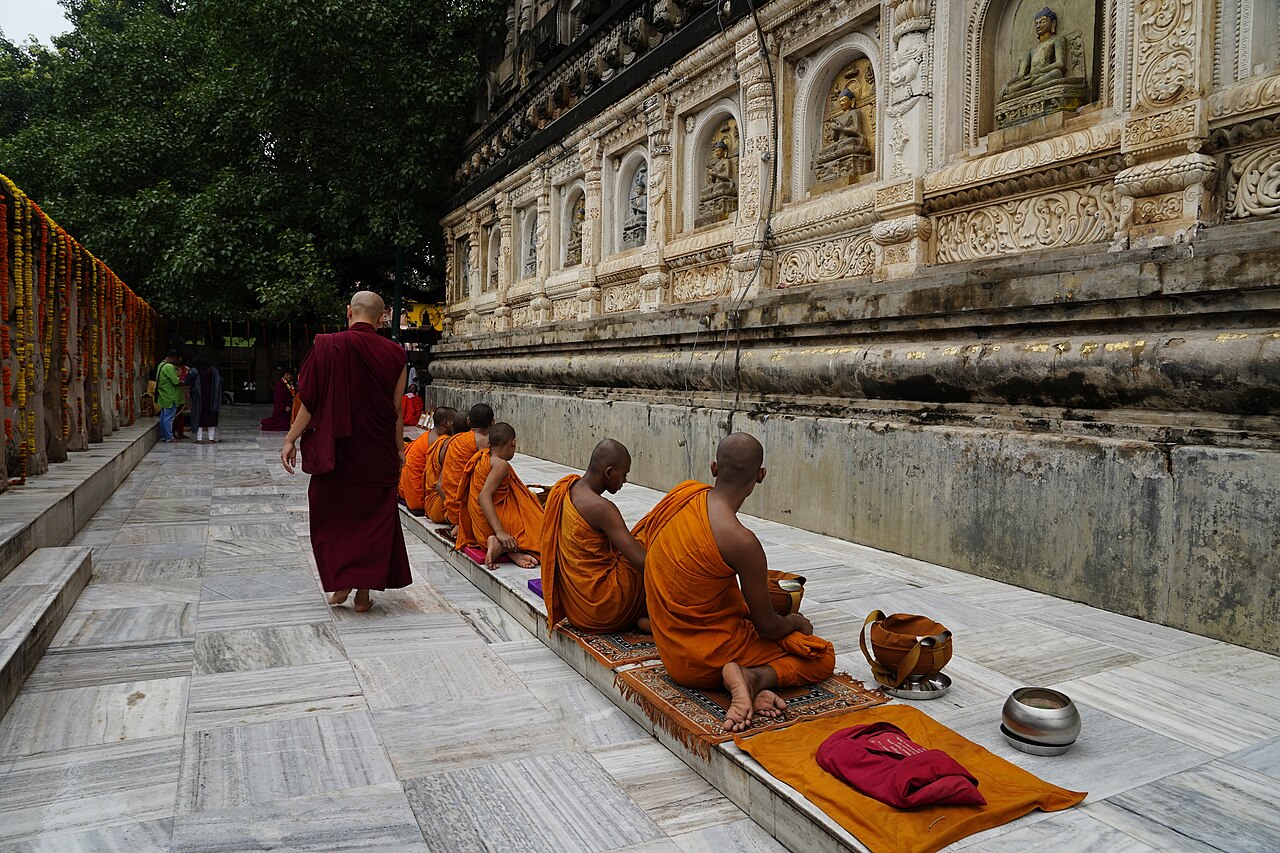
The gilded Buddha in the sanctum of the Mahabodhi Temple, seated in the earth-touching gestureBhikkhus seated in prayer beside the carved niches of the Mahabodhi Temple wall
The gilded Buddha of the sanctum, and bhikkhus in prayer beneath the temple wall · photos CC BY-SA 4.0 Sumitsurai and CC BY 4.0 Amitabha Gupta, Wikimedia Commons
The full moon of Vaishakha
Buddha Purnima at the seat of enlightenment
Everywhere else in the world, Buddha Purnima commemorates the enlightenment. Here it returns to the place where it happened. On the Vaishakha full moon the birth, awakening and passing of the Buddha are honoured at the foot of the Bodhi tree itself, with chanting, offerings and processions that draw monks and lay pilgrims from every Buddhist nation, many of whom keep vigil under the tree through the full-moon night. The Temple's own daily rhythm already carries the memory: every morning at 10 am kheer, the milk-rice Sujata offered the ascetic Siddhartha, is offered again. The next Buddha Purnima falls on Thursday 20 May 2027.
Expect the largest crowds of the year and arrive very early; the winter chanting season, December to January, brings the Tipitaka chanting and the Kagyu Monlam and is nearly as full.
Plan your visit
By air
Gaya International Airport (GAY) is about 10 km from the Temple, a short taxi ride. Patna airport, about 135 km away, has far more connections.
By rail
Gaya Junction is the nearest station, about 17 km away; taxis and autos run to Bodh Gaya through the day.
By road
Patna is about 135 km, Rajgir 78 km, Varanasi 252 km. Regular buses run from Gaya, Patna and Varanasi.
Timings
The Temple is open 5 am to 9 pm every day of the week. The Meditation Park inside the complex is open sunrise to sunset for a small charge.
Fees
Entry is free. A camera ticket costs ₹100 and a video camera ₹300. Mobile phones are not allowed inside and are deposited free at the entrance counters.
Best time
Come for the 5:30 am chanting, when the courtyard is coolest and quietest. November to February is the great pilgrimage season.
Dress
Dress modestly with shoulders and knees covered. Shoes are deposited free at the gate; the marble around the shrine is walked barefoot or in socks.
Mahabodhi means the great awakening; the Temple's formal name is the Mahabodhi Mahavihara, and it is run by the Bodhgaya Temple Management Committee under the Bodhgaya Temple Act of 1949.
Phones must be left at the free deposit counters before the security check, so plan meeting points with companions in advance and carry small cash for offerings.
The whole sacred enclosure lies about five metres below the surrounding streets; you descend into it, which is part of why the outside world goes quiet.
December and January are the chanting season: the International Tipitaka Chanting Ceremony in early December and the Kagyu Monlam that follows fill the grounds with tens of thousands of monks and pilgrims from across Asia.
Questions pilgrims ask
Is this the actual tree the Buddha sat under?
It is the same spot and the same lineage, not the same trunk. A sapling of the original tree was carried to Anuradhapura in Sri Lanka by Sanghamitta in the 3rd century BCE and still grows there. After the old tree at Bodh Gaya fell in a storm in 1876, the present tree was planted on the spot in 1881 from that Sri Lankan line, so the tree standing today is a direct descendant of the tree of the enlightenment.
Can people of any faith enter?
Yes. The Mahabodhi Temple is open to everyone, of every tradition and none, free of charge, from 5 am to 9 pm daily. It is a living place of worship, so visitors are asked to keep voices low and dress modestly.
Can I meditate there?
Yes, and many do. Pilgrims and monks sit in meditation all around the grounds, under the Bodhi tree and along the circumambulation path. A dedicated Meditation Park inside the complex, open sunrise to sunset for a small charge, is reserved for quiet sitting.
What is the Vajrasana?
The Diamond Throne: a polished sandstone slab placed by Emperor Ashoka in the 3rd century BCE between the Temple and the Bodhi tree, marking the exact seat of the enlightenment. It was unearthed in excavations in 1863 and 1881 and is venerated as the centre of the Buddhist world.
What happens at the Temple each day?
The shrine opens at 5 am. Sutta chanting and meditation are held from 5:30 to 6 am, kheer is offered at 10 am in memory of Sujata's offering, Mahayana chanting follows at 6 pm and Pali chanting at 6:30 pm, and the Temple closes at 9 pm.
The Sthan in photographs
Darshan from afar
From the temple's own channels. Nothing loads until you press play.
Dharamshalas and guest houses near this Sthan, shared by devotees. Adisthan takes no bookings and no money; contact each stay directly.
No stays are listed here yet. Know one that serves pilgrims well?
Are you with the Bodhgaya Temple Management Committee or the sangha that keeps the chanting alive beneath the Bodhi tree? Claim this page to keep its hours, festivals and guidance true for every pilgrim.