Makkah al-Mukarramah · Makkah Province, Saudi Arabia
Every prayer on earth turns toward this House.
Be the first to check in
Coming up: Ramadan at the Haram · 8 FebEntry tended 11 Jul 2026
Entry to Makkah is for Muslims Tawaf circles the Kaaba day and night Hajj · about 14 to 19 May 2027 Free · umrah permit via Nusuk Zamzam water shared freely
White marble cool underfoot even at noon, a hundred languages folding into one Arabic prayer, and then the courts open and you see it: the black cube of the Kaaba, turning a slow river of people around itself. Men in two unstitched white cloths, women in simple modesty, all moving in one direction, as pilgrims have moved for centuries. Know this before you plan: entry to Makkah is reserved for Muslims, and this page exists for the devotional reference of Muslim devotees worldwide. You have faced this House your whole praying life. Here, it faces you back.
The Kaaba is the qibla. Every Muslim on earth, at every one of the five daily prayers, turns to face this single point. The Quran calls it the first House of worship appointed for humanity, at Bakkah, blessed and a guidance for all people (Quran 3:96).
The Quran relates that Prophet Ibrahim and his son Prophet Ismail raised the foundations of this House, praying as they built: Our Lord, accept this from us (Quran 2:127). The rites taught to them, the tawaf and the sa'i, are still performed here in unbroken continuity.
Hajj, the fifth pillar of Islam, gathers millions here in the month of Dhu al-Hijjah, and every Muslim who is physically and financially able is called to make the journey once in a lifetime. Successive expansions have raised the mosque's capacity from about 770,000 toward more than two million worshippers.
The House that Prophet Ibrahim raised
The Quran and the tradition tell it this way. Prophet Ibrahim was commanded to leave his wife Hajar and their infant son Ismail in a barren valley, with a little water and a little food, and to trust Allah with the rest. When the water was gone, Hajar climbed the hill of Safa searching the horizon, then crossed the valley to Marwa, then back again, seven times in the heat. At her child's feet a spring broke from the ground: Zamzam, which flows to this day. Around that water the valley became a settlement, and the settlement became Makkah.
Years later, father and son were commanded to build. The Quran relates how Prophet Ibrahim and Prophet Ismail raised the foundations of the House, praying as they worked: Our Lord, accept this from us; indeed You are the All-Hearing, the All-Knowing (Quran 2:127). The Kaaba they raised was appointed as a house for the worship of the One God, and the rites given to them, circling the House, walking between the hills, standing in prayer, became the pattern of pilgrimage for all who came after.
In the sixth century of the common era the Prophet Muhammad, peace be upon him, was born in this city. When Makkah opened to him, he cleansed the House of its idols and returned it to the worship of Allah alone, and the qibla of the Muslim prayer was fixed upon the Kaaba forever. Every mosque on earth is built facing the point where you now stand, and the circling of the House has not ceased.
What you'll actually see
1
The Kaaba and the kiswa
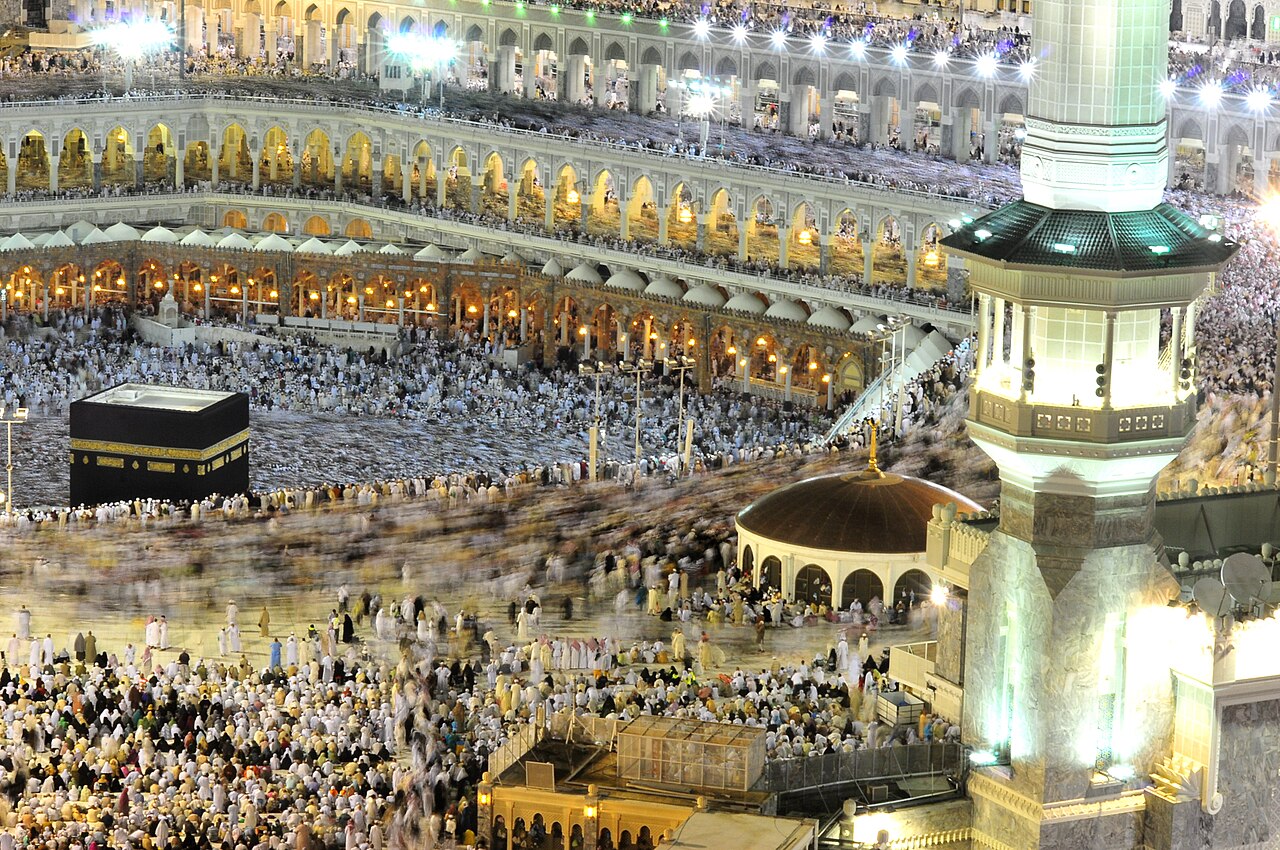
A stone cube about thirteen metres high, draped in the kiswa, a black silk covering embroidered with Quranic verses in gold and silver thread along its upper band, the hizam. The kiswa is woven in Makkah and replaced each year, in recent years on the first day of Muharram, the Islamic New Year. Set into the eastern corner is al-Hajar al-Aswad, the Black Stone, where each of the seven rounds of tawaf begins, the House always kept on the pilgrim's left.
2
Maqam Ibrahim
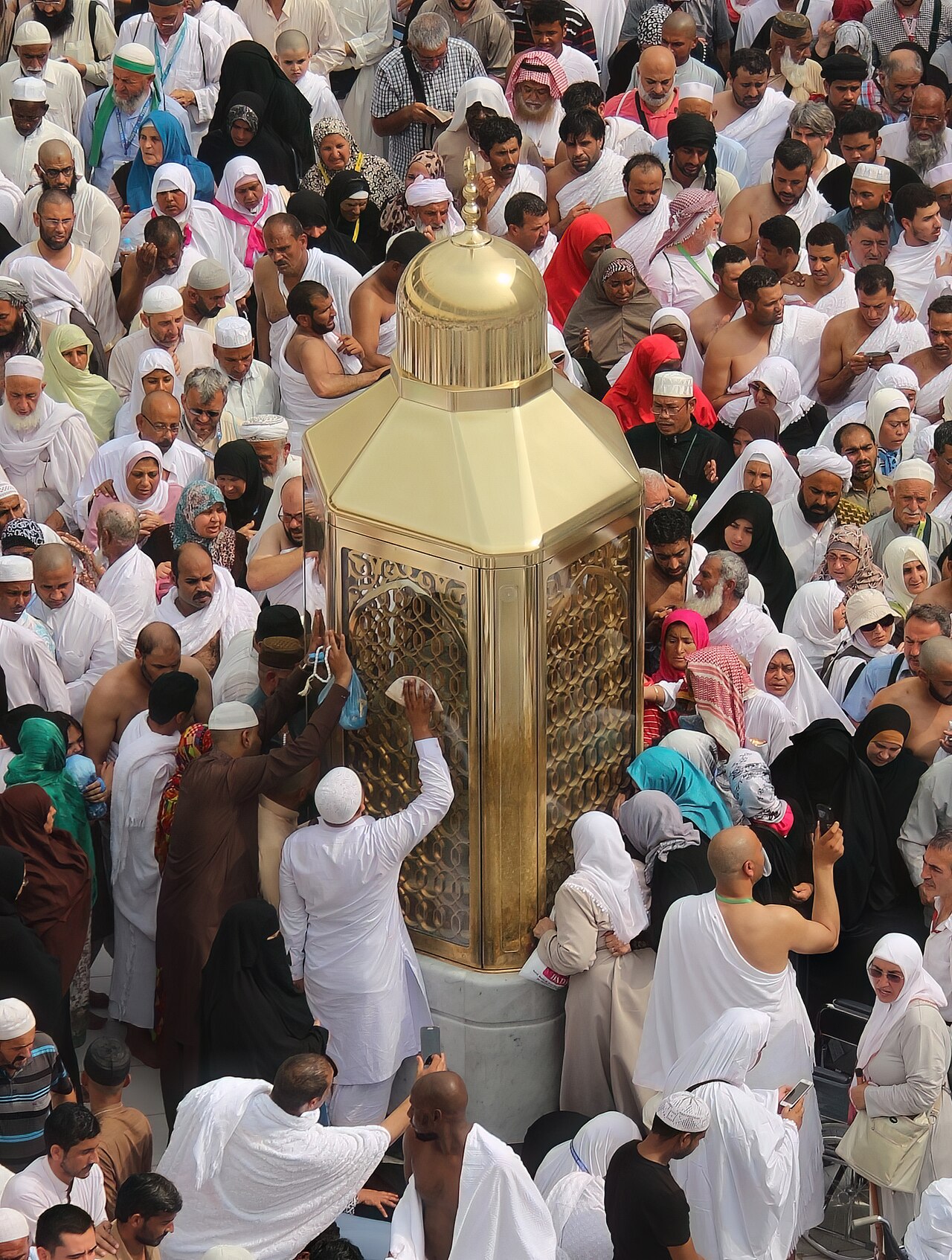
A few paces from the Kaaba stands a golden crystal enclosure over a small stone bearing an imprint that tradition associates with the feet of Prophet Ibrahim, who is said to have stood upon it as the walls rose. After completing tawaf, pilgrims offer two rak'ahs of prayer behind it, following the Quran's instruction to take the standing place of Ibrahim as a place of prayer.
3
Zamzam and the Mas'aa
The well of Zamzam lies about twenty metres east of the Kaaba, and its water is shared freely with pilgrims throughout the mosque. Along the eastern side runs the Mas'aa, the enclosed marble gallery joining the hills of Safa and Marwa, about 450 metres end to end. Walking its seven crossings in sa'i, a little over three kilometres, retraces Hajar's search for water for her son.
The golden crystal enclosure of Maqam Ibrahim before the Kaaba in al-Masjid al-HaramPilgrims performing the farewell tawaf around the Kaaba at the close of Hajj
The Haram at prayer · photos CC BY-SA, Wikimedia Commons
THE PILGRIMAGE OF A LIFETIME
Hajj, the fifth pillar
Once a year, in the days of 8 to 13 Dhu al-Hijjah, the Haram becomes the heart of the largest recurring gathering of worship on earth. Pilgrims enter ihram at the miqat boundaries, circle the Kaaba in tawaf, walk the sa'i between Safa and Marwa, then move out to Mina, the plain of Arafah and Muzdalifah before returning for the tawaf of the pilgrimage. In 1448 AH the Hajj window falls around 14 to 19 May 2027, with the exact days confirmed by the sighting of the new moon. Hajj places are allocated by permit only, through the Nusuk Hajj platform and each country's authorized channels.
Umrah, the shorter pilgrimage, is performed through most of the year with a free permit booked on the Nusuk app; check current permit windows there, as the umrah calendar pauses around the days of Hajj.
Plan your visit
By air
King Abdulaziz International Airport in Jeddah is the gateway to Makkah; the Haramain railway runs from its own station inside the airport, and taxis and buses cover the road route.
By rail
Haramain High Speed trains reach Makkah from Jeddah's Al-Sulimaniyah station in about 43 minutes, with stations also at Jeddah airport and Madinah. Makkah station stands in the Rusayfah district, linked by a park and ride toward the Haram.
Ihram
Pilgrims for umrah or Hajj enter ihram before crossing the miqat boundaries on the routes into Makkah; those flying in assume it before the miqat passes. Men wear two unstitched white cloths; women wear their ordinary modest dress.
Permits
Entry to the city is reserved for Muslims. Umrah requires a free permit booked through the official Nusuk app of the Ministry of Hajj and Umrah; Hajj is by allocated permit only.
Timings
The mosque lives around the five daily prayers, Fajr, Dhuhr, Asr, Maghrib and Isha, with Jumu'ah replacing Dhuhr on Friday; tawaf continues between them through the day and the night.
Best time
Makkah is hot for much of the year; many pilgrims choose the night hours and the stillness after Fajr for tawaf, and the winter months for gentler days.
The sa'i
The gallery between Safa and Marwa is about 450 metres each way; the seven crossings of sa'i total a little over three kilometres, level, enclosed and cooled.
Haram means sanctuary: within the sacred boundary of Makkah, fighting, hunting and the uprooting of green things are forbidden by sacred law, a peace that frames the whole city.
The miqat boundaries where ihram begins, among them Dhu al-Hulayfah, al-Juhfah, Qarn al-Manazil and Yalamlam, were fixed by the Prophet Muhammad, peace be upon him, and still govern every approach to Makkah.
You cannot reach the Black Stone in a crowd, and you are not required to: raising a hand toward it with the takbir from any distance is fully sufficient, and pushing others contradicts the spirit of tawaf.
Saudi Quran TV, the Kingdom's official channel, broadcasts the Haram live around the clock, carrying the five prayers and the Friday khutbah from the mosque to the world.
Questions pilgrims ask
Do Muslims worship the Kaaba?
No. Muslims worship Allah alone. The Kaaba is the qibla, the shared direction that gathers the prayer of the whole world into one orientation. It is honored as Bayt Allah, the House of Allah, but it is never the object of worship.
Can non-Muslims visit al-Masjid al-Haram?
No. Entry to Makkah, including the Haram, is restricted to Muslims. This listing exists for the informational and devotional reference of Muslim devotees worldwide, and for the respectful understanding of everyone else.
Do I need a permit for umrah?
Yes. Umrah pilgrims book a free permit through the official Nusuk app of the Ministry of Hajj and Umrah, choosing a date and time slot; the digital permit carries a QR code that may be checked on entry. Hajj is separate, allocated by country through official channels.
What is the difference between Hajj and umrah?
Hajj is the fifth pillar of Islam, performed only in the fixed days of 8 to 13 Dhu al-Hijjah and obligatory once in a lifetime for every Muslim who is able. Umrah is the shorter pilgrimage of tawaf and sa'i, and may be performed through most of the year.
Does the tawaf ever stop?
It pauses when the congregation lines up for each of the five daily prayers, and in rare exceptional circumstances. Otherwise, by day and by night, in every season, the circling of the Kaaba continues.
The Sthan in photographs
Darshan from afar
From the temple's own channels. Nothing loads until you press play.
Dharamshalas and guest houses near this Sthan, shared by devotees. Adisthan takes no bookings and no money; contact each stay directly.
No stays are listed here yet. Know one that serves pilgrims well?
Do you serve with the official custodianship of the Grand Mosque or an authorized body of the Two Holy Mosques? Claim this page to keep its guidance exact for the pilgrims of Allah.