Madinah al-Munawwarah · Madinah Province, Saudi Arabia
The Prophet, peace be upon him, built this mosque with his hands; now it holds him, and the world comes to greet him.
Be the first to check in
Coming up: Ramadan at the Prophet's Mosque · 8 FebEntry tended 11 Jul 2026
Mosque reserved for Muslims Open around the clock The Rawdah · free Nusuk permit The Green Dome · domed since 1279 Ramadan · from about 8 Feb 2027 Free entry
You cross marble that stays cool underfoot while the sky is still dark, and overhead the great umbrellas unfold in silence, a garden of canvas opening at dawn. Pigeons wheel over white minarets, and ahead, past rank upon rank of worshippers, rises a single dome the colour of deep jade. Know this before you plan: the mosque and the central district of Madinah around it are reserved for Muslims, and this page serves the devotional reference of Muslim devotees worldwide. Beneath the Green Dome rests the Prophet himself, peace be upon him.
The Prophet Muhammad, peace be upon him, built this mosque with his own hands in 622 CE, the first year of the hijrah, beside the room where he lived. In that room he passed from this world, and there he rests, with his companions Abu Bakr and Umar, may Allah be pleased with them, beside him.
One prayer here outweighs a thousand. The Prophet, peace be upon him, said that a prayer in this mosque of his is better than a thousand prayers anywhere else, except al-Masjid al-Haram (Sahih al-Bukhari 1190; Sahih Muslim 1394).
Between his house and his minbar lies the Rawdah, of which he said it is a garden from the gardens of Paradise (Sahih al-Bukhari 1195, 1196). Pilgrims book a free permit for a few minutes of prayer on its carpets.
The mosque the Prophet built
When the Prophet Muhammad, peace be upon him, reached Madinah in 622 CE after the hijrah from Makkah, every family begged him to stay with them. Tradition tells that he let his camel walk free, saying she was under Allah's command, and where she knelt the mosque would rise. The land belonged to two orphan boys and was bought fairly, and the Prophet worked alongside his companions, carrying the mud bricks and palm trunks himself. The first mosque was of the simplest kind: earthen walls, a roof of palm fronds, and the rooms of his household along one side.
For ten years this courtyard was the heart of the first Muslim community, its place of prayer and counsel, its school, and the shelter of its poorest, the people of the Suffa, who slept along its shaded wall. In the year 632 the Prophet, peace be upon him, passed from this world in the room of his wife Aisha, may Allah be pleased with her, and was buried where he died, for so, tradition holds, the prophets are buried. Abu Bakr was laid beside him, and then Umar, may Allah be pleased with them both.
Caliphs and dynasties enlarged the mosque century after century, always keeping the sacred chamber at its heart. The Mamluk sultan Qalawun raised the first dome over the chamber in 1279, and in 1837 the Ottomans painted the present brick dome the green the world now knows. The Saudi expansions have carried the mosque outward until it holds about a million worshippers, yet at its centre it is still what it was: the mosque beside the Prophet's home.
What you'll actually see
1
The Green Dome and the Sacred Chamber
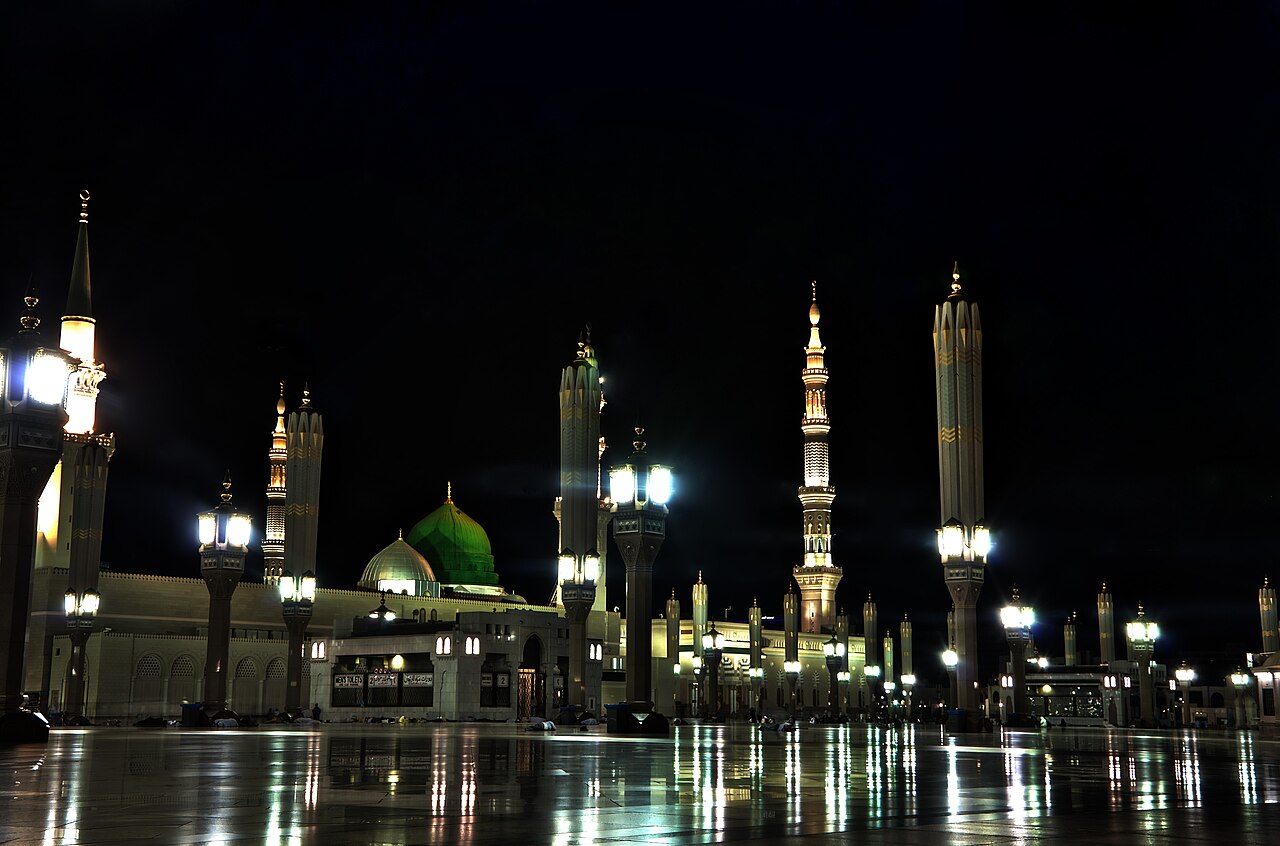
Above the southeastern corner of the old mosque rises the Green Dome, built in brick, covered in lead, and painted green in 1837. Beneath it is the chamber that was once the room of Aisha, may Allah be pleased with her, holding the graves of the Prophet, peace be upon him, and of Abu Bakr and Umar, may Allah be pleased with them. Visitors pass slowly before the golden grilles to offer salam, faces turned toward the grave, voices low.
2
The Rawdah
Between the Prophet's minbar and the sacred chamber lies the Rawdah, the area his own words called a garden from the gardens of Paradise. Carpets of pale green mark it out from the red carpets of the rest of the mosque. Entry is by a free timed permit booked on the Nusuk app, with separate schedules for men and for women, and the minutes inside are few and unforgettable.
3
The umbrella courts
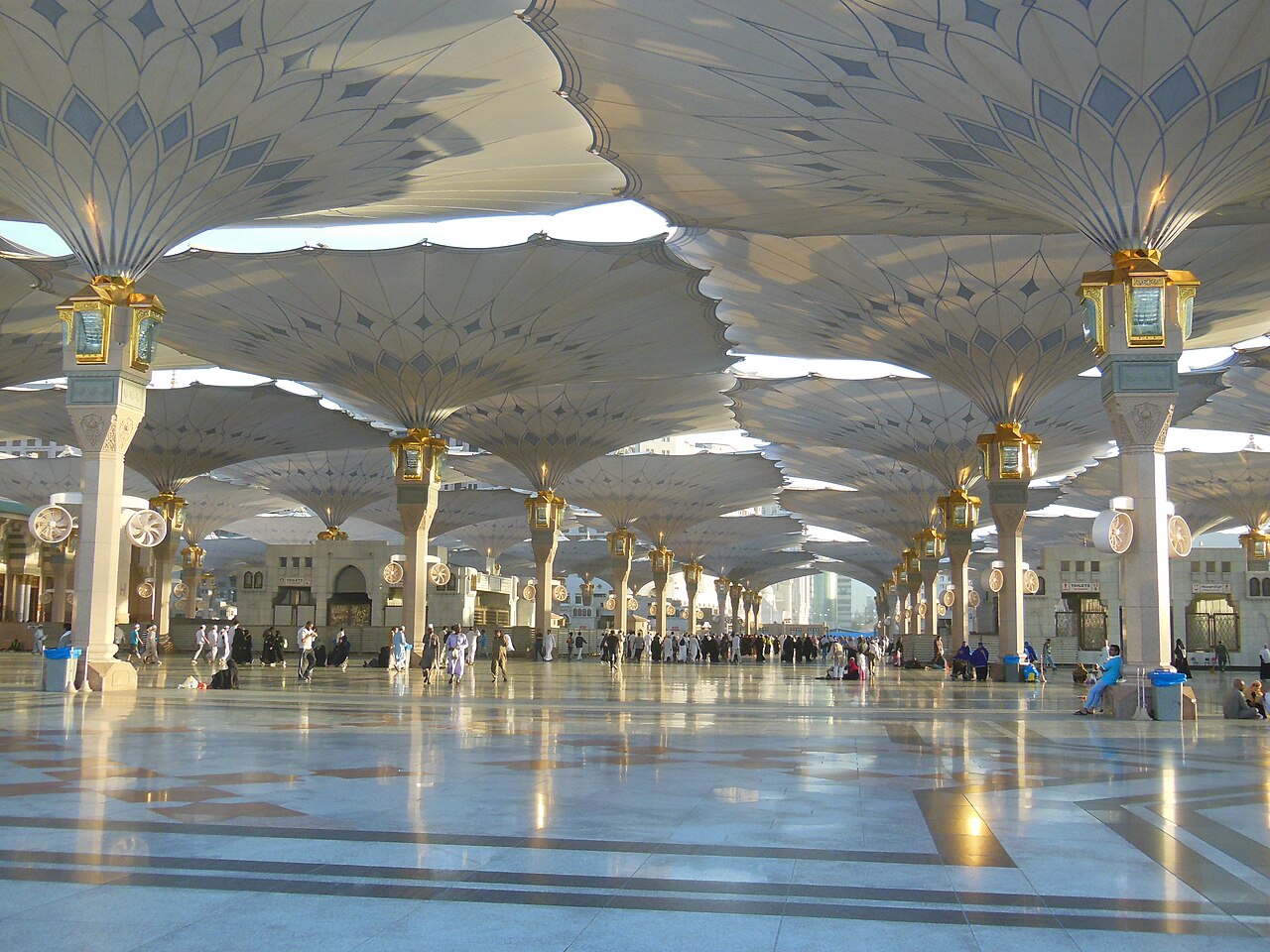
In the courtyards stand 250 giant folding umbrellas, completed in 2010 by the German engineering firm SL Rasch. Each spans 25.5 metres square, opens or closes in about three minutes, and together they overlap into a continuous canopy sheltering as many as 250,000 worshippers, cooling the marble piazzas by around eight degrees in the Hijaz heat.
The great retractable umbrellas open over the courtyards of the Prophet's MosqueAl-Masjid an-Nabawi glowing at night, its minarets lit above the marble courts
The Prophet's Mosque by day and by night · photos CC BY-SA and CC0, Wikimedia Commons
A GARDEN OF PARADISE ON EARTH
A few minutes in the Rawdah
The Prophet, peace be upon him, said: what is between my house and my minbar is a garden from the gardens of Paradise (Sahih al-Bukhari 1195, 1196; Sahih Muslim 1391). To pray in that small space is the longing of every visitor to Madinah. Entry is regulated by a free permit booked through the official Nusuk app of the Ministry of Hajj and Umrah, under Prophet's Mosque services, with separate visiting schedules for men and for women. Slots are released only days ahead and are taken within moments, and the time inside is short, on the order of ten to fifteen minutes, moving with the flow of pilgrims.
Book the moment slots open and keep your travel dates flexible; and if the permit never comes, remember that every prayer anywhere in this mosque already carries the thousandfold reward.
Plan your visit
By air
Prince Mohammad bin Abdulaziz International Airport (MED) serves Madinah, roughly 15 to 20 km from the mosque, about 20 to 25 minutes by taxi.
By rail
Haramain High Speed trains link Madinah with Makkah in about two hours, with stations at Jeddah and inside Jeddah airport. Madinah station stands on King Abdulaziz Road, a short taxi ride from the Haram.
Permits
The mosque is free and open to Muslims; no permit is needed for general prayer. The Rawdah requires a free timed permit booked on the official Nusuk app.
Timings
The mosque is in practice open around the clock, living around the five daily prayers, Fajr, Dhuhr, Asr, Maghrib and Isha, with Jumu'ah replacing Dhuhr on Friday.
Best time
The stillness after Fajr and the late night are the gentlest hours; winter months bring kinder weather, while Ramadan brings the greatest crowds and the greatest reward.
Dress
Modest dress throughout: men in clothing covering the shoulders and knees, women in loose dress with the hair covered, as is the custom of the mosque.
Ziyarah nearby
Quba Mosque, the first mosque of Islam, stands in the south of the city; Mount Uhud and the graves of its martyrs lie to the north. Both are visited from the Prophet's Mosque by short taxi rides.
Madinah al-Munawwarah means the radiant city; the mosque and the central Haram district around it are reserved for Muslims, while the wider city, its hotels, markets and museums, is open to visitors of all faiths.
The etiquette of ziyarah is quietness: the Quran commanded the believers not to raise their voices above the voice of the Prophet (Quran 49:2), and the mosque keeps that hush around his resting place to this day.
The Prophet, peace be upon him, used to visit Quba Mosque every Saturday, and said that whoever purifies at home and prays there has the reward of an umrah.
Saudi Sunnah TV, the official channel of the Saudi Broadcasting Authority in Madinah, streams the mosque live around the clock, carrying the five prayers and the Friday khutbah to the world.
Questions pilgrims ask
Do Muslims worship at the Prophet's tomb?
No. Worship is for Allah alone. Visiting the Prophet, peace be upon him, is a greeting: pilgrims stand before the chamber, offer salam upon him and his two companions, and move on. Prayer in the mosque, like prayer everywhere, is directed only to Allah.
Can non-Muslims visit Al-Masjid an-Nabawi?
No. The mosque and the central Haram area of Madinah are reserved for Muslims. Unlike Makkah, the rest of Madinah city is open to visitors of all faiths, and non-Muslim travellers may stay in the city and see the mosque from beyond the marked boundary. This listing exists for the devotional reference of Muslim devotees worldwide.
Do I need a permit to pray in the mosque?
No permit is needed to enter and pray in the mosque itself, at any hour. Only the Rawdah, the small garden area between the minbar and the sacred chamber, requires a free timed permit booked through the official Nusuk app, with separate schedules for men and for women.
What is the reward of praying here?
The Prophet, peace be upon him, said that one prayer in this mosque of his is better than a thousand prayers anywhere else, except al-Masjid al-Haram in Makkah (Sahih al-Bukhari 1190; Sahih Muslim 1394).
Is the mosque ever closed?
In practice, no. It is generally open regardless of date or time, day and night, and has closed to visitors only once in modern times, during the pandemic of 2020.
The Sthan in photographs
Darshan from afar
From the temple's own channels. Nothing loads until you press play.
Dharamshalas and guest houses near this Sthan, shared by devotees. Adisthan takes no bookings and no money; contact each stay directly.
No stays are listed here yet. Know one that serves pilgrims well?
Do you serve with the official custodianship of the Prophet's Mosque or an authorized body of the Two Holy Mosques? Claim this page to keep its guidance exact for the visitors of the Prophet's city.