Here the long walking ended, and impermanence taught its final lesson.
Be the first to check in
Coming up: Parinirvana Day · 15 FebEntry tended 28 Jun 2026
Kushinagar, Uttar Pradesh, near the Nepal border Open 6 am to 8 pm daily, entry free The 6.1 m reclining Buddha, Gupta era Buddha Purnima · 20 May 2027 Temple rebuilt 1956 over an Ashokan stupa core Ramabhar cremation stupa, 1.5 km east
You come off the Kushinagar road onto a walled brick platform, and the Temple rises ahead of you under a curved, boat-shaped roof, a white stupa dome swelling behind it. Inside, barefoot, the air cools and quiets. A gilded figure lies the length of the chamber, on its right side, eyes half closed, one hand a pillow beneath its head. Saffron and crimson cloth is draped fold on fold across the shoulders, left by hands that came before yours. No one stands here. Everyone, in spirit, lies down beside him.
The Mahaparinibbana Sutta records that the Buddha, gravely ill after forty five years of teaching, ordained his last disciple, Subhadda, spoke his final counsel to the Sangha on this ground, and passed into parinirvana: the final extinguishing beyond birth and death.
The reclining image at the heart of the shrine is cut from a single block of Mathura sandstone, 6.1 metres long, laid on its right side with its head to the north and its face turned west. An inscription on the platform names the donor, the monk Haribala, and the sculptor, Dinna, and dates the gift to the fifth century CE, the reign of the Gupta emperor Kumaragupta.
Kushinagar is one of four places the Buddha himself named worthy of pilgrimage: Lumbini where he was born, Bodh Gaya where he woke, Sarnath where he first taught, and this ground, where he died. His body was carried a short distance to be cremated; that separate mound, now called Ramabhar Stupa, still stands 1.5 kilometres from this door and is not to be mistaken for this one.
The last teaching, and the last words
Tradition holds that the Buddha, in his eightieth year and gravely ill, chose to travel on to Kushinagar rather than die anywhere else, and asked his attendant Ananda to prepare a couch between a pair of sal trees, his head to the north. The Mahaparinibbana Sutta records that a wandering ascetic named Subhadda came seeking him that last night and was ordained on the spot, becoming, tradition says, the Buddha's final direct disciple. To the monks gathered around him the Buddha gave his last counsel, then spoke his final words: vayadhamma sankhara, appamadena sampadetha, all conditioned things are impermanent, strive on with diligence. He then passed, through the stages of meditative absorption, into parinirvana.
The emperor Ashoka is said to have come here around 260 BCE and raised the first stupa and shrines over the spot. Building continued outward from that core through the Kushan centuries and into the Gupta age, when, in the fifth century CE, the monk Haribala gave the great reclining image, carved by the sculptor Dinna, and the Temple that housed it was raised in grander form. The Chinese pilgrim Xuanzang found the vaulted chamber and its statue still standing when he passed through in 637 CE.
Centuries of neglect buried the site until 1876, when the excavator A.C.L. Carlleyle, working from clues Alexander Cunningham had matched to Xuanzang's account, uncovered the shrine and found the great statue broken into fragments. The Archaeological Survey of India pieced it back together and restored the Temple by March 1877. The present Temple building is newer still: it was raised by the Government of India in 1956, to mark the 2,500th year of the Buddha's parinirvana in the Buddhist calendar, so that the ancient statue found a dignified home again.
What you'll actually see
1
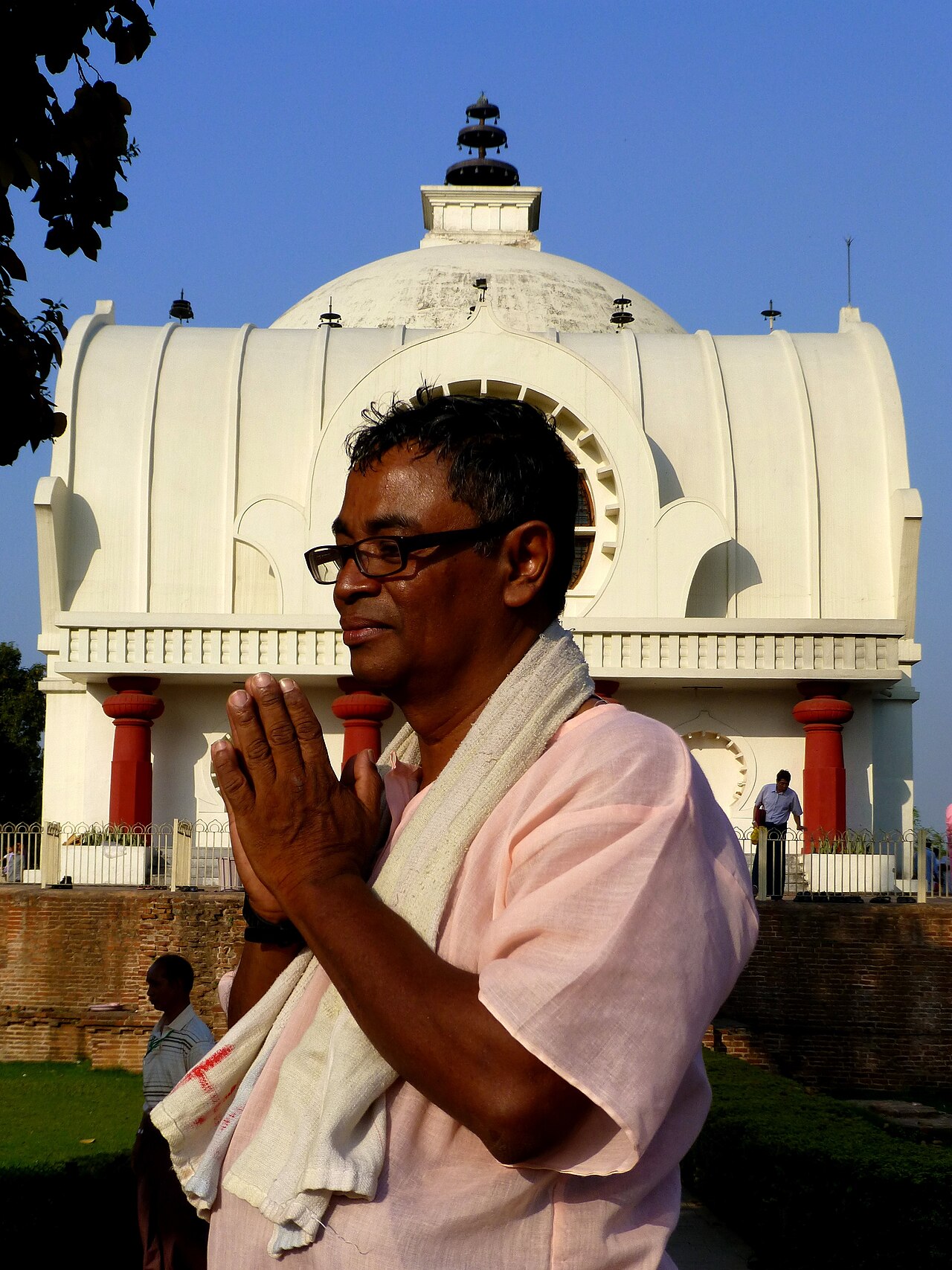
The white vaulted Temple and the stupa behind it
The Temple's low, boat-shaped roof, ribbed in plaster and pierced with two great round windows, sits in front of a tall white stupa dome. Red-painted columns line its porch, and the whole structure rises from an excavated brick platform, the footprint of older shrines beneath it.
2
The gilded reclining Buddha
Inside, the 6.1 metre stone image lies the length of the chamber, gilded and draped in cloth offered by pilgrims, layer over layer of saffron and crimson silk. Devotees circle it barefoot, chanting quietly in whatever tongue they carry: Pali, Thai, Sinhala, Tibetan, Japanese.
3
The excavated platform and its relief panels
At the statue's base, carved relief panels uncovered in the same 1876 excavation show mourning figures from the moment of the Buddha's death. The brick platform beneath the Temple, 2.74 metres high, is itself part of that excavation, the ground floor of shrines built and rebuilt across fifteen centuries.
Close view of the gilded face of the reclining Buddha statue at the Parinirvana Temple, draped in offered clothA devotee praying with folded hands before the Parinirvana Temple at Kushinagar
The gilded face of the reclining Buddha, and a pilgrim in prayer before the temple · photos by Photo Dharma (Anandajoti), CC BY 2.0, Wikimedia Commons
THE DAY OF BIRTH, AWAKENING AND DEATH
Buddha Purnima at the ground of the parinirvana
Everywhere else in the Buddhist world, the full moon of Vaishakha marks the Buddha's birth and his enlightenment. Here it completes itself: the same day is held to mark his parinirvana too, so Buddha Purnima returns, at Kushinagar, to the very ground of the event it partly commemorates. Monks and lay pilgrims from Thailand, Myanmar, Sri Lanka, Tibet and beyond gather at the reclining Buddha to chant, to drape fresh cloth over the statue, and to sit through the day in quiet observance. The next Buddha Purnima falls on Thursday, 20 May 2027.
Arrive at first light if you want the chamber quiet before the day's crowds and chanting groups fill it.
Plan your visit
By air
Kushinagar International Airport (KBK) is about 8 km from the Temple but has limited direct flights; Gorakhpur's airport, about 53 km away, has far more connections.
By rail
Gorakhpur Junction, roughly 50 km away, is the nearest major railhead with frequent long-distance trains; Kushinagar's own small station has very limited services.
By road
Gorakhpur is about 53 km away, Varanasi about 230 km (5 to 6 hours); taxis and buses run the route.
Timings
The Temple and stupa grounds are open 6 am to 8 pm daily, and entry is free.
Dress
Shoes come off before the Temple threshold; shoulders and knees covered is the custom, as at any Buddhist shrine.
Best time
Early morning or dusk, when lamps are lit and the chamber is quietest; October to March brings cooler, more comfortable weather.
Nearby
The Ramabhar cremation stupa is 1.5 km east; the Matha Kuar shrine, with its own seated Buddha image, is a few hundred metres away.
Kushinagar takes its name from Kusinara, the Malla kingdom's capital in the Buddha's time; today's town sits over that ancient ground, rebuilt around the excavated shrines.
This is an Archaeological Survey of India protected monument, not a Temple with a resident priesthood, so there is no fixed daily liturgy; the chanting you hear is pilgrims and visiting monastic groups, not a scheduled service.
Do not confuse this Temple with the Ramabhar Stupa 1.5 km away: this is where the Buddha died, Ramabhar is where his body was cremated. Many pilgrims walk both in one visit.
Kushinagar's other monasteries, built by Myanmar, Thailand, Japan and other Buddhist nations, sit within a short drive and each keeps its own hours and customs; they are separate institutions from this ASI site.
Questions pilgrims ask
Is this the exact spot where the Buddha died?
It is the spot the tradition and the archaeology agree on: excavation here uncovered a shrine, a stupa core going back to Ashoka's time, and the great reclining statue, all built up around what generations held to be the place. No inscription fixes the ground to the metre, but this has been the recognised site of the parinirvana since at least Xuanzang's visit in 637 CE.
Is the reclining Buddha the same statue the Buddha's own contemporaries would have seen?
No. The statue was carved and installed in the fifth century CE, roughly a thousand years after the Buddha's death, a gift of the monk Haribala. It was found shattered into fragments during excavation in 1876 and pieced back together by the Archaeological Survey of India; the gilding and the draped cloth are added and renewed by pilgrims today.
How is this different from the Ramabhar Stupa?
This Temple marks where the Buddha died; Ramabhar Stupa, 1.5 km east, marks where his body was cremated. They are two separate sites a short walk apart, and most pilgrims visit both.
Can anyone enter, or is it Buddhists only?
Everyone is welcome, free of charge, from 6 am to 8 pm. Visitors are asked to remove their shoes, dress modestly, and keep their voices low; many who come are not Buddhist and simply wish to sit quietly.
Dharamshalas and guest houses near this Sthan, shared by devotees. Adisthan takes no bookings and no money; contact each stay directly.
No stays are listed here yet. Know one that serves pilgrims well?
Are you with the Archaeological Survey of India's Sarnath Circle, the Kushinagar district administration, or a monastery that keeps vigil at this shrine? Claim this page to keep its hours, festivals and history accurate for every pilgrim who comes.
.jpg/1280px-064_Parinirvana_Statue_Face,_Kusinara_(9239626994).jpg)