The old architect set a dome to answer Hagia Sophia, and called it the work of his mastership.
Be the first to check in
Coming up: Ramadan · 8 FebEntry tended 25 May 2026
Open around the five daily prayers Prayer hall under a single 31 m dome Mimar Sinan · built 1568 to 1575 Ramadan · expected from 8 Feb 2027 Free to enter · modest dress Crowns the skyline of old Ottoman Edirne
You see it long before you reach it: four needle-thin minarets and a great grey dome riding above the rooftops of Edirne, catching the light on the plain where three rivers meet. Climb to the walled forecourt, leave your shoes at the door, and step inside into one vast room of stone and light, no forest of columns, no dividing walls, only the eight tall piers lifting the dome and the mihrab glowing with Iznik blue at the far wall. The adhan still calls the town to prayer here, as it has for four and a half centuries.
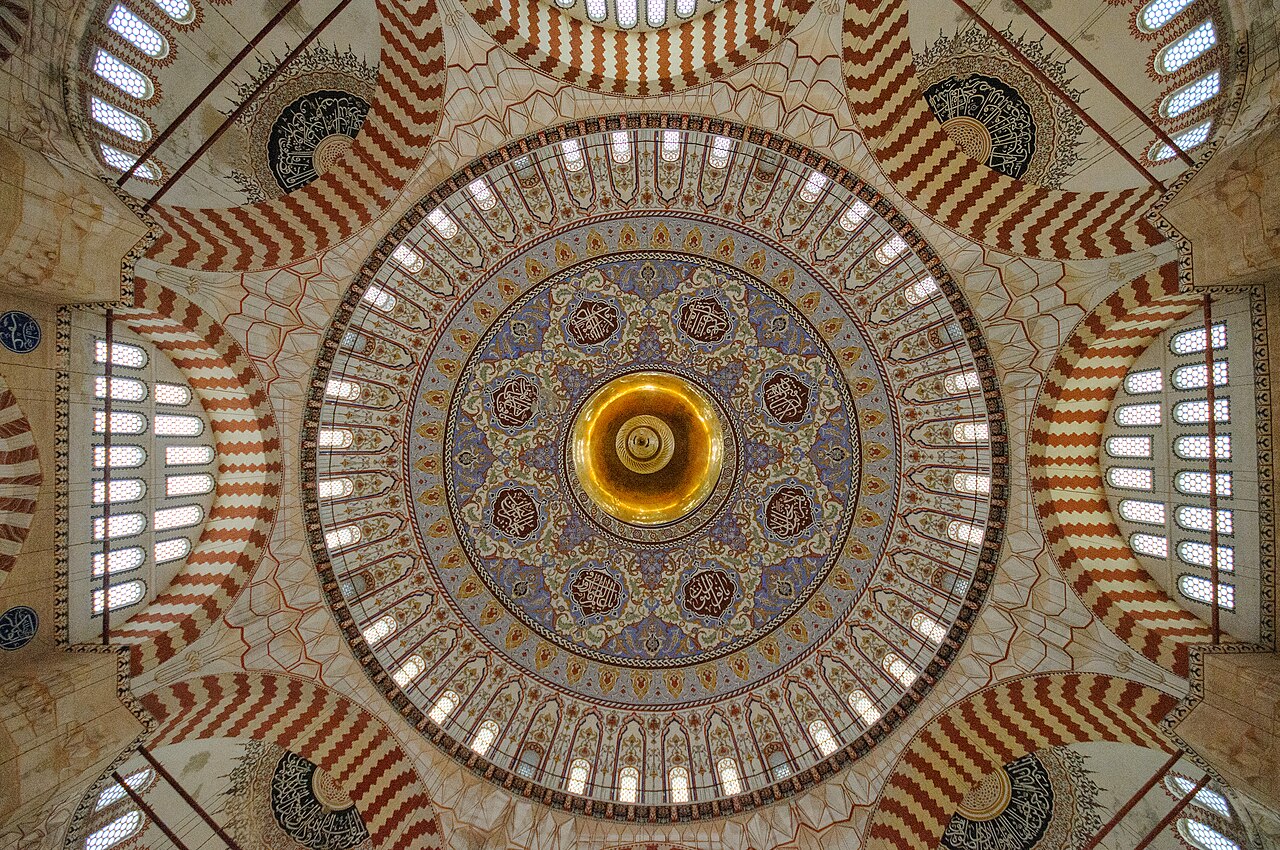
The dome Sinan built to rival Hagia Sophia. About 31.25 metres across and set on eight piers, it was the first Ottoman dome to match the span of the great church at Constantinople; Sinan's own biography claims he raised it six cubits higher and four cubits wider than Hagia Sophia's.
Four identical minarets, each about 70.89 metres tall, among the tallest in the whole Ottoman world. Sinan set them at the four corners of the prayer hall rather than around the courtyard, so that they frame the central dome instead of competing with it.
At the exact centre of the hall, directly beneath the dome, stands the raised muezzin mahfili, the singers' platform on twelve small arches. Placing it under the dome's crown was a stroke Sinan tried nowhere else, and beneath one of its marble feet is carved the famous upside-down tulip.
The work of Sinan's old age
Mimar Sinan, chief architect to the Ottoman sultans, was past eighty when he raised the Selimiye. He had already built the vast Suleymaniye in Istanbul, yet tradition holds that he named the Suleymaniye the work of his journeyman years and this mosque at Edirne the work of his mastership, his ustalik eseri. It was commissioned by Sultan Selim II and built between 1568 and 1575 in Edirne, the old European capital of the empire, on the highest ground in the city so that its dome would command the whole plain.
The problem Sinan set himself was the one that had haunted Ottoman builders for a century: to match, and answer, the immense dome of Hagia Sophia, the sixth-century church that the Ottomans had made their first great mosque. He solved it by carrying the dome not on heavy walls but on eight slender piers set in an octagon, opening the walls between them to a great many windows so that the interior floods with light and the eye meets one single unbroken space. In his biography, dictated to the poet Sai Mustafa Celebi, Sinan claimed he had built a dome six cubits higher and four cubits wider than Hagia Sophia's. In truth the two domes are close to the same width, but the achievement was real: for the first time an Ottoman mosque held its own beside the church that had awed its architects for generations.
The mosque never became a museum. Selim II died before it was finished; the empire that raised it is long gone; a cannonball scar from the Balkan Wars is still kept in its stone as a deliberate reminder. Yet five times a day the prayer is called from these minarets, and the town still gathers under Sinan's dome as it was built to do.
What you'll actually see
1
The courtyard and the four minarets
You enter through a colonnaded forecourt with a domed ablution fountain at its centre, where worshippers perform wudu before prayer. From here the four minarets rise sheer and fluted to about 70.89 metres, so slender they look drawn rather than built, and the dome floats grey and immense behind them.
2
The single domed hall
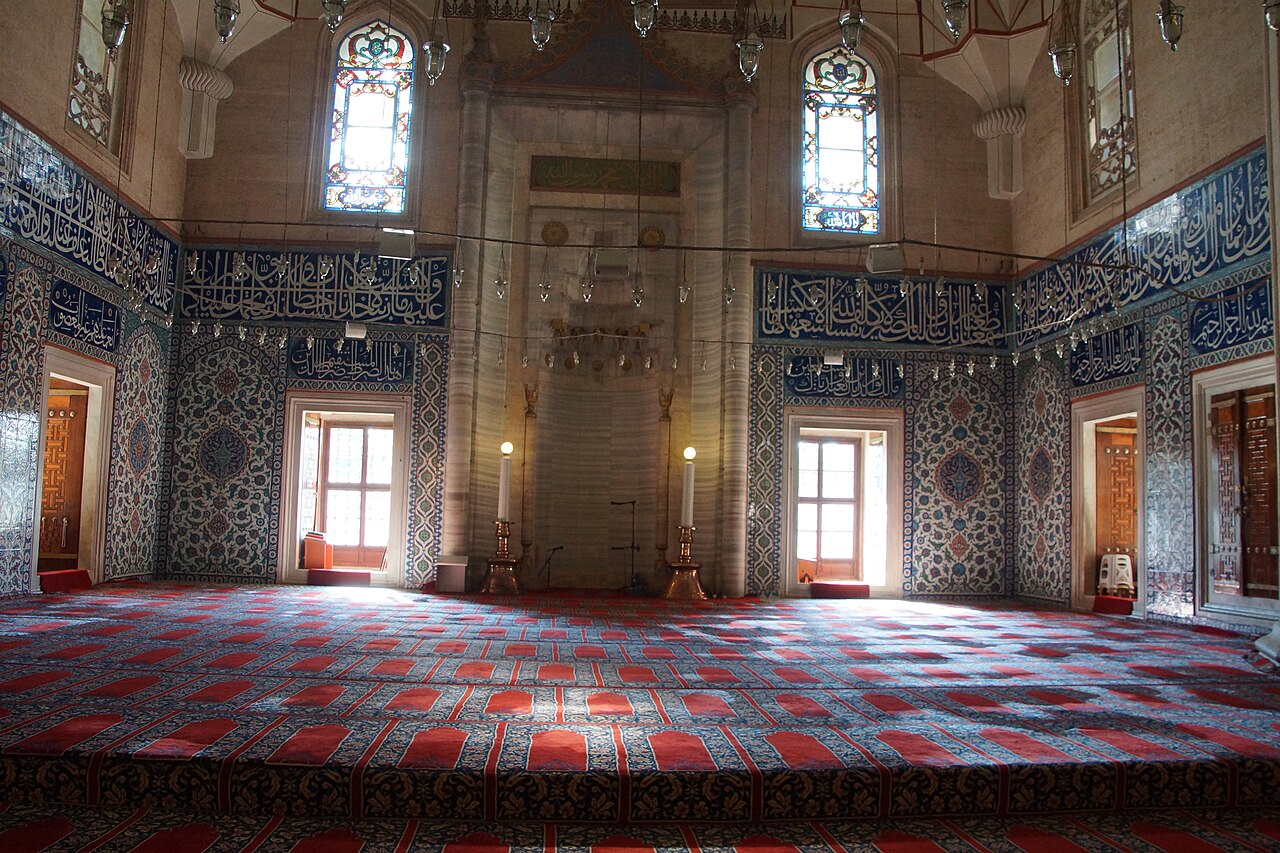
Inside there are no side aisles and no screen of columns, only one great room roughly square in plan, crowned by the dome on its ring of eight piers. Light pours from tiers of windows in the walls and drum. Stand at the centre and the whole space turns around you, the way Sinan intended, drawing every eye up to the painted crown of the dome.
3
The mihrab, minber and the singers' platform
At the qibla wall the marble mihrab sits in a shallow apse lit from three sides and framed by some of the finest Iznik tilework in Türkiye, deep blues, reds and the tulips and carnations of the Ottoman court. Beside it rises the carved marble minber, a masterwork of geometric stone. In the middle of the hall, on its twelve arches, stands the muezzin mahfili; look under its marble feet for the small reversed tulip.
The painted interior of the Selimiye Mosque's great dome, ringed with windows, seen from the prayer hall floorWorshippers and visitors in the single vast prayer hall of the Selimiye Mosque beneath Sinan's dome
The crown of Sinan's dome and the prayer hall it covers · photos CC BY-SA 4.0 (Tarik Kaan Muslu) and CC BY 2.0 (rob Stoeltje), Wikimedia Commons
THE MONTH THE MOSQUE FILLS TO ITS WALLS
Ramadan at the Selimiye · expected from about 8 February 2027
Through Ramadan the great single hall comes into its own. As maghrib nears, families gather to break the fast, and after the night prayer the tarawih is prayed in long rows across the whole floor, the dome overhead lit against the dark. On the mornings of Eid al-Fitr and Eid al-Adha the congregation fills the hall and spills into the forecourt for the festival prayer. Ramadan 1448 is expected to begin around 8 February 2027, with Eid al-Fitr expected around 10 March 2027, both subject to the sighting of the moon.
Come toward sunset on a Ramadan evening for the breaking of the fast and the night prayer; for the Eid morning prayer, arrive early, as the hall fills well before the takbir.
Plan your visit
By air
Edirne has no airport of its own. The nearest major gateway is Istanbul, about 230 km east; from either Istanbul Airport (IST) or Sabiha Gokcen, continue to Edirne by intercity bus or car.
By road
Edirne sits near the Greek and Bulgarian borders, roughly 2.5 hours by car from Istanbul on the O-3 motorway. Frequent intercity buses run from Istanbul's main coach terminal, taking around 3.5 hours; the mosque stands in the city centre, an easy walk from the bus connections.
Timings
An active mosque open every day, free of charge, roughly from the dawn prayer until the night prayer. It is busiest and briefly closed to sightseeing during each of the five daily prayers and for the Friday congregation around midday, so time a visit outside prayer times.
Entry
Free. There is no admission charge; a donation box helps maintain the mosque. Photography is generally allowed outside prayer times without flash; be discreet toward worshippers.
Dress
Modest dress for all: shoulders and knees covered. Women cover the hair; headscarves are usually available to borrow at the door. Shoes come off before you step onto the carpet.
Best time
Mid-morning or the last hours before sunset, between prayers, when the light through the many windows is at its finest and the hall is calm. Avoid arriving right at a prayer time or at Friday midday if you have come only to look.
Jumu'ah
The Friday midday prayer draws the largest weekly congregation. Worshippers should come early; those visiting only to see the building should choose another time out of respect.
The reversed tulip carved under the singers' platform has many tellings; the best-loved says the land belonged to a woman with a tulip garden who would sell only if something would remember her for as long as the mosque stood, and Sinan carved her tulip upside down as a gentle nod to her stubbornness.
The mosque is the heart of a kulliye, a social complex that with its madrasas, hadith school, covered arasta market and library was inscribed together on the UNESCO World Heritage List in 2011 as the Selimiye Mosque and its Social Complex.
A four-year restoration of the dome, minarets, stonework and calligraphy was completed and the mosque formally reopened in June 2026; it stayed open for worship throughout the work.
Edirne, called Adrianople in older books, was the Ottoman capital before Constantinople; the Selimiye is the crown of that lost imperial city.
Questions pilgrims ask
Can non-Muslim visitors go inside?
Yes. The Selimiye is a living mosque that welcomes respectful visitors of every faith outside prayer times. Dress modestly, remove your shoes at the carpet, keep quiet, and note that sightseeing pauses during the five daily prayers and the Friday midday congregation. Entry is free.
Did Sinan really surpass Hagia Sophia?
Sinan's own biography claims he built a dome higher and wider than Hagia Sophia's, and this is often repeated. In fact the two domes are close to the same span, around 31 metres. What is beyond dispute is that the Selimiye was the first Ottoman mosque to match Hagia Sophia's dome and to answer it with a single, unified, light-filled interior, which is why Sinan regarded it as his finest work.
Is the mosque still under restoration?
No. The major four-year restoration finished and the mosque was formally reopened in June 2026. It remained open for prayer during the work, and now stands fully accessible to worshippers and visitors.
What is the upside-down tulip everyone mentions?
It is a single tulip carved in reverse beneath one marble foot of the muezzin's platform at the centre of the hall. Several legends explain it, most famously the story of a stubborn landowner with a tulip garden; whatever its origin, it has become the mosque's most quietly loved detail.
How do I get there from Istanbul?
Edirne is about 230 km west of Istanbul, near the Greek and Bulgarian borders. By car it is roughly 2.5 hours on the motorway; frequent intercity buses take around 3.5 hours from Istanbul's main coach terminal. The mosque is in the city centre and easy to reach on foot once you arrive.
Dharamshalas and guest houses near this Sthan, shared by devotees. Adisthan takes no bookings and no money; contact each stay directly.
No stays are listed here yet. Know one that serves pilgrims well?
Do you serve the Selimiye Mosque or its foundation in Edirne? Claim this page to keep its prayer times, festival dates and guidance true for every worshipper and visitor who climbs to Sinan's dome.