Second only to Shatrunjaya among Śvētāmbara tirthas
Shankheshwar Parshvanath Jain Temple
Shankheshwar · Patan District, Gujarat, India
A conch sounded over a fallen army, and the sound became this town's name.
Be the first to check in
Coming up: Diwali · 8 NovEntry tended 24 May 2026
Darshan 5:30 am to 8:30 pm Posh Dashami · 2 Jan 2027 Present shrine completed 1811 Free entry About 125 km from Ahmedabad One of 108 named forms of Parshvanath
The road from Patan runs flat and dry until, without warning, a skyline of white shikharas breaks over the fields, dozens of them, ribboned with red dhajas that crack in the wind. Inside the gate, sandstone carving gives way to marble, and the crowd thins to a hush at the sanctum door. Ask any pilgrim here why they came and the answer repeats itself for centuries: not to see a Temple, but to see this idol, the one so many replica shrines elsewhere are named for.
Tradition holds that the mulnayak itself is impossibly old: an idol first worshipped in a former age of the world, carried through the realms of gods and serpent-kings before it ever reached human hands. The legend says Lord Krishna recovered it from the netherworld to revive his stricken army, then blew his conch in celebration and gave the town its name.
Shankheshwar is held by the Śvētāmbara Jain tradition to rank next only to Shatrunjaya at Palitana in importance, and the Shankheshwar Parshvanath form of the twenty-third Tirthankara is counted among the 108 principal named icons of Parshvanath, with replica shrines carrying its name across India and the diaspora.
Devotees still repeat Krishna's own penance. The attham, a continuous three-day fast, is kept here by the thousand on Posh Dashami, Parshvanath's birth-kalyanaka and the Temple's single largest day of the year.
The conch that named a town
Jain tradition does not date this idol to any one century; it dates it to before time was counted this way. The legend says a devotee named Ashadhi Shravak, tormented by questions about liberation, was told by Damodar Swami, the ninth Tirthankara, that he would one day become a chief disciple of a Parshvanath still to come. Absorbed in that promise, he consecrated an image so charged with power that gods worshipped it in heaven and serpent-kings in the netherworld, age after age, long before it touched Gujarat's soil.
Tradition brings it to Shankheshwar through Krishna. During his war with Jarasandha, the legend says, Jarasandha's Jara affliction struck Krishna's army senseless, and Neminath, the twenty-second Tirthankara and Krishna's own kinsman, counselled a three-day fast to reach the idol, buried in the netherworld. The serpent-king Dharanendra and the Goddess Padmavati brought it up; Krishna bathed his soldiers in its abhisheka water and they rose whole. In his relief he blew his conch, shankh, and the town took its name from the sound: Shankhapur, the idol Shankheshwar Parshvanath. Devotees still keep his three-day fast in memory of it.
The Temple's remembered history is a chronicle of ruin and rebuilding. Sajjan Shah renovated it beside the Rupen river in 1098, and in 1229 the minister-brothers Vastupala and Tejpala, fresh from raising Dilwara's Luna Vasahi, added fifty-two shrine-cells around the sanctum under Acharya Vardhamansuri's guidance. Invaders razed the Temple in the fourteenth century of the Vikram era and the idol was hidden for a generation before Acharya Vijaysensuri's inspiration brought a new Temple in its place; the Jain sangha rebuilt it again in 1703, and the shrine standing today was completed in 1811.
What you'll actually see
1
The rampart of fifty-two shrines
Pilgrims enter beneath a long sandstone wall carved in tight rows of dancing and music-making figures, and above it rises a rampart of white marble shikharas, each fronted by a slim dhaja pole and its knot of red cloth. The number remembers the fifty-two subsidiary shrine-cells Vastupala and Tejpala raised around the sanctum in 1229, each holding its own small Tirthankara image.
2
The mulnayak in the sanctum
At the centre sits the mulnayak, a white image of Parshvanath in padmasana close to six feet high, gold-crowned and garlanded, flanked by the smaller shrines of Bhidbhanjan Parshvanath and Ajitnatha. Nearby stand images of Dharanendra, Padmavati and Chakreshwari, the guardian figures the legend names in the story of how the idol reached this ground.
3
The 108 Parshwanath Bhaktivihar, a short walk away
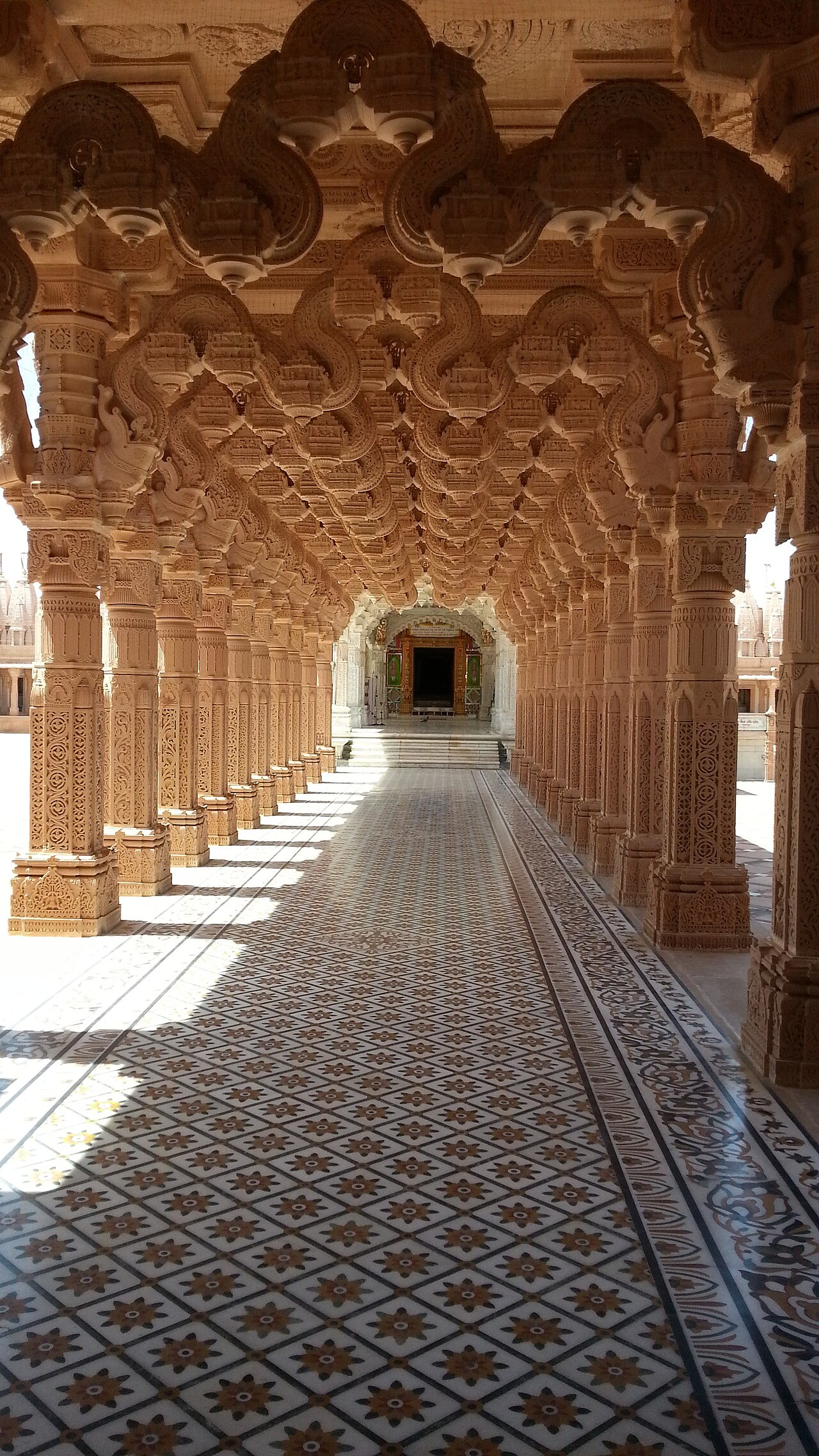
A separate, newer complex gathers all 108 named forms of Parshvanath under one roof, its idols consecrated in 1988 at the last wish of Acharya Bhaktisurishvarji. Pillared corridors in pale stone lead between shrine after shrine, each one a different regional Parshvanath, with a large dedicated image of the Goddess Padmavati among them.
Carved dancer and musician figures flank a mythical creature on the Temple's sandstone plinth, with small Tirthankara images seated in the niches beside themA pillared marble corridor at the 108 Parshwanath Bhaktivihar leads toward a shrine doorway
Carved plinth at the main temple photographed by Sanket Oswal, and the 108 Parshwanath Bhaktivihar corridor by Sejal.L.Shah, both CC BY-SA 4.0 · Wikimedia Commons
The festival found nowhere else
Posh Dashami · 2 January 2027
On Posh Vad Dashami, the day tradition holds as Parshvanath's own birth-kalyanaka, Shankheshwar draws its largest crowd of the year across a run of days centred on the tenth. Thousands undertake the attham, the continuous three-day fast that recalls Krishna's own penance before the idol was recovered, and worship continues at the sanctum from early morning into the night. Fresh dhajas are raised on the shikharas for the season, and the whole rampart of shrines flies red cloth against the winter sky.
The date follows the Jain lunar calendar and shifts every year; confirm it against a current panchang or with the Temple before travelling, and expect the dharamshalas to fill early.
Plan your visit
By rail
Radhanpur is the nearest railway station on the Western Railway line; Patan station, about 60 to 68 km away with direct trains from Ahmedabad, Mumbai and Jodhpur, is the better-connected railhead most pilgrims use.
By air
Sardar Vallabhbhai Patel Airport, Ahmedabad, about 120 to 125 km away, roughly 2.5 to 3 hours by road.
By road
National and state highways connect Shankheshwar to Ahmedabad, Patan and Radhanpur, with GSRTC buses running from major towns across Gujarat.
Darshan timings
Daily from about 5:30 am to 8:30 pm; the Temple keeps extended hours and night worship around Posh Dashami.
Best time
October to March for cooler travel, or Posh Dashami itself for the fullest experience of the Temple's worship, if the crowds don't trouble you.
Dress
Modest dress is expected: a dhoti or pajama with a covered upper body, or plain trousers and shirt, for men; a saree or chudidar for women. Leave shorts and sleeveless clothing behind.
Entry
Free for all visitors.
Nearby
The 108 Parshwanath Bhaktivihar and several smaller Jain Temples, including the Agam Mandir, stand within easy walking distance of the main sanctum.
Shankheshwar means Lord of the Conch: shankh for the conch Krishna is said to have blown here, ishwar for the Lord it names.
The idol is also called Shankheshwar Parshvanath, one of 108 principal named forms of Parshvanath in Śvētāmbara worship, and dozens of replica shrines elsewhere carry its name.
Shankheshwar sits in Patan district, though older writing sometimes places it in Mehsana district, the larger district Patan was carved from in 2000.
An upashray, an ayambilshala, a bhandar, a pathshala and a hall where food is given to pilgrims for their journey all serve the town's Temples, alongside its dharamshalas.
Questions pilgrims ask
Is the 108 Parshwanath Bhaktivihar the same Temple as the old Shankheshwar Parshvanath Temple?
No, they are two separate Temples a short walk apart. The original Shankheshwar Parshvanath Temple, its present structure completed in 1811 on far older foundations, holds the ancient mulnayak at the heart of the Temple's legends. The 108 Parshwanath Bhaktivihar is a newer, independently built complex whose idols were consecrated in 1988, gathering all 108 named forms of Parshvanath under one roof.
Why is the Temple called Shankheshwar?
Tradition traces the name to a conch, shankh. The legend says Krishna blew his conch here in relief after the recovered idol of Parshvanath revived his army against Jarasandha, and the town took its name, Shankhapur, from the sound.
What is Posh Dashami?
The day Jain tradition holds as Parshvanath's birth-kalyanaka, and Shankheshwar's single largest day of pilgrimage. Thousands keep the attham, a three-day fast, and the Temple fills through the night.
Can non-Jain visitors enter?
Yes, respectful visitors of any background are welcome during darshan hours, subject to the same modest dress expected of every pilgrim.
How old is the idol really?
No one dates it by century. Jain tradition holds it was first worshipped in an earlier age of the world, long before it reached Shankheshwar. The Temple building itself, rebuilt many times after invasions and repairs, dates in its present form to 1811.
Dharamshalas and guest houses near this Sthan, shared by devotees. Adisthan takes no bookings and no money; contact each stay directly.
No stays are listed here yet. Know one that serves pilgrims well?
Are you a trustee or pujari of the Shankheshwar Parshvanath Temple or the 108 Parshwanath Bhaktivihar? Claim this page to confirm current darshan timings, Posh Dashami arrangements, and a way for pilgrims to reach the trust directly.