Sinan's journeyman work · Suleiman's imperial mosque
Süleymaniye Mosque · Süleymaniye Camii
Süleymaniye · Fatih, Istanbul
On the Third Hill, an empire's golden age raised in stone, and still called to prayer.
Be the first to check in
Coming up: Ramadan · 8 FebEntry tended 25 May 2026
Süleymaniye · Fatih, Istanbul Free · closed to visitors at prayer times An active imperial mosque Dome 26.5 m wide · 53 m high Built 1550 to 1557 · Mimar Sinan Ramadan · from about 8 Feb 2027
You climb through the old booksellers' lanes of the Süleymaniye quarter, and the mosque opens above you: a wide forecourt of grey granite and marble, four minarets holding the corners of the sky, and behind them the great lead dome riding the crest of Istanbul's Third Hill. Step inside and the space lifts, calm and full of light, under a low ring of lamps and a wall of coloured glass. From the terrace the whole Golden Horn lies at your feet. This is the mosque an empire built at the height of its power, and the work its greatest architect called his journeyman's proof.
The imperial architect Mimar Sinan raised it between 1550 and 1557 for Sultan Suleiman the Magnificent. In his own reckoning, recorded in his memoirs, he set it between the Şehzade Mosque of his apprenticeship and the Selimiye of Edirne, his masterwork: the Süleymaniye, he said, was the work of his journeyman years, and it crowns the Third Hill of the old city.
The central dome spans about 26.5 metres and rises some 53 metres above the floor, answering the Hagia Sophia across the skyline. Four minarets stand at the corners of the courtyard bearing ten balconies in all, which tradition reads as Suleiman being the fourth sultan to reign in Istanbul and the tenth of the Ottoman line.
It was never a mosque alone but the heart of a külliye, a whole quarter of charity: four madrasas, a medical school and hospital, a caravanserai, a hamam, and an imaret that cooked for the poor. In the walled garden behind the qibla wall lie the domed tombs of Suleiman and of Hurrem Sultan, and just outside the corner of the complex, the modest tomb of Sinan himself.
The Magnificent age, set in stone
By 1550 Suleiman the Magnificent ruled from the Danube to the Gulf, and he asked his chief architect Sinan for a mosque worthy of that reach. Sinan answered on the Third Hill with a building of granite, marble and lead that took seven years to raise and opened in 1557. Its prayer hall runs close to fifty-nine metres square under a dome the eye reads as weightless, its thrust carried down through four great columns that tradition holds were gathered from across the old world. Sinan braced the whole against the earthquakes that shake the city, and set ostrich eggs among the hanging lamps, believed to keep spiders and their webs from the vaults.
The mosque was only the centre of Suleiman's gift. Around it he endowed a külliye: colleges of law and tradition, a school of medicine and a hospital, a caravanserai for travellers, baths, and a public kitchen that fed the poor of the quarter without asking their faith. Charity and learning were built into the same foundation as prayer. In the garden behind the qibla wall the sultan and his wife Hurrem Sultan, known in Europe as Roxelana, were laid in two octagonal tombs; Sinan, who outlived them both, lies in a small tomb of his own design just beyond the walls.
The centuries tested it. A great fire scarred the complex in 1660 and was repaired under Sultan Mehmed IV; an earthquake damaged the dome in the eighteenth century, and the interior was worked over again in the nineteenth. Major restorations followed in the 1950s and, most recently, between 2007 and 2010. In 1985 UNESCO inscribed it within the Historic Areas of Istanbul, and through all of it the mosque has never stopped being a mosque, filling for the five daily prayers as it has for close to five hundred years.
What you'll actually see
1
The courtyard and the ablution
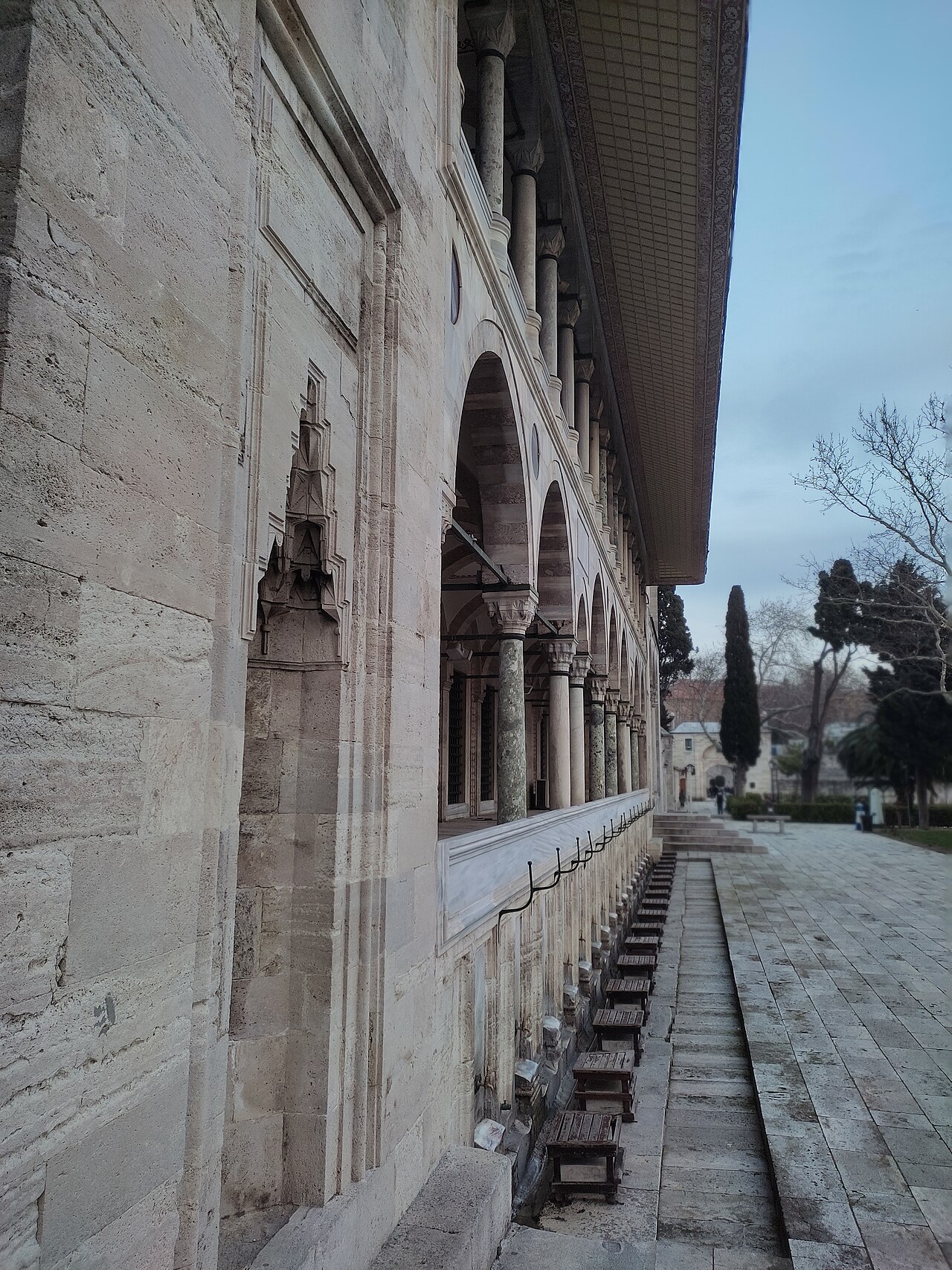
You enter through a colonnaded forecourt, its arcade of columns and small domes wrapping a marble pavement, with an ablution fountain at the centre and rows of taps set into the outer walls where worshippers perform wudu before prayer. From here the four minarets rise directly overhead, two taller pair reaching about seventy-six metres to their lead caps, and the mass of the dome gathers behind the entrance portal.
2
The prayer hall under the dome
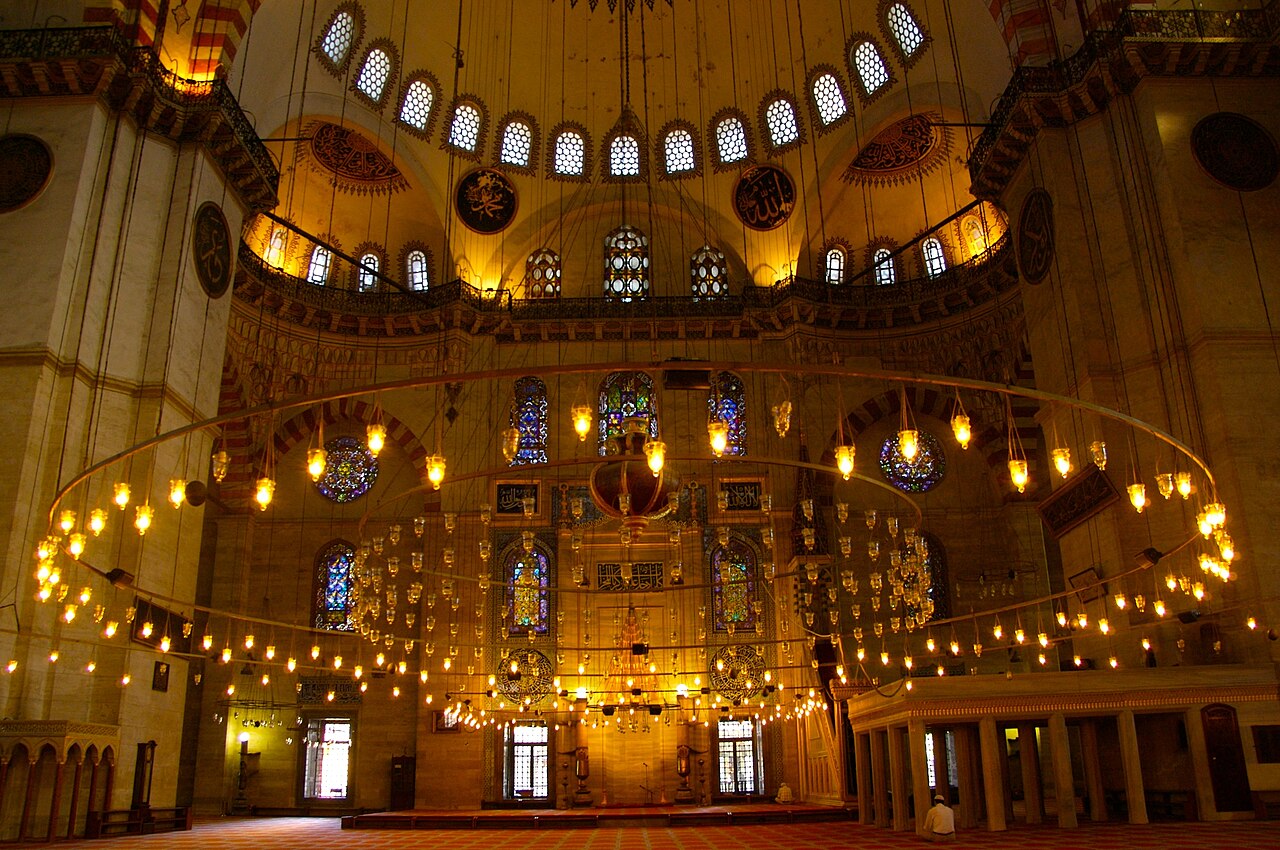
Inside, the hall opens as a single calm volume, the dome floating on half-domes and pierced with rings of windows so the light falls soft and even. A great iron hoop of oil lamps hangs low over the carpet. The mihrab and minbar are worked in carved marble, framed by İznik tiles and by stained glass in the qibla wall, and the ostrich eggs still hang among the lamps, Sinan's quiet guard against cobwebs.
3
The garden of tombs
Behind the mosque, in a walled cemetery garden, stand the two great türbe: Suleiman's, domed and octagonal, its interior set with tile and light, and beside it the tomb of Hurrem Sultan, tiled in İznik blossom. Later sultans and princes lie nearby. Step out of the far corner of the complex and you reach the small, plain tomb of Mimar Sinan, the architect who gave the hill its crown.
The interior of the Süleymaniye Mosque, the low iron ring of oil lamps hanging beneath the great dome and its ring of windows, with the tiled qibla wall beyondBrass ablution taps set into the marble outer wall of the Süleymaniye Mosque, with the arcaded gallery and courtyard behind
The prayer hall and the ablution taps · photos CC BY 2.0 (Minamie's Photo) and CC BY-SA 4.0 (Interfase), Wikimedia Commons
THE MONTH THE HILL FILLS AGAIN
Ramadan at the Süleymaniye · expected from about 8 February 2027
Through Ramadan the mosque keeps the rhythm of the fast with the old quarter around it. The fast breaks at maghrib, the night brings the long tarawih prayers under the dome, and in the Ottoman manner strings of mahya lights are hung between the minarets to spell blessings across the night sky. Laylat al-Qadr is sought in the last ten nights, and the Eid al-Fitr prayer at dawn gathers the largest congregation of the year. Ramadan 1448 is expected to begin around 8 February 2027, with Eid al-Fitr expected around 11 March 2027, both subject to the sighting of the moon.
Visitor access pauses for every congregational prayer and for longer at the Friday jumu'ah, so during Ramadan plan to come between prayer times and dress modestly.
Plan your visit
By air
Istanbul Airport (IST) serves the European side and Sabiha Gökçen (SAW) the Asian side. From either, the metro and tram network, or a taxi, brings you toward the old city and the Beyazıt district.
By tram and ferry
The T1 tram stops at Beyazıt-Kapalıçarşı and at Laleli-Üniversite, each about a ten-minute uphill walk to the mosque. From the Golden Horn, the Eminönü ferry pier is roughly a twenty-minute walk away.
On foot
The mosque crowns the Third Hill above the Grand Bazaar and the Spice Bazaar, reached by climbing through the Süleymaniye quarter's lanes of booksellers and old timber houses.
Timings
Open to visitors through the day, roughly from morning until early evening, but closed to visitors during each of the five daily prayers, about half an hour each time, and for longer on Fridays around midday for jumu'ah. Prayer times shift with the season, so the visiting windows move through the year.
Entry fee
Free. Unlike some sites in the old city, the Süleymaniye charges no admission; donation boxes inside support the upkeep of the mosque and its complex.
Dress
Modest dress for all: shoulders and knees covered, and women cover the hair with a scarf. Scarves are lent free at the entrance, and shoes come off before the prayer carpet.
Best time
Weekday mornings are quietest, before the tour groups arrive. Late afternoon light on the terrace is the finest hour for the view over the Golden Horn.
The mosque is named for its founder: Süleymaniye Camii means the mosque of Suleiman, and it stands over the quarter and the Third Hill that carry the same name.
Ostrich eggs hang among the chandelier lamps by long tradition, placed there in Sinan's day in the belief that they keep spiders and cobwebs from the vaults.
The terrace on the Golden Horn side of the complex gives one of the widest open views in the old city, across the water to Beyoğlu and the Galata Tower.
This is an active mosque, not a museum: enter quietly, keep phones silent, and wait outside the prayer hall while prayers are in progress.
Questions pilgrims ask
Is this the Blue Mosque?
No. The Süleymaniye is a different and older mosque, built by Sinan for Suleiman the Magnificent and finished in 1557, standing on the Third Hill above the Grand Bazaar. The Blue Mosque (Sultan Ahmed Mosque) is a later mosque near Hagia Sophia in Sultanahmet. The two are often confused because both are great domed imperial mosques of Istanbul.
Can non-Muslims visit, and is there a fee?
Yes, visitors of every faith are welcome, and entry is free. Come outside the times of the five daily prayers and the Friday jumu'ah, when the prayer hall is reserved for worshippers. Modest dress is required, and women cover the hair; scarves are available at the door.
When is it closed to visitors?
The mosque pauses visitor access during each of the five daily prayers, for roughly half an hour at a time, and for a longer period around midday on Fridays for the congregational prayer. Because prayer times follow the sun, these windows shift through the year, so it is worth checking the day's prayer times before you go.
Whose tombs are in the garden?
In the walled garden behind the qibla wall stand the domed tombs of Sultan Suleiman the Magnificent and of his wife Hurrem Sultan, known in Europe as Roxelana, along with later members of the dynasty. The tomb of the architect Mimar Sinan stands separately, just outside the corner of the complex.
What else is there to see around the mosque?
The mosque was built as the centre of a külliye, a complex of charitable foundations that included madrasas, a hospital and medical school, a caravanserai, a hamam and a public kitchen. Many of the buildings survive around the mosque and now serve other uses, and the streets of the Süleymaniye quarter around them keep much of their old character.
Dharamshalas and guest houses near this Sthan, shared by devotees. Adisthan takes no bookings and no money; contact each stay directly.
No stays are listed here yet. Know one that serves pilgrims well?
Do you serve with the Süleymaniye Mosque or the General Directorate of Foundations that cares for it? Claim this page to keep its guidance exact for every worshipper and visitor who climbs the hill.