Ottoman imperial mosque · Six minarets over Sultanahmet
Sultan Ahmed Mosque · The Blue Mosque
Sultanahmet · Fatih, Istanbul
Six minarets against the Istanbul sky, and within, a sky of its own: twenty thousand blue tiles under one great dome, where the city has knelt for four hundred years.
Be the first to check in
Coming up: Ramadan · 8 FebEntry tended 25 May 2026
Sultanahmet · tram T1 Free · a working mosque Dome 23.5 m across · 43 m high 21,043 İznik tiles Ramadan · from about 8 Feb 2027 Open daily between prayer times
You cross the wide garden of Sultanahmet, Hagia Sophia at your back, and it rises all at once: a cascade of grey domes climbing to one great crown, and six slender minarets holding the corners of the sky, more than any Ottoman mosque of its age. Step out of your shoes at the door, and the light changes. Some two hundred and sixty windows pour daylight onto tier upon tier of blue and green İznik tile, until the whole vast hall seems washed in the colour that gave the mosque its second name. This is not a museum. It is a place of prayer, and has been since 1617.
The mosque of six minarets, alone among the imperial foundations of its day. The tale is often told that the young Sultan Ahmed I asked for altın (gold) minarets and his architect heard altı (six); when the number was thought to rival the Sacred Mosque of Makkah, the story holds, the Sultan had a seventh minaret raised at al-Masjid al-Haram to keep its precedence.
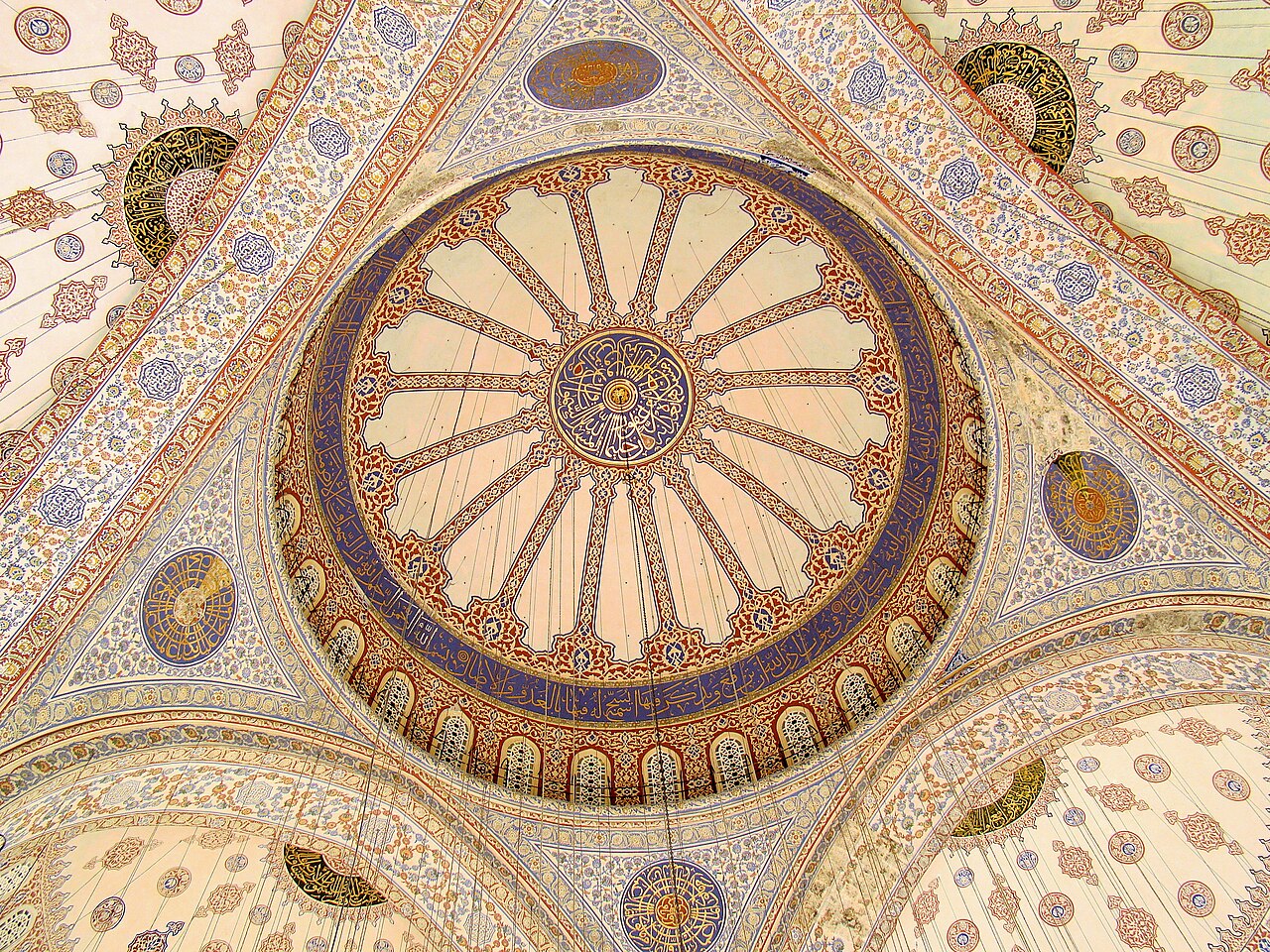
The Blue Mosque, named for its light. A total of 21,043 İznik tiles in more than fifty tulip, carnation and cypress designs line the galleries and upper walls, lit by some 260 windows, so that the interior glows blue and green as no other Ottoman mosque does.
A living imperial mosque, still. Built between 1609 and 1617 for Sultan Ahmed I by Sedefkar Mehmed Agha, successor to the great Sinan, it faces Hagia Sophia across the old Hippodrome and gathers worshippers for the five daily prayers and jumu'ah to this day, the Sultan himself buried in the türbe at its side.
The mosque a young sultan raised
Ahmed I came to the Ottoman throne as a boy of thirteen, and unlike the sultans before him he had won no great campaign whose spoils might pay for an imperial mosque. He built one anyway, drawing on the treasury for a pious foundation that some at the court thought too bold for a ruler without a conquest to his name. He chose a commanding site on the old Byzantine Hippodrome, the At Meydanı, facing Justinian's Hagia Sophia across an open square, and gave the work to Sedefkar Mehmed Agha, a pupil and successor of Mimar Sinan. Construction ran from 1609 to the opening in 1617.
Mehmed Agha answered Hagia Sophia with the classical Ottoman plan at its most confident: one central dome, 23.5 metres across and 43 metres high, carried on four immense fluted piers the Turks call fil ayağı, the elephant's feet, and let down to the ground through a cascade of half-domes and smaller cupolas. Around and above the prayer hall he set 21,043 tiles from the kilns of İznik and pierced the walls with some 260 windows. Tradition tells that the mosque's six minarets, unheard of for an Ottoman foundation, caused unease for seeming to match the Sacred Mosque of Makkah, and that the Sultan resolved it by paying for a seventh minaret there.
Ahmed I did not long outlive his mosque. He died in 1617, months after its completion, and was laid to rest in the türbe on its northeast corner, where his wife Kösem Sultan and several of his sons also lie. The mosque stood at the heart of a great külliye: a madrasa, a hospice and public kitchen, a primary school, a hospital and a market whose rents maintained it all. The complex lies within the Historic Areas of Istanbul, inscribed by UNESCO in 1985, and a comprehensive restoration returned the tiles, stone and lead to their old brilliance, the mosque reopening in April 2023.
What you'll actually see
1
The forecourt and the ablution fountain
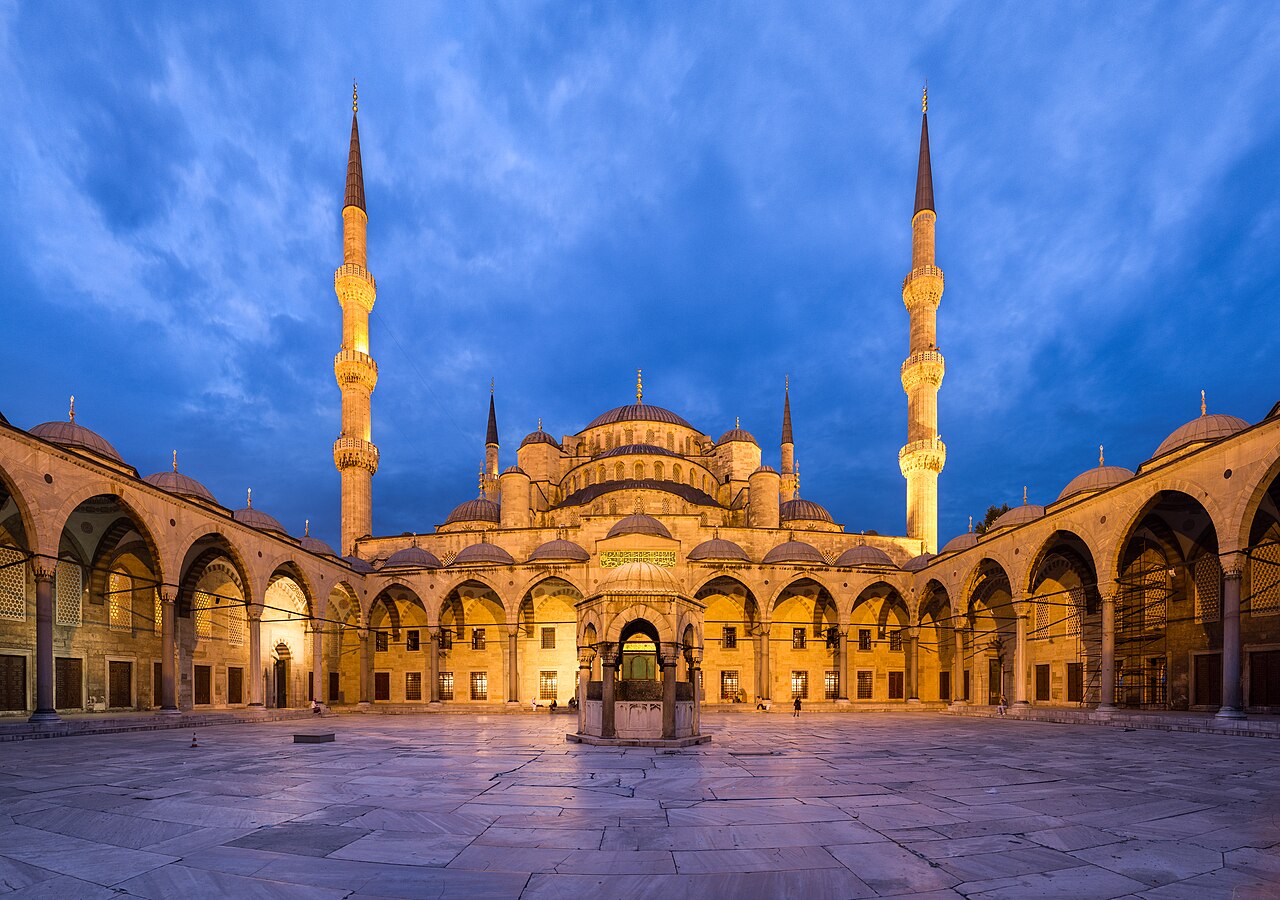
You enter first into a courtyard as large as the prayer hall itself, ringed by an arcade of thirty domes on marble and granite columns, with a small hexagonal fountain at its centre. Worshippers perform wudu, the washing before prayer, at taps set along the outer wall. Look up here for the first minarets and the long climb of half-domes toward the crown; this is the view the Ottomans meant a visitor to meet first.
2
The tiled hall beneath the dome
Inside, the four fluted piers, each some five metres thick, carry the central dome 43 metres overhead. The lower walls and galleries wear the 21,043 İznik tiles that name the mosque, their blues deepening as they rise; above them painted arabesque and roundels of calligraphy fill the domes, and daylight from 260 windows, once filled with coloured Venetian glass, moves across it all through the day. A great chandelier hangs low over the carpet where the rows of worshippers form.
3
The mihrab, the minbar, and Ahmed I's tomb
At the qibla wall stands the finely carved marble mihrab, the niche pointing to Makkah, with the stepped minbar beside it from which the Friday sermon is given, and the screened royal loge where the sultan once prayed. Step out to the northeast and you reach the türbe, the domed tomb where Sultan Ahmed I lies with Kösem Sultan and his sons, open to visitors beside the mosque he raised.
The painted central dome and pendentives of the Sultan Ahmed Mosque, ringed by windows above the blue İznik tileworkThe arcaded courtyard of the Sultan Ahmed Mosque at dusk, its domes and minarets lit against the sky
The tiled dome and the arcaded courtyard · photos CC BY-SA 3.0 (Bjørn Christian Tørrissen; Benh LIEU SONG), Wikimedia Commons
THE MONTH THE MINARETS SPEAK
Ramadan at Sultanahmet · expected from about 8 February 2027
Through Ramadan the six minarets carry the mahya, the Ottoman art of stringing lit messages between twin minarets so that a line of light reads across the night: greetings to the holy month at its start, words of farewell at its close. The mosque fills for the long tarawih prayers after isha, the last ten nights are kept for Laylat al-Qadr, and the Eid al-Fitr prayer at its end draws the largest congregation of the year. Ramadan 1448 is expected to begin around 8 February 2027 and Eid al-Fitr around 9 March 2027, both subject to the sighting of the moon.
The mosque is busiest for the night prayers and on the Ramadan Fridays; come well before the call if you mean to find a place on the carpet.
Plan your visit
By air
Istanbul Airport (IST) is about 49 km away on the European side; Sabiha Gökçen serves the Asian side. Metro and Marmaray connections or a taxi bring you to Sultanahmet.
By rail and tram
Tram T1 stops at Sultanahmet, a few minutes' walk across the square. The Marmaray rail line stops at Sirkeci, about 10 to 15 minutes on foot.
Getting in
Worshippers enter freely for prayer. Visitors use the separate visitor entrance on the Hippodrome side; shoes come off at the door and are carried in a bag provided, and modest-dress scarves are handed out free.
Timings
The mosque lives around the five daily prayers and closes to visitors for about ninety minutes at each, and on Friday until the early afternoon for jumu'ah. Visitor windows fall between the prayers, roughly 8:30 to noon, mid-afternoon and early evening; times shift with the season and the prayer calendar, so check locally on the day.
Entry fee
Free for worship and for visiting. A donation box for the mosque's upkeep stands near the exit.
Dress
Modest dress for all: shoulders and knees covered, and women cover the hair. Scarves and wraps are lent free at the visitor entrance, and shoes are removed before the prayer carpet.
Best time
The first visitor window after opening is quietest, and midweek mornings are calmer than Fridays or weekends. Worshippers find the hall stillest at fajr, before the city wakes.
The name Blue Mosque is a visitors' name, for the blue and green İznik tiles within; in Turkish it is Sultanahmet Camii, the mosque of Sultan Ahmed.
The six minarets were once thought to rival the Sacred Mosque of Makkah; tradition holds the Sultan answered by funding a seventh minaret there, and the tale is told at the mosque to this day.
It is a working congregational mosque, not a monument: visiting stops for each of the five daily prayers and for the Friday jumu'ah, so plan around the prayer times rather than against them.
A major restoration of the tiles, stonework and lead roofing was completed in 2023, the mosque reopening fully in April of that year.
Questions pilgrims ask
Why is it called the Blue Mosque?
For the light inside. Its walls and galleries are lined with 21,043 İznik tiles in blues and greens, and with some 260 windows pouring daylight over them the whole interior takes on a blue cast. Its proper name is the Sultan Ahmed Mosque, Sultanahmet Camii, after the sultan who built it between 1609 and 1617.
Can non-Muslims visit?
Yes. Visitors of every faith are welcome outside prayer times, entering by the visitor door on the Hippodrome side; entry is free. The mosque closes to visitors for about ninety minutes at each of the five daily prayers and until the early afternoon on Fridays. Modest dress is required, women cover the hair, and shoes come off at the door; scarves and wraps are lent free at the entrance.
Why does it have six minarets?
It was the only Ottoman mosque of its day to have six, and tradition explains it with a play on words: the Sultan is said to have asked for altın (gold) minarets and the architect to have heard altı (six). Because six was thought to match the Sacred Mosque of Makkah, the story holds that Sultan Ahmed I paid for a seventh minaret there to preserve its precedence.
Is it still an active mosque?
Yes. The Sultan Ahmed Mosque has been a working congregational mosque since 1617 and remains one today, gathering worshippers for the five daily prayers and the Friday jumu'ah, with the largest crowds through Ramadan. Visiting is arranged around the prayers so that worship comes first.
Is it near Hagia Sophia?
Very. The two face each other across the garden and fountains of Sultanahmet Square, the old Byzantine Hippodrome between them, a walk of a few minutes. Both stand within the Historic Areas of Istanbul, inscribed by UNESCO in 1985, and the tram T1 stops at Sultanahmet beside them.
Dharamshalas and guest houses near this Sthan, shared by devotees. Adisthan takes no bookings and no money; contact each stay directly.
No stays are listed here yet. Know one that serves pilgrims well?
Do you serve with the Sultan Ahmed Mosque or Turkey's Presidency of Religious Affairs? Claim this page to keep its prayer times and visiting guidance exact for every worshipper and visitor who comes to Sultanahmet.