Temple gave way to church, and church to mosque, and prayer has never once left this ground.
Be the first to check in
Coming up: Ramadan · 8 FebEntry tended 25 May 2026
Lives around the five daily prayers Shrine of Prophet Yahya within Umayyad · built 705 to 715 CE Ramadan · from about 8 Feb 2027 Free for worshippers Heart of the walled Old City
You come to it through the covered dusk of al-Hamidiyya Souq, six hundred metres of voices and spice, until the arcade ends and Roman columns forty feet tall stand open to the sky. Beyond them spreads a courtyard of polished stone so bright it seems lit from beneath, walled in gold and green mosaic. Children run, pigeons wheel, and the adhan rises as it has for thirteen centuries. Prayer has never left this ground. It has only deepened: Temple, then cathedral, then one of the first great houses of Islam.
One of the oldest and largest mosques in the world. The caliph al-Walid I raised it between 705 and 715 CE with some 12,000 craftsmen, and its plan of courtyard, arcades and long prayer hall became a model for congregational mosques across the Muslim world.
Inside the prayer hall stands the marble shrine of Prophet Yahya, John the Baptist, peace be upon him, honoured by Muslims and Christians alike. In 2001 Pope John Paul II paused before it in silent reflection, the first pope in history to enter a mosque.
The tallest of its three minarets is the Minaret of Isa. The Prophet Muhammad, peace be upon him, said that Isa son of Maryam will descend at the white minaret in the eastern side of Damascus (Sahih Muslim 2937a), and Damascene tradition has watched this minaret for that morning ever since.
Three thousand years of prayer, one ground
This ground was holy long before the first minaret rose over it. The Arameans raised a Temple here to Hadad; Rome rebuilt it as the Temple of Jupiter, the largest sanctuary in Roman Syria, whose gateway columns still stand at the mosque's western door. At the end of the fourth century it became a cathedral, and a tradition reaching back to the sixth century linked the church to the head of John the Baptist. When the Muslims received Damascus in 634, the old accounts tell that the two faiths worshipped for some seventy years within the same walled compound, the Christians in their church and the Muslims in a modest prayer space beside it.
By 705 the Muslim community had outgrown that corner. The caliph al-Walid I took the whole precinct for the mosque, granting the Christians other churches in return, and set thousands of craftsmen to work for nine years. They sheathed the walls in some 4,000 square metres of gold and glass mosaic, gardens and rivers of a paradise without human figures. And during the digging, the chronicler Ibn al-Faqih records, workers opened a cave chapel and found a casket bearing the head of Yahya. Al-Walid ordered it enshrined within the new hall, where it rests to this day.
The mosque has burned and risen more than once, most recently after the fire of 1893 took down the central dome. Salah al-Din, buried in a garden by its north wall, prayed here; the captives of Karbala were brought here in chains, a grief Shia pilgrims still honour. And in December 2024, at a turning point in Syria's history, hundreds of thousands filled this courtyard for jumu'ah. The Great Mosque simply continued what it has always done: it gathered Damascus to pray.
What you'll actually see
1
The courtyard and the Barada mosaics
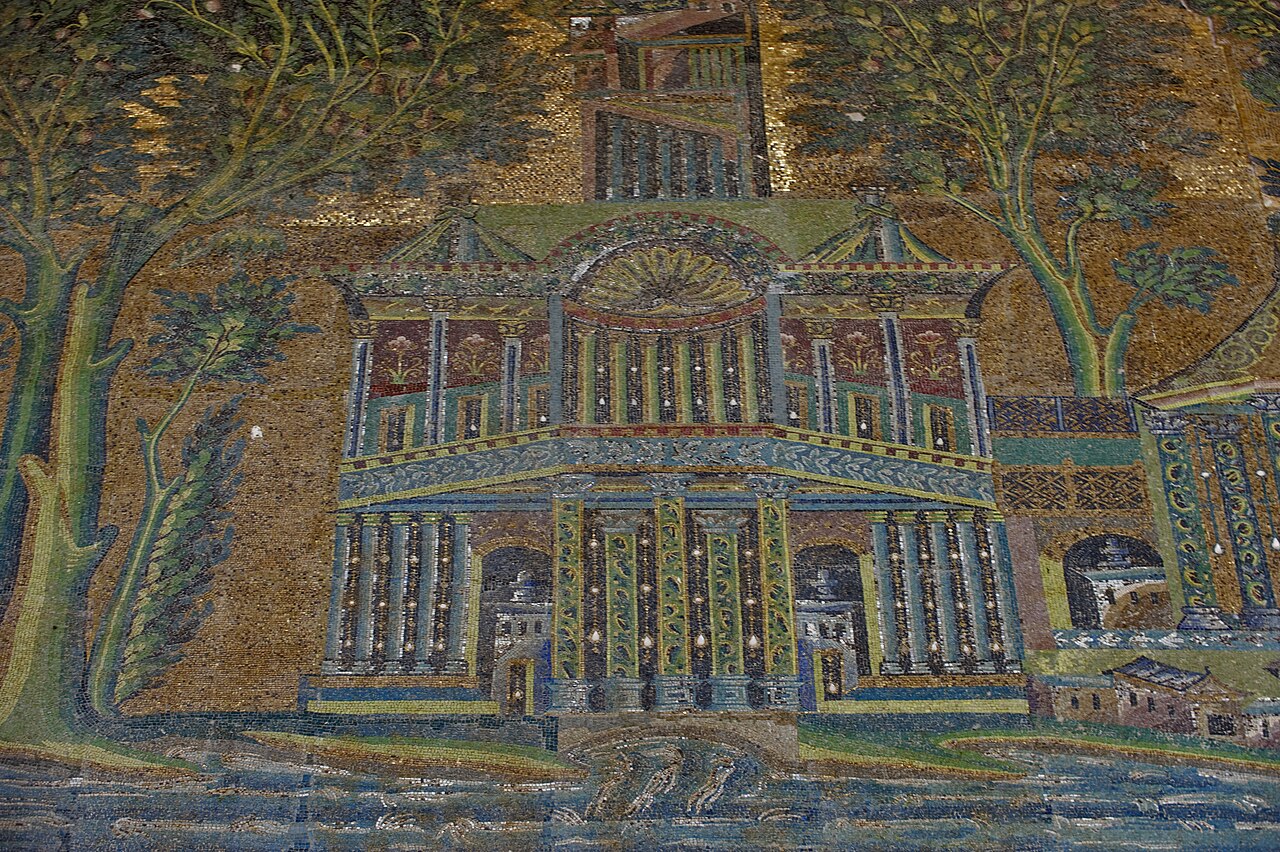
A vast court of pale polished stone, ringed by two-storey arcades on alternating columns and piers. Along the western portico runs the Barada Panel, a river landscape in gold and green glass 34.5 metres long, the finest survivor of the mosaic skin that once covered the whole mosque. Near the centre stands the ablutions fountain, and to the west the little Dome of the Treasury, Bayt al-Mal, perched on eight Roman columns, where the city's funds were once kept.
2
The prayer hall and the shrine of Prophet Yahya
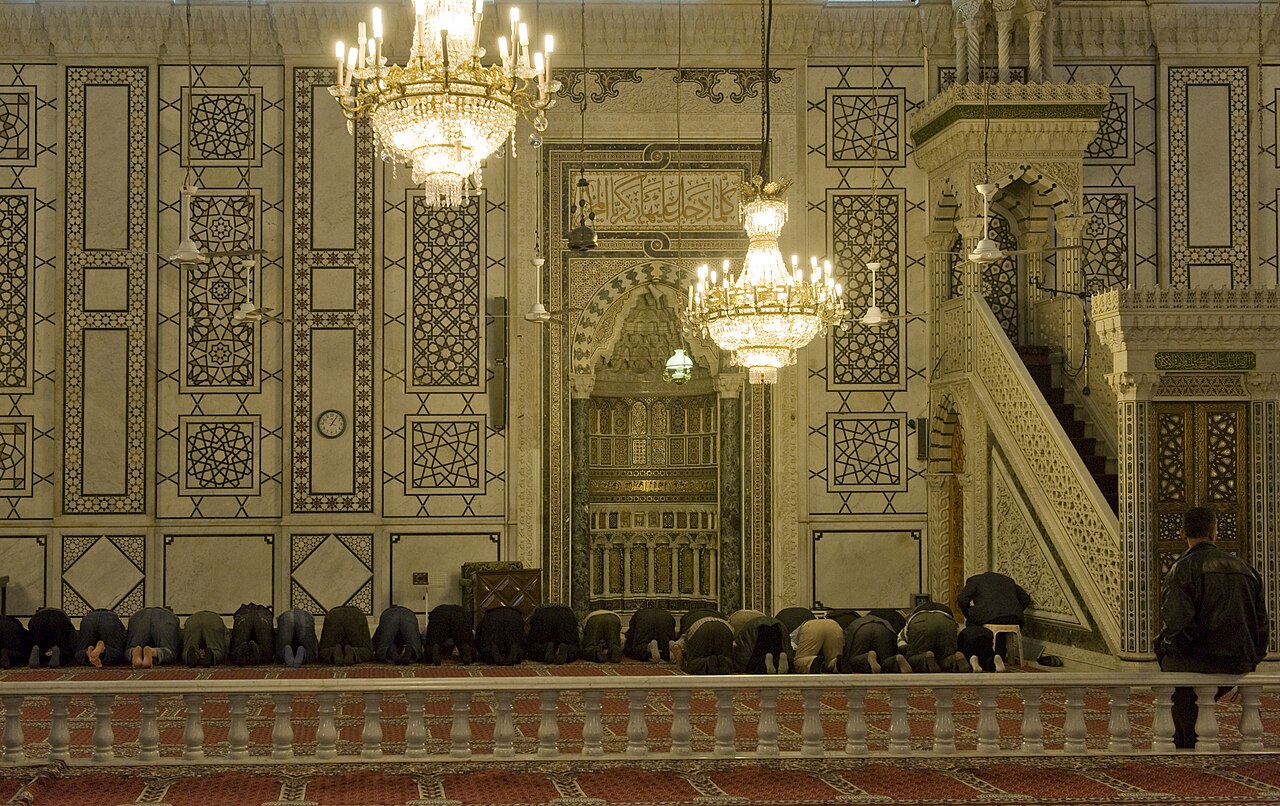
The sanctuary runs 136 metres along the qibla wall, three aisles of columns under the Dome of the Eagle, 36 metres above the carpets. Midway down the hall stands the green-domed marble shrine of Prophet Yahya, John the Baptist, peace be upon him. Muslims pause here in dua, Christian pilgrims in prayer of their own; it is one of the few shrines on earth kept by one faith and loved by two.
3
The three minarets
Each minaret carries its own story. The Minaret of the Bride on the north wall is the oldest, climbed by 160 stone steps. The Minaret of Qaytbay to the southwest, of 1488, is a Mamluk octagon in the Egyptian manner. And the Minaret of Isa at the southeast corner, at 77 metres the tallest, is the one tradition names for the descent of Isa son of Maryam at the end of days.
The Barada Panel, golden Umayyad mosaics of rivers and pavilions along the western porticoThe prayer hall of the Umayyad Mosque near the mihrab, columns and carpets under the Dome of the Eagle
The Barada mosaics and the great prayer hall · photos CC BY-SA 4.0 (Dosseman), Wikimedia Commons
THE MONTH THE COURTYARD FILLS
Ramadan at the Umayyad Mosque · expected from about 8 February 2027
Each Ramadan the Great Mosque becomes the beating heart of Damascus. The courtyard fills between maghrib and isha, families break the fast along the arcades, and tarawih carries through the ancient hall late into the night, prayer moving under mosaics that have watched thirteen hundred Ramadans. Ramadan 1448 is expected to begin around 8 February 2027, with the Eid al-Fitr prayer expected around 9 March 2027, both subject to the sighting of the moon.
Come for tarawih on any night to feel it; on the last ten nights and at the Eid prayer, arrive very early and expect the courtyard itself to become the prayer hall.
Plan your visit
By air
Damascus International Airport is about 30 km southeast of the city. International flights resumed in January 2025 but routes remain limited, so confirm connections and current travel guidance before you plan.
On foot
Walk the 600 metres of al-Hamidiyya Souq from al-Thawra street; the covered market ends at the mosque plaza, under the standing columns of the Roman Temple of Jupiter.
Timings
The mosque lives around the five daily prayers, Fajr through Isha. Local guides in 2025 list visitor hours of roughly 9 am to 9 pm, but arrangements in the current transition change, so confirm locally on the day.
Entry
Worship is free. Foreign visitors have recently paid a modest ticket, listed at 25,000 Syrian pounds in 2025; confirm the current arrangement at the gate.
Dress
Modest dress for all: shoulders and legs covered, and women cover the hair. Robes are provided at the entrance, and shoes come off before the prayer hall.
Best time
Early morning, when the low sun sets the gold mosaics alight and the courtyard is quiet before the day's visitors arrive.
Jumu'ah
Friday midday prayer fills the hall and courtyard. Worshippers should come early; sightseeing visitors should choose another time out of respect.
Damascenes call it simply al-Jami' al-Umawi. The ground beneath it has carried a house of worship for roughly three thousand years: the Aramean Temple of Hadad, the Roman Temple of Jupiter, the cathedral of Saint John, and since 705 CE the mosque.
For Shia pilgrims this is ground of deep grief and devotion: the captives of Karbala were brought to Damascus in 680 CE, tradition places the head of Imam al-Husayn in a shrine within the mosque, and Mashhad Ali marks where Imam Zayn al-Abidin was held. The Sayyida Ruqayya Mosque, shrine of al-Husayn's small daughter, stands a short walk to the north.
Salah al-Din (Saladin) lies buried in a garden beside the mosque's northern wall; his mausoleum is part of the same visit.
The mosque anchors the Ancient City of Damascus, a UNESCO World Heritage Site since 1979, placed on the List of World Heritage in Danger in 2013.
Questions pilgrims ask
Can Christians and other non-Muslim visitors enter?
Yes. The Umayyad Mosque has long welcomed respectful visitors of every faith outside prayer times, and the shrine of Prophet Yahya, John the Baptist, draws Christian pilgrims in their own right; Pope John Paul II prayed before it in 2001. Dress modestly, remove shoes for the hall, and note that visiting arrangements during Syria's transition can change, so confirm locally on the day.
Is the head of John the Baptist really inside?
The shrine is real and the reverence is centuries deep; the relic itself rests on tradition rather than proof. A sixth-century tradition already linked the cathedral here to the head of John the Baptist, and the chronicler Ibn al-Faqih records that workers building the mosque found it in a cave chapel beneath the old church. Muslims honour him as the Prophet Yahya, and his shrine has been kept within the prayer hall ever since.
What is the Minaret of Isa?
The tallest of the three minarets, 77 metres, at the mosque's southeastern corner. The Prophet Muhammad, peace be upon him, said that Isa son of Maryam will descend at the white minaret in the eastern side of Damascus (Sahih Muslim 2937a), and Damascene tradition has identified this minaret with that promise for centuries.
Why do Shia pilgrims come here?
After the Battle of Karbala in 680 CE, the surviving family of Imam al-Husayn were brought as captives to the court of Yazid in Damascus, and the heads of the martyrs were carried to this mosque. Maqams within and beside the complex honour that memory, including the place associated with the head of Imam al-Husayn and the spot where Imam Zayn al-Abidin was held, and the nearby Sayyida Ruqayya shrine mourns al-Husayn's young daughter. Sunni and Shia worshippers alike pray in the same great hall.
Is the mosque open now?
Yes. The Umayyad Mosque has remained alive with worship through Syria's political transition; in December 2024 hundreds of thousands gathered here for the first jumu'ah of a new era. The five daily prayers and Friday prayer continue as they have for thirteen centuries. Check current travel guidance for Syria and confirm visiting arrangements locally.
Dharamshalas and guest houses near this Sthan, shared by devotees. Adisthan takes no bookings and no money; contact each stay directly.
No stays are listed here yet. Know one that serves pilgrims well?
Do you serve the Umayyad Mosque or the religious endowments of Damascus? Claim this page to keep its guidance true for every worshipper and pilgrim who seeks the Great Mosque.