Venerated as Ali ibn Abi Talib's tomb, a contested claim Turquoise tile domes · rebuilt 1481 by Sultan Husayn Bayqara Nowruz banner-raising · publicly suspended since 2022 Free, by visitor accounts · no official fee listing found Central Mazar-i-Sharif, Balkh Province
You come to it across the wide central park of Mazar-i-Sharif, white pigeons wheeling above turquoise domes long before the tilework itself resolves into pattern. Vendors of pigeon feed and prayer beads line the approach; inside the marble sahn, the noise of the city falls back. Afghans call this Rawze-i-Sharif, the noble shrine, and many will tell you, quietly and with total conviction, that the grave at its heart belongs to Imam Ali himself. Whether it does is a question the rest of the Muslim world answers differently.
Many Afghans hold this to be the resting place of Ali ibn Abi Talib, cousin and son-in-law of the Prophet Muhammad, said by local tradition to have been buried here in secret and revealed centuries later in a mullah's dream. The wider Muslim world, and mainstream Shia scholarship in particular, locates Ali's tomb at the Imam Ali Shrine in Najaf, Iraq. Adisthan presents both as living traditions, not as a settled historical question, and takes no side.
The Seljuk sultan Ahmad Sanjar raised the first shrine on this spot in 1136. Genghis Khan's army destroyed it in 1220, reportedly searching for treasure said to lie beneath it. What stands today is largely the work of the Timurid ruler Sultan Husayn Bayqara, who rebuilt it in 1481 and gave the growing city around it the name it still carries: Mazar-i-Sharif, the noble shrine.
Historically, Nowruz drew crowds reported as high as two hundred thousand to the shrine's Jahenda Bala, the raising of a sacred banner believed to carry luck into the new year. Since the Taliban's return to power in 2021, public Nowruz observance has been banned across Afghanistan, and, by multiple recent press accounts, has not been permitted at the shrine since 2022.
A dream, a grave, and a city that took its name from it
The legend told in Balkh holds that in the early twelfth century a local mullah dreamed that Ali ibn Abi Talib appeared to him and revealed that his body had been carried here in secret, out of Kufa, to keep it from desecration by his enemies, and buried quietly near the ancient city of Balkh. Acting on the dream, the Seljuk sultan Ahmad Sanjar had the grave located and, in 1136, raised a shrine and a small town around it. It stood for less than a century.
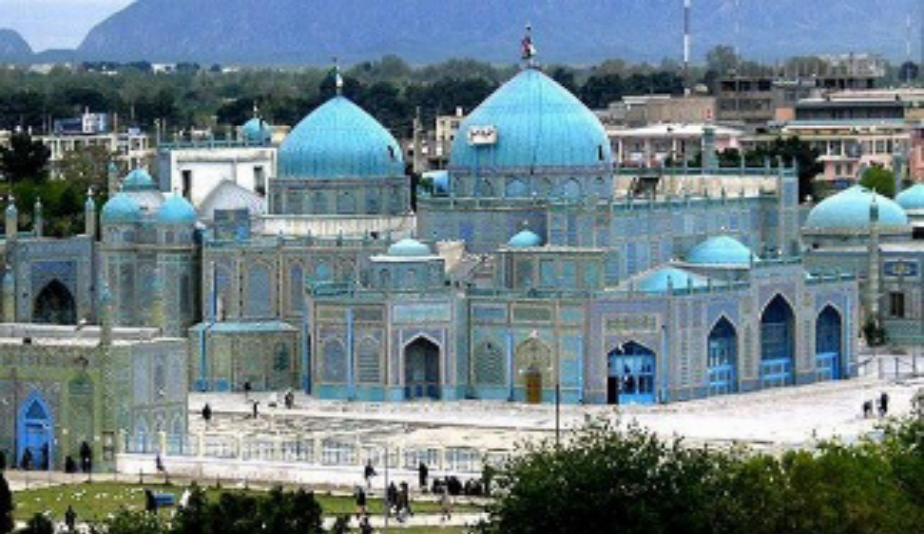
In 1220, Genghis Khan's armies swept through the region and razed the shrine, tradition says in search of treasure believed hidden beneath it, and the site fell into ruin and, for a time, obscurity. It was rediscovered and rebuilt on a far grander scale in 1481 by Sultan Husayn Bayqara, the Timurid ruler of Herat, who is recorded to have given the project his own close and sustained attention. The rebuilt shrine, sheathed in the blue and turquoise tile that gives the building its popular name, became the seed of a new city, which took the shrine's own name: Mazar-i-Sharif, the noble shrine.
That devotion has never required the wider Muslim world's agreement. Classical Sunni historians, including al-Tabari and Ibn Sa'd, recorded burial traditions placing Ali near Kufa or in Medina, and mainstream Shia scholarship, tracing the location to the sixth Imam, Ja'far al-Sadiq, holds that Ali rests at the Imam Ali Shrine in Najaf, one of Shia Islam's holiest sites. Balkh's tradition of a hidden, later grave is real and old, and is held here with as much sincerity as Najaf's is held elsewhere. Adisthan records both without adjudicating between them.
What you'll actually see
1
The park of the white pigeons
Before the shrine itself, there is the park: wide paths, benches, and thousands of pigeons, fed by visitors and by the shrine's own keepers. Local belief holds that any grey or speckled pigeon that joins the flock here turns pure white within forty days, a sign of the ground's own purity.
2
Turquoise domes and tiled iwans
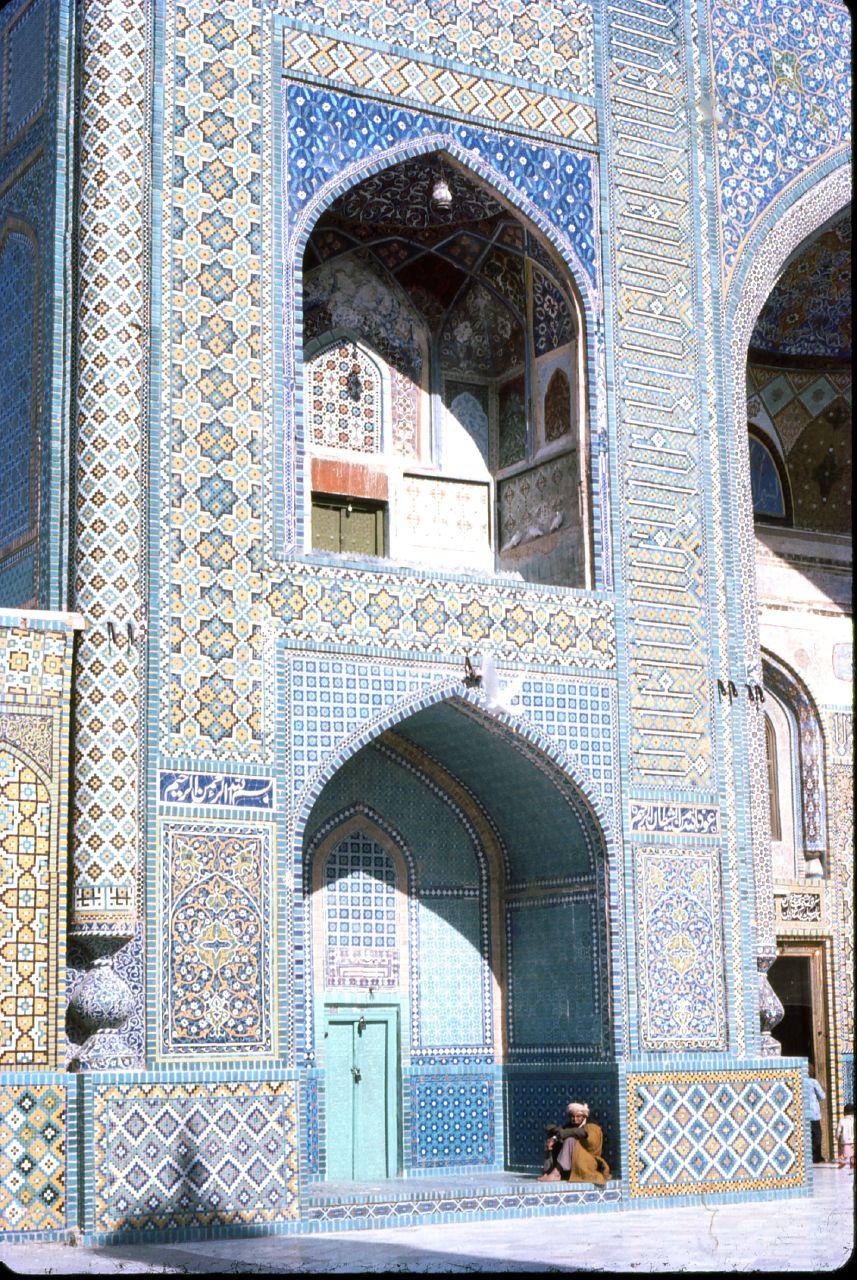
The shrine's domes and soaring arched iwans are sheathed floor to crown in blue and turquoise tilework, glazed in geometric star-and-vine patterns that catch differently at dawn, midday, and dusk. Minarets rise at the corners; the whole complex has been repeatedly regilded and restored across the centuries, most recently after cracking reported in the walls and a minaret following the 2025 Balkh earthquake.
3
The marble slab within
Inside the shrine's western mosque, oriented toward Mecca, a marble slab carved with the words "Ali, Lion of God" marks the tradition's heart. Nearby stand the separate domed tombs of three nineteenth-century Afghan rulers, Amir Dost Mohammad Khan, Wazir Akbar Khan, and Amir Sher Ali Khan, added to the complex long after Sultan Husayn Bayqara's rebuilding.
Close view of the Blue Mosque's turquoise and cobalt tilework, showing the geometric star-and-vine glazed patternWhite pigeons gathered on the paving of the Blue Mosque's courtyard in Mazar-i-Sharif
Tilework and the shrine's white pigeons · photos by Wendy Tanner, CC BY 2.0, Wikimedia Commons
THE BANNER NOT RAISED IN PUBLIC SINCE 2022
Nowruz and the Jahenda Bala · the equinox falls on 21 March 2027
For generations, the Persian New Year at the shrine meant Jahenda Bala: a sacred banner raised over the courtyard on Nowruz morning, drawing crowds reported in the hundreds of thousands from across Afghanistan, many reaching to touch the flag for luck in the year ahead. Since the Taliban's return to power in August 2021, Nowruz has been struck from the official calendar and its public celebration outlawed nationwide, and Afghan and international press have reported the ceremony absent at the shrine every year since 2022.
Do not plan a visit around this date expecting the ceremony to occur. Whether any observance returns to the shrine is unknown and unpredictable from outside Afghanistan; check current independent Afghan press before travel.
Plan your visit
By air
Mazar-i-Sharif International Airport (MZR) lies about 9 km east of the city, commonly cited at around 15 minutes by taxi to the shrine, though checkpoints can extend this.
Getting there
The shrine sits in a large central park in the middle of the city; there is no metro or tram in Mazar-i-Sharif, and visitors arrive by taxi or on foot.
Timings
No official published visiting-hours schedule was found. Visitor accounts describe the shrine and its park as open through the day; expect closures around each of the five daily prayers. Confirm locally.
Entry
Described as free by visitor accounts and travel guides. No official fee schedule was found to confirm this independently.
Women's dress
Since 2021 the Taliban have required women to be fully covered, commonly a burqa, to enter. Multiple 2024 to 2025 Afghan press reports describe signage at the gates restricting women's entry to one day a week, most recently reported as Mondays; policy and enforcement have been reported as inconsistent, and this should be treated as current media reporting, not confirmed official policy.
Foreign and non-Muslim visitors
Historically the shrine welcomed visitors of any faith. Given Afghanistan's current security situation and the volatility of Taliban policy since 2021, access for foreign and non-Muslim visitors cannot be confirmed from outside the country and may change without notice. Most governments advise against travel to Afghanistan; treat any visit as requiring current, on-the-ground guidance, not general claims found online.
The name Mazar-i-Sharif, the noble shrine, belongs first to this sanctuary; the city that grew up around it took the shrine's own name.
Local belief holds that any grey or mottled pigeon joining the shrine's flock turns pure white within forty days of arriving.
The 2025 Balkh earthquake left cracks in the shrine's walls and damaged one minaret; the extent of repair completed since could not be confirmed from available sources.
Conditions in Afghanistan, including access, dress requirements, and safety, have changed repeatedly and without much notice since 2021. Treat every visiting detail on this page as a snapshot, not a guarantee, and verify locally before travel.
Questions pilgrims ask
Is this really the tomb of Ali?
It depends who you ask, and Adisthan does not adjudicate the question. Many Afghans hold, on the strength of a centuries-old local tradition, that Ali ibn Abi Talib is buried here in secret, moved from Kufa and rediscovered in a mullah's dream. Mainstream Shia scholarship, and most of the wider Muslim world, holds instead that Ali is buried at the Imam Ali Shrine in Najaf, Iraq, one of Shia Islam's holiest sites. Both are living traditions, held sincerely by those who hold them.
Can women visit the shrine?
As of recent reporting, yes, but under restriction. Afghan press has described signage at the gates limiting women's entry to a single day a week, most recently reported as Mondays, and requiring full covering, commonly a burqa. Because Taliban policy and its enforcement have shifted repeatedly since 2021, treat this as a snapshot of recent reporting rather than a fixed rule, and verify current conditions before planning a visit.
Can foreign or non-Muslim visitors go?
Historically the shrine was open to visitors of every faith, and some accounts describe this continuing. Given Afghanistan's current security situation and the pace at which access rules have changed since 2021, this cannot be confirmed independently, and most governments advise against travel to Afghanistan altogether. Anyone considering a visit needs current, on-the-ground guidance, not general claims found online.
Does the Nowruz banner-raising still happen?
Not publicly, as far as recent reporting shows. The Jahenda Bala ceremony once drew crowds reported in the hundreds of thousands each Nowruz. Afghan and international press have reported it absent, along with public Nowruz celebration generally, in every year since the Taliban banned Nowruz observance in 2022. Its future status is not something this page can predict.
Why is it called the Blue Mosque?
For its tilework. The shrine's domes, minarets, and arched iwans are sheathed in blue and turquoise glazed tile in geometric and vine patterns, a Timurid-era style that gave the building its popular English name long before any of its Persian or Arabic ones.
Dharamshalas and guest houses near this Sthan, shared by devotees. Adisthan takes no bookings and no money; contact each stay directly.
No stays are listed here yet. Know one that serves pilgrims well?
Do you serve the administration or custodianship of the Shrine of Hazrat Ali in Mazar-i-Sharif? Claim this page to keep its guidance exact for every pilgrim who comes to Rawze-i-Sharif.